Daniel Okonkwo · Senior ML Engineer · Published 2026-11-18
TLDR Compare Kling 4.0 and Kling 4.0 Flash across 30-second 10-keyframe trajectory blocking, 20-second 720p distilled throughput, community motion tests, and workspace credit economics.
30-Second Multi-Keyframe Choreography vs. 20-Second Distilled Throughput
Kling 4.0 delivers up to 30 seconds of 1080p video generation anchored by 10 spatial keyframes and 15 Omni Reference inputs, whereas Kling 4.0 Flash trades away intermediate keyframe blocking and caps output at 20 seconds in 720p SDR to accelerate draft inference — choosing the right checkpoint depends on whether a shot requires deterministic camera waypoints or rapid storyboard scouting.
Video engineering and creative studio teams adopting Kuaishou's October and November 2026 Kling 4 ecosystem frequently run into a classic production bottleneck: burning full-tier 1080p credits on early prompt exploration quickly exhausts campaign budgets, while relying solely on distilled Flash checkpoints introduces texture smoothing on close-up hero shots. Understanding the exact architectural pruning points between Kling 4.0 and Kling 4.0 Flash allows teams to pair both models in a two-stage hybrid pipeline.
Key Takeaways
- Duration and Resolution Ceiling Split: Full
Kling 4.0 generates native clips up to 30 seconds at 720p, 1080p, and 4K (with 10-bit HDR and 2-minute Video Extension announced as upcoming), while Kling 4.0 Flash enforces a hard cap of 20 seconds at 720p 8-bit SDR.
- 10-Keyframe Blocking Divide: Full
Kling 4.0 supports Multi-Keyframe Control (1 start frame + up to 8 intermediate keyframes + 1 end frame) plus 15 Omni Reference slots, whereas Kling 4.0 Flash omits multi-keyframe and end-frame anchors entirely.
- Unified Multi-Model Studio Routing: The live
kling4ai.io studio exposes Kling 4.0, Kling 4.0 Flash, Kling 3.0, Kling 3.0 Turbo, Kling O3, Kling 2.6, and Kling Avatar 2.0 under three core tabs (01 Text to Video, 02 Image to Video, 03 Motion Control).
- Community Realism Observations: Hands-on evaluators on
r/KlingAI_Videos praise full Kling 4.0 for high-velocity action and camera tracking, while noting that Kling 4.0 Flash exhibits distilled texture smoothing and occasional unrequested mid-clip cuts.
- 50% Off Annual Credit Economics: On
kling4ai.io/pricing, the Pro yearly plan discounts annual billing by 50% ($294.00/yr down from $598.80), while purchasing 2+ one-time credit packs adds +10% permanent bonus credits (800 base credits Starter at $29.90).
Kling 4.0 vs Kling 4.0 Flash at a Glance
The table below compares verified architectural limits, motion controls, and billing parameters across both tiers based on official release specifications and live kling4ai.io workspace telemetry.
| Feature / Metric | Kling 4.0 (Full Flagship Tier) | Kling 4.0 Flash (Distilled Speed Tier) |
|---|
| Primary Engineering Role | Final commercial masters, multi-point camera choreography, complex physics | Rapid prompt scouting, automated social batch runs, 720p storyboard drafts |
| Maximum Native Clip Length | 30 seconds (3s–30s single pass; 2-min extension pending) | 20 seconds (3s–20s hard ceiling) |
| Output Resolution & Bit Depth | 720p and 1080p live; 4K supported; 10-bit HDR upcoming | Hard-capped at 720p 8-bit SDR |
| Keyframe Trajectory Control | Up to 10 Keyframes (Start, 8 Mid-Frames, End Frame) | Start Frame / Prompt only (no mid-keyframes or end-frame lock) |
| Omni Reference Capacity | Up to 15 reference inputs (images, videos, characters, props) | Standard reference conditioning |
| Audio & Dialogue Synthesis | Native stereo sound, multilingual/dialect speech, lip sync | Native stereo sound (community notes occasional ambient BGM on silent prompts) |
| Workspace Credit Burn | 10 credits/s (720p) · 15 credits/s (1080p -> 450 credits / 30s) | Lower draft credit tier for rapid iteration |
| AA Video Arena Status | Standalone v4.0 Elo unverified — no public number yet (Kling 3.0 = 1,000 Elo anchor) | Unverified — no public number yet |
Multi-Keyframe Trajectory Architecture and Motion Control
In standard image-to-video diffusion, providing only Frame 0 leaves the denoising network free to hallucinate camera drift after second six. Full Kling 4.0 solves long-take drift by letting directors pin up to eight intermediate spatial waypoints between the opening and closing frames alongside an 8,000-token scene prompt.
Kling 4.0 Two-Stage Studio Production Pipeline:
[Stage 1: Fast Blocking Scout]
   Prompt + Start Frame ──> [Kling 4.0 Flash (720p, 10s)] ──> Validate Pacing & Lighting
                                                                         │
[Stage 2: 10-Keyframe Master]                                            ▼
   Start + 8 Mid-Frames + End Frame ──> [Kling 4.0 Full (1080p, 30s)] ──> Locked Commercial Cut
Inside the live Kling 4 video studio, creators can switch directly between 01 Text to Video, 02 Image to Video, and 03 Motion Control across Kling 4.0, Kling 4.0 Flash, Kling 3.0 Turbo, Kling O3, and Kling Avatar 2.0 without re-uploading assets.
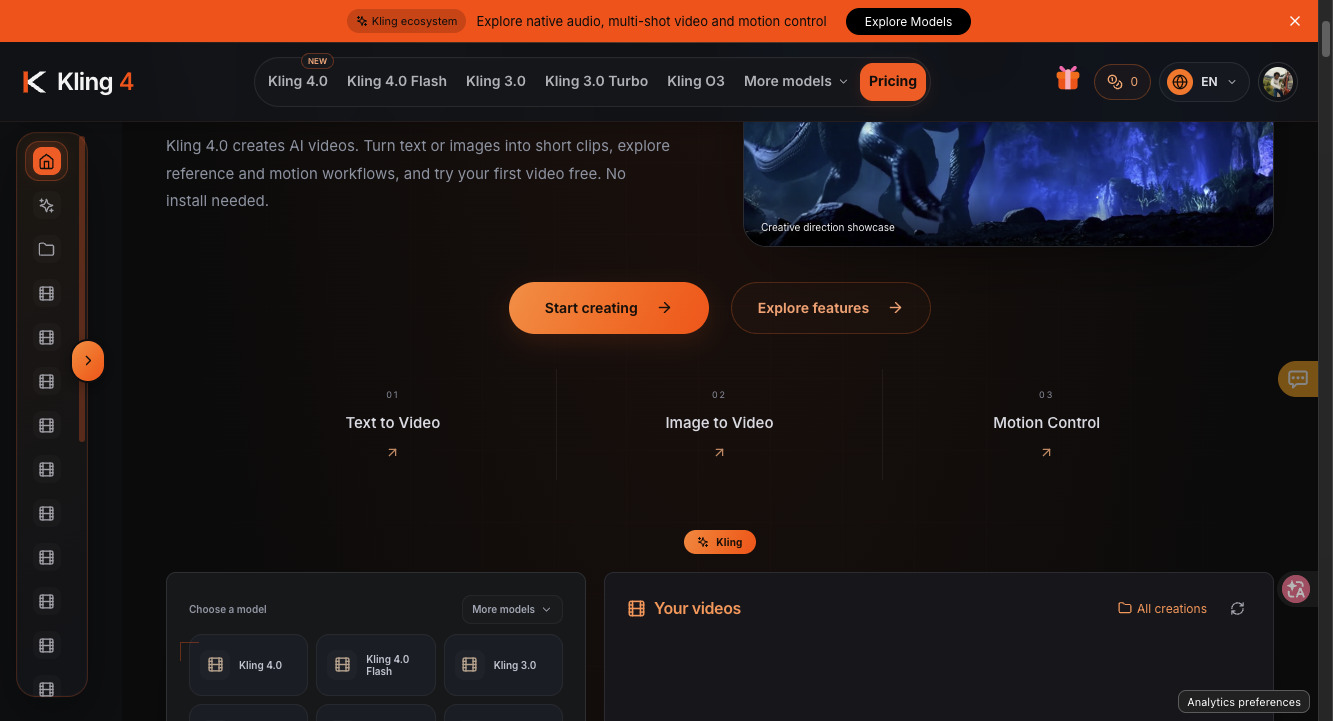
Source: kling4ai.io Live Video Studio
To direct a 30-second camera move without mid-shot warping, structure your prompt around explicit temporal beats:
KLING 4.0 — 30-SECOND MULTI-KEYFRAME COMMERCIAL PROMPT:
[00s–08s, Keyframes 1–3]: Low-angle 35mm dolly push along a rain-slicked Tokyo alley at dusk; a courier in a matte charcoal waterproof jacket checks a glowing brass compass.
[08s–20s, Keyframes 4–7]: Smooth 90-degree orbital pan around the courier as warm tungsten ramen-shop lanterns reflect across wet asphalt; natural fabric wind inertia.
[20s–30s, Keyframes 8–10]: Crane tilt up to a wide rooftop skyline reveal, synchronized rain foley and footsteps, zero camera jitter, 1080p cinema grade.
Community Hands-On Testing and Known Failure Modes
While Kling 3.0 1080p Pro serves as the 1,000 Elo baseline anchor on the Artificial Analysis Video Arena (where standalone v4.0 blind-vote aggregation is still in progress), active practitioner discussions on Reddit's r/KlingAI_Videos provide concrete diagnostic signals on where both v4.0 tiers excel and where they stumble.
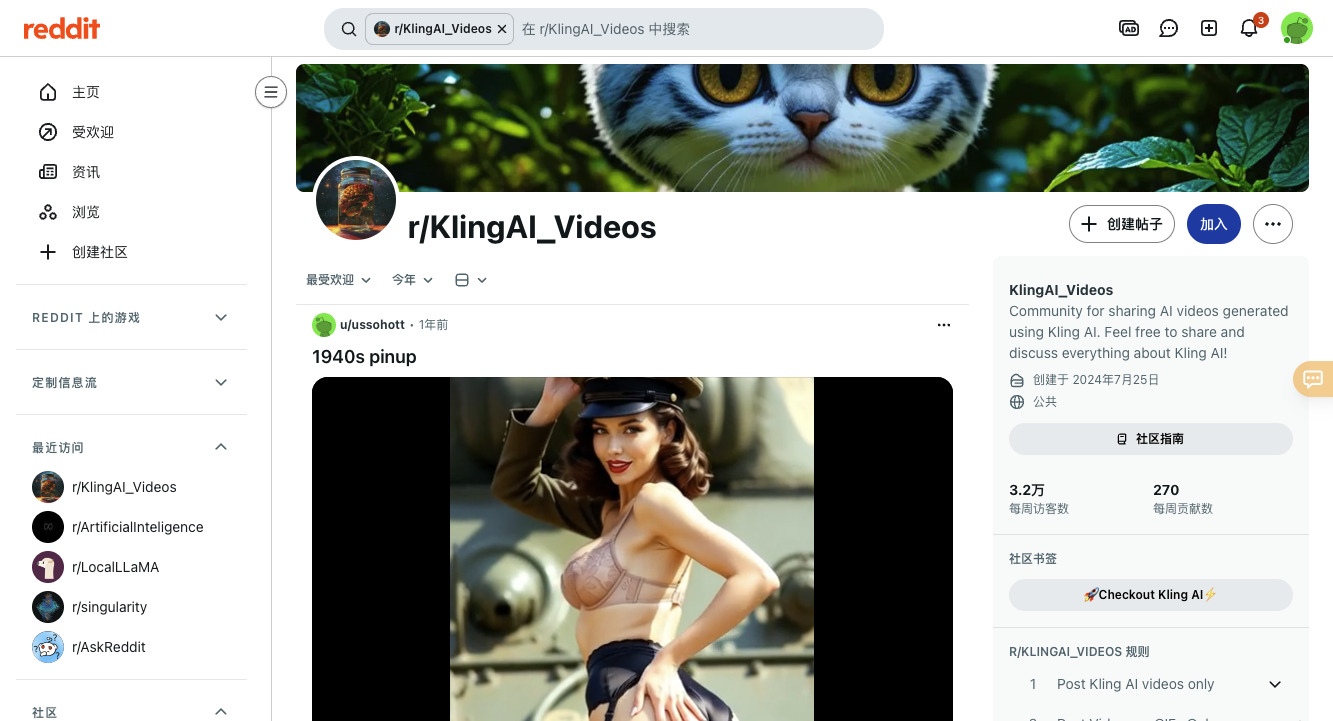
Source: Reddit r/KlingAI_Videos Community Thread
- Distilled texture smoothing on Flash: Community reviewers (including
MbahSurip) note that Kling 4.0 Flash sheds computational overhead by smoothing fine skin pores, foliage, and asphalt grain — making it ideal for fast motion blocking but no substitute for full Kling 4.0 on close-up beauty or product shots.
- Unsolicited ambient music in silent clips: Testers reported that
Kling 4.0 Flash occasionally injects background music during quiet dialogue prompts and inserts unrequested jump cuts when prompts describe too many scene actions without keyframe anchors.
- Unshipped 10-bit HDR and 2-minute extension: Although announced during the October 15, 2026 launch cycle, 10-bit HDR color output and the 2-minute Video Extension remain marked as upcoming.
That is a community impression, not a controlled lab measurement — always validate critical client shots in a short 5-second test first.
Pricing and Credit Unit Economics
At full Kling 4.0 rates (10 credits/s at 720p and 15 credits/s at 1080p, or $0.157–$0.235/s on public API baselines), a single 30-second 1080p render consumes 450 credits. On kling4ai.io/pricing, the Pro Yearly Plan cuts the annual price by 50% from $598.80 down to $294.00/year, while one-time credit packs start at $29.90 for 800 base credits (Starter) with a +10% permanent bonus when buying 2+ packs.
30-Second Master Credit Formula:
Total Credits (Kling 4.0 1080p) = 15 credits/s × 30 seconds = 450 credits per take
What That Costs in Practice
| Production Task | Model & Resolution Tier | Credit Calculation | Total Credits | Why It Saves Budget |
|---|
| 1. 10s Motion Blocking Scout | Kling 4.0 Flash · 720p (10s) | Draft scout pass | ~60–80 credits | Tests camera path before committing 1080p credits |
| 2. 15s Social Ad Master | Kling 4.0 Full · 720p (15s) | 10 credits/s × 15s | 150 credits | Clean 9:16 social feed delivery |
| 3. 30s 10-Keyframe Hero Cut | Kling 4.0 Full · 1080p (30s) | 15 credits/s × 30s | 450 credits | Full 10-keyframe spatial lock + stereo sound |
| 4. Hybrid 3-Scout + 1-Master | 3× 10s scouts + 1× 30s 1080p master | (3 × 70) + 450 | 660 credits | Saves 51% vs. running 3× blind 30s 1080p masters (1,350 credits) |
Which One Should You Use?
Choose Full Kling 4.0 if:
- Your scene requires mid-clip camera choreography: Pinning up to 8 intermediate keyframes between your start and end frames stops subject morphing during complex orbital pans.
- You are rendering final 1080p commercial deliverables: Full pore, fabric, and lighting fidelity requires the un-distilled base model.
Choose Kling 4.0 Flash if:
- You are testing 10 prompt variations to find a hook: Fast 720p inference up to 20 seconds lets directors validate framing at low cost.
- You run automated MCP or CLI agent pipelines: High-throughput social previews benefit from Flash's reduced latency.
Frequently Asked Questions
How many keyframes does Kling 4.0 support in a single video?
The full Kling 4.0 model supports up to 10 keyframes in a single 30-second generation (1 start frame, up to 8 intermediate keyframes, and 1 end frame), alongside up to 15 Omni Reference inputs. Kling 4.0 Flash supports only a start frame.
Why is Kling 4.0 Flash capped at 20 seconds and 720p?
Kling 4.0 Flash is a distilled throughput checkpoint designed to minimize inference latency and credit cost. It enforces a strict ceiling of 20 seconds at 720p 8-bit SDR and omits multi-keyframe interpolation.
How do the Pro annual discount and 2+ credit pack bonus work on kling4ai.io?
On kling4ai.io/pricing, choosing the Pro yearly subscription applies a 50% discount ($294.00/year instead of $598.80). For one-time credit packs (Starter at $29.90 for 800 base credits), purchasing 2+ packs adds +10% permanent bonus credits that never expire.
What to Watch Next
Builders are watching for Kuaishou's activation of the announced 10-bit HDR pipeline and 2-minute Video Extension, as well as standalone Kling 4.0 and Kling 4.0 Flash Elo scores on the Artificial Analysis Video Arena.
Try related models on Kling 4: Kling 4.0, Kling 4.0 Flash, Kling 3.0 Turbo, Kling O3, and Kling Avatar 2.0.
About the Author
Daniel Okonkwo · Senior ML Engineer
Daniel writes about inference systems, model architecture, and what new releases actually change for builders.