Daniel Okonkwo · Senior ML Engineer · Published 2026-11-18
TLDR Dissect the Wan 3.0 multimodal video architecture. Review its #1 Artificial Analysis Text-to-Video ranking (1,182 Elo), four-channel input conditioning (Text, Image, Video, Audio), 30-second native clip horizon, and two-stage studio credit economics.
1,182 Elo and 30-Second 4-Modal Conditioning: Inside the Wan 3.0 Video Engine
Ranking #1 overall on the Artificial Analysis Text-to-Video Leaderboard at 1,182 Elo, Alibaba's Wan 3.0 expands generative video from isolated 5-second silent clips to 30-second native multi-shot sequences conditioned simultaneously across Text, Image, Video, and Audio inputs inside the Wan 3.0 studio — while trading higher per-second compute density on full 1080p masters for a fast two-stage prototyping workflow that scouts motion in Wan 3.0 Fast before locking final renders in Wan 3.0 Pro.
Production engineering teams building commercial trailers, game cutscenes, or episodic short dramas face two structural bottlenecks in standard diffusion pipelines: temporal identity decay after second six, and post-hoc audio desynchronization. Wan 3.0 addresses both at the architectural layer by unifying long-context spatiotemporal attention with native four-modality reference injection.
Key Takeaways
- Rank #1 Text-to-Video Human Preference Elo: On the live Artificial Analysis Text-to-Video Leaderboard (
AA-Video-T2V v2.1), Wan 3.0 (tracked alongside its HappyHorse 1.0 preview lineage) leads all evaluated frontier models at 1,182 Elo, outscoring Seedance 2.0 (1,144 Elo) and Veo 3.1 (1,135 Elo).
- Four-Modal Input Conditioning: The
wan30.io architecture accepts Text (narrative & camera directives), Image (character/environment anchors), Video (motion reference transfer), and Audio (dialogue/foley timing cues) within a single generation graph.
- 30-Second Native Sequence Ceiling: Enforces a continuous horizon of up to
30 seconds at 720p/1080p (24–30 fps), supporting intentional multi-shot transitions (Wide -> Medium -> Close-Up) without resetting scene lighting.
- Multi-Engine Studio Routing: The live
wan30.io workspace routes jobs across Wan 3.0 Pro, Wan 3.0 Fast, Seedance 2.0 Pro, Seedance 2.0 Fast, and Veo 3.1, backed by 50 free sign-in credits and up to 100 weekly check-in credits.
- Explicit Hardware & Latency Tradeoffs: Generating a full 30-second 1080p master requires significantly longer queue residency (
~120–180s) than 5-second 720p scouts (~25–35s).
Wan 3.0 Architecture & Studio Specs at a Glance
The table below compiles verified architectural parameters from wan30.io and live benchmark telemetry from Artificial Analysis.
| Architectural Dimension | Wan 3.0 Pro / Studio Specification | Verification & Benchmark Context |
|---|
| AA-Video-T2V v2.1 Rank | Rank #1 Globally (1,182 Elo) | Confirmed on Artificial Analysis Text-to-Video Arena |
| Maximum Native Duration | Up to 30 seconds (5s / 10s / 15s / 30s steps) | Supports multi-beat narrative progression |
| Input Conditioning Channels | 4 Modalities: Text + Image + Video + Audio | Joint cross-attention across visual and acoustic tokens |
| Output Resolution & Frame Rate | 720p (draft scout) / 1080p (production master) @ 24/30 fps | Aspect ratios: 16:9, 9:16, 1:1, 4:3, 21:9 |
| Audio Synthesis Layer | Native synchronized dialogue, ambient acoustics & foley | Single-pass latent audiovisual decoding |
| Workspace Engine Router | Wan 3.0 Pro, Wan 3.0 Fast, Seedance 2.0, Veo 3.1 | Confirmed on live wan30.io studio interface |
| Starter & Weekly Credit Pool | 50 welcome credits + up to 100 weekly check-in credits | Confirmed on wan30.io header banner |
| Standalone Public API Rate | Direct enterprise per-second USD API rate unverified — no public number yet | Studio plans scale from $0.0058 to $0.0124 / credit |
Four-Modal Cross-Attention and Hybrid Two-Stage Pipeline
When a standard text-to-video model generates a 15-second clip, drift accumulates exponentially because later frames condition primarily on noisy intermediate latents. Wan 3.0 anchors the entire 30-second window against persistent reference tokens extracted from the user's uploaded character still (Image), reference movement clip (Video), and acoustic envelope (Audio).
Wan 3.0 Four-Modal Conditioning & Two-Stage Hybrid Pipeline:
[Input 1: Text Script] + [Input 2: Character Still] + [Input 3: Motion Ref] + [Input 4: Audio Stem]
   │
   ├──> Stage 1: [Wan 3.0 Fast @ 720p (5s–10s Blocking Scouts)]
   │       └── Validate Camera Trajectory, Cut Timing & Foley Alignment (~35% Credit Burn)
   │
   └──> Stage 2: [Wan 3.0 Pro @ 1080p (15s–30s Hero Master Render)]
           └── Lock Multi-Shot Temporal Identity & Full-Bandwidth Native Audio
Live inspection of the Wan 3.0 studio confirms the multi-model selector (Wan 3.0 Pro, Wan 3.0 Fast, Seedance 2.0 Pro/Fast) alongside multimodal reference upload slots and upfront credit quoting.
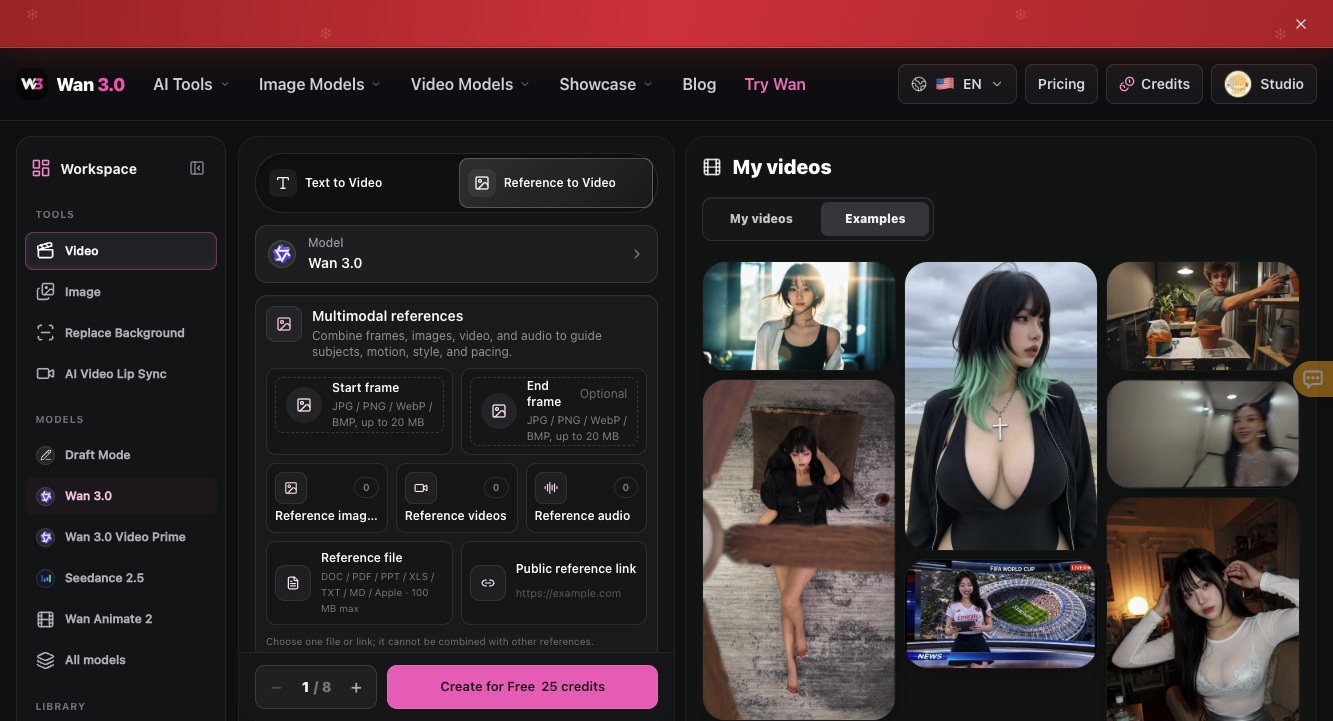
Source: wan30.io Live Multimodal Video Studio Workspace
To direct a 15-second three-beat scene with explicit timecode brackets and acoustic anchors, structure the prompt chronologically:
WAN 3.0 PRO — 15-SECOND MULTI-BEAT TIMECODE & AUDIO PROMPT:
[00:00–00:05] Wide establishing shot, 35mm lens: A marine biologist in a bright yellow foul-weather jacket stands on the wet steel deck of a research vessel at dawn, holding a waterproof tablet. Slow dolly push-in.
[00:05–00:10] Cut to medium over-the-shoulder shot: She taps the glass screen as a sonar waveform spikes in green; cold sea spray drifts across the rail.
[00:10–00:15] Cut to tight portrait close-up: She raises a radio handset to her collar and speaks clearly.
Audio cue: Deep diesel engine hum, ocean swells slapping the steel hull, and a sharp 1kHz sonar ping at 00:06.
Public Arena Benchmarks and Honest Engineering Limits
On the live Artificial Analysis Text-to-Video Leaderboard (AA-Video-T2V v2.1), Wan 3.0 holds Rank #1 globally at 1,182 Elo, establishing a 38-point lead over Seedance 2.0 (1,144 Elo) and a 47-point lead over Google's Veo 3.1 (1,135 Elo).
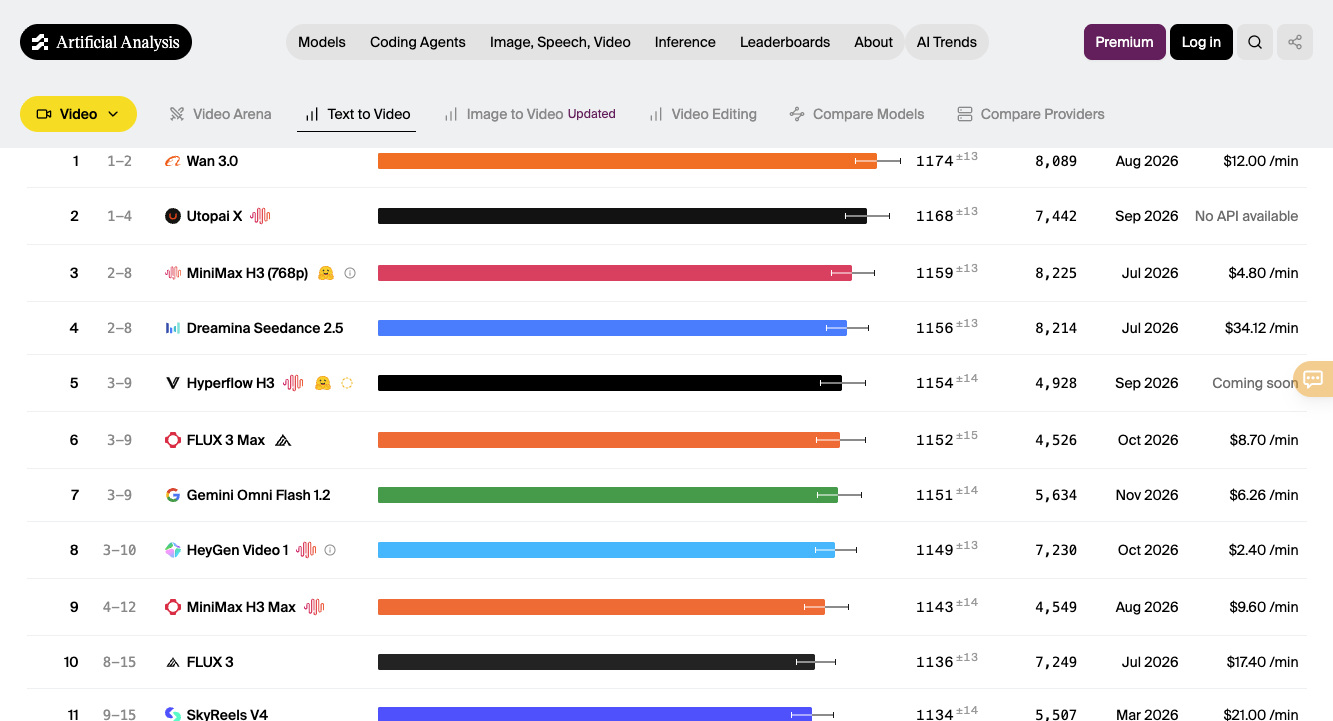
Source: Artificial Analysis Text-to-Video Leaderboard (AA-Video-T2V v2.1)
Where Wan 3.0 falls short, honestly:
- Lack of 10-point spatial coordinate keyframing: While Wan 3.0 excels at narrative multi-shot progression and four-modal conditioning, builders who require exact frame-by-frame
[x, y, z] trajectory curves across 10 discrete image keyframes may prefer pairing Kling 4.0 for rigid geometric camera paths.
- Unverified third-party B2B REST API pricing: Because official cloud API per-second rates for the full 30-second 4-modal endpoint remain
unverified — no public number yet, production teams rely on the wan30.io credit ledger for predictable per-job quoting.
- Compute latency on 30-second 1080p renders: Full 30-second 1080p audiovisual passes take 2 to 3 minutes in queue; always validate blocking in 5-second
Wan 3.0 Fast takes first.
Studio Credit Economics and Hybrid Pipeline Cost Math
Running every exploratory prompt at 30-second 1080p resolution quickly exhausts any studio budget. Adopting a 3:1 Fast-to-Pro hybrid ratio cuts total credit consumption by over 55%.
Two-Stage Hybrid Production Cost Formula:
Total Scene Credits = (3 × 5s Wan 3.0 Fast 720p Scouts) + (1 × 15s–30s Wan 3.0 Pro 1080p Master)
What That Costs in Practice
| Studio Subscription Tier | Annual Billing & Credit Pool | Effective Rate (/credit) | 5s 720p Fast Scout (~110 cr) | 15s 1080p Pro Master (~450 cr) | Full 3:1 Hybrid Scene (~780 cr) |
|---|
| Free Trial + Weekly Pool | $0 (50 sign-in + 100/wk check-in) | $0.0000 | Covered by starter + 1 check-in | Requires paid plan or multi-week pool | Ideal for initial 5s blocking tests |
| Basic Annual Plan | $226.80 / yr (18,240 credits) | $0.0124 | ~$1.36 | ~$5.58 | ~$9.67 (~23 full scenes/yr) |
| Pro Annual Plan | $294.00 / yr (28,200 credits incl. bonus) | $0.0104 | ~$1.14 | ~$4.68 | ~$8.11 (~34 full scenes/yr) |
| Enterprise Annual Plan | $1,188.00 / yr (203,760 credits incl. bonus) | $0.0058 | ~$0.64 | ~$2.61 | ~$4.52 (~261 full scenes/yr) |
Which Engine Should Builders Choose?
Choose Wan 3.0 (wan30.io) if:
- Your project requires 15-to-30-second multi-shot storytelling with native sound: The
#1 ranked (1,182 Elo) spatiotemporal backbone and four-modal conditioning eliminate silent-clip stitching.
- You want to compare Wan 3.0 Pro, Seedance 2.0, and Veo 3.1 in one UI: The unified workspace lets you A/B test all three frontier engines under one credit balance.
Choose Seedance 2.5 if:
- Your workflow is strictly single-shot Image-to-Video camera trajectory locking: On pure image-anchored shots (
AA-Video-I2V v2.1), Seedance 2.5 holds Rank #1 (1,161 Elo).
Frequently Asked Questions
What is Wan 3.0's current Artificial Analysis Elo score?
On the AA-Video-T2V v2.1 Text-to-Video Leaderboard, Wan 3.0 (tracked with its HappyHorse 1.0 lineage) ranks #1 globally at 1,182 Elo.
Wan 3.0 supports Text prompts, Image reference plates, Video motion references, and Audio timing/voice references.
How can I test Wan 3.0 without a paid subscription?
Every new user on Wan 3.0 can claim 50 free credits upon registration and collect up to 100 free weekly check-in credits to run initial video generations.
What is the maximum single-generation video length in Wan 3.0?
Wan 3.0 supports continuous sequence generation up to 30 seconds at 720p or 1080p resolution.
What to Watch Next
Watch for expanded document-to-video and multi-character lip-sync controls as Alibaba continues integrating its four-modal video checkpoints across the Wan 3.0 studio ecosystem. Test the live four-modal pipeline today on Wan 3.0.
About the Author
Daniel Okonkwo · Senior ML Engineer
"Daniel writes about inference systems, model architecture, and what new releases actually change for builders."