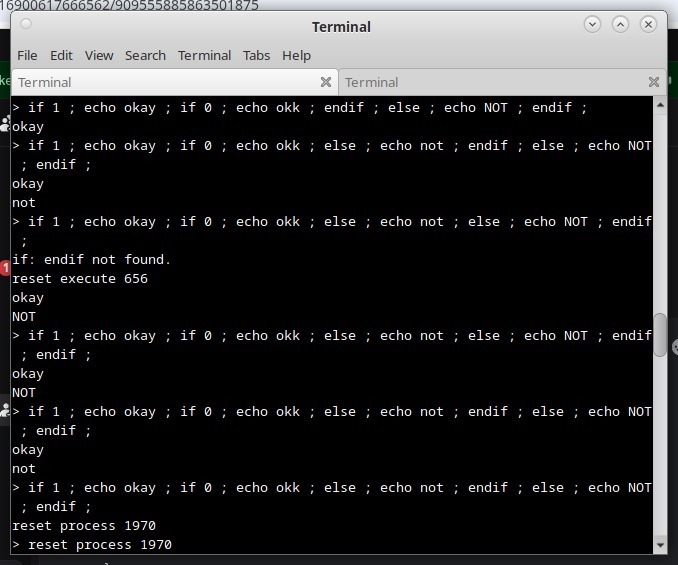
Hello. I'm writing this post as a matter of contribution. I forked Tcsh, and added some features. My most-recent contribution is on one-line control structure parsing. I'm currently working on an implementation to parse control structures in a single line, as in Bourne shells.
It's well known that, e.g., foreach n ( * ) ; echo $n ; end doesn't work on any C shell. The line is parsed as a whole before further action is taken. The issue here is that ; and a line feed can't be used interchangeably. This work is an attempt to implement this interchangeability.
At first, I thought on implementing this in sh.func.c, the source relating to built-in commands. The work was supposed to create and run temporary functions. However, I realized this would be dangerous and ineffective. Therefore, the implementation is now residing in sh.sem.c, the source relating to post-parsing execution. I parse semicolons into a new node mode (NODE_LINE). I implemented a new mode (F_LINE). I "reparse" the entire tree, setting the F_LINE bit to every command node (NODE_COMMAND). Then, in execute(), I walk through the entire tree, analyzing which of the NODE_COMMAND entries contain the F_LINE mode. The node shall be saved in a circular linked list for each containing the F_LINE mode. Next, the circular linked list is analyzed from search(). search() shall perform a recursive operation, and analyze the opening and enclosing block for each keyword.
Because I first tried to implement this on top of a temporary function, I altered how semicolons are parsed. Notably, the command-line must end with a semicolon. This is only true when a semicolon is inserted. E.g.: echo hello ; echo world ;.
Moreover, I guess this implementation shall make a good companion to aliases. Even though I've worked on the function built-in, I realized aliases may make a great fit for functions. With this ongoing implementation on one-line control structure parsing, aliases may come handy for functions.
alias myfunc 'if \!^ then ; echo hello ; else ; echo bye ; endif ;'
This might be ugly, but is one way to implement functions.
I'm seeking for testers. The implementation is done.
I'd appreciate for contributions and feedback.
Thank you.

