SpaceXAI released Grok 4.6 on August 12, 2026, about a month after Grok 4.5. The pitch is narrow and specific, which I appreciate: the release is aimed at long-running agents and at "more ambitious interactive and visual work" — models that stay on a task across many steps rather than models that win a one-shot benchmark.
(If the vendor name looks wrong to you: xAI was absorbed into SpaceX and the combined entity rebranded as SpaceXAI in July 2026. The API domain is still api.x.ai, the docs still live at docs.x.ai, and nothing about your integration changes. The branding did.)
I teach AI engineering at Cursuri-AI.ro, and what follows is the read I'd give a team deciding whether this model belongs in their routing table. Every number below comes from xAI's own announcement and API docs. Where the framing is mine rather than theirs, I say so.
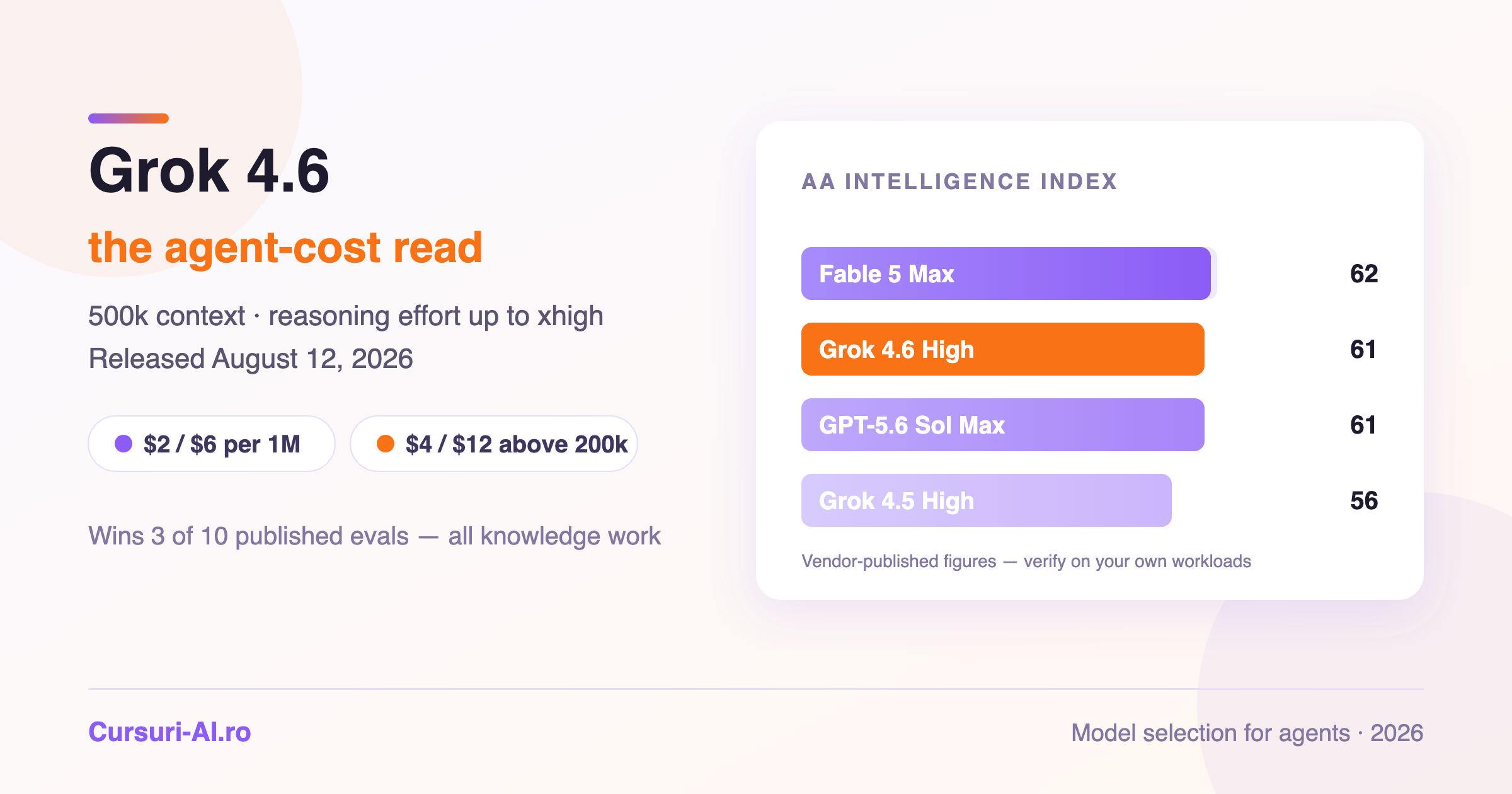
The spec sheet
| Spec | Grok 4.6 |
|---|
| Model ID | grok-4.6 |
| Context window | 500k tokens |
| Modalities | Text + image in, text out — no stated output limit |
| Reasoning effort | low, medium, high (default), xhigh — cannot be disabled |
| Pricing (≤200k prompt tokens) | $2 / $0.50 / $6 per 1M (input / cached input / output) |
| Pricing (>200k prompt tokens) | $4 / $1 / $12 per 1M |
| Fast variant | 2x the standard price |
| Availability | xAI API, Grok Build, Cursor, OpenRouter, Vercel, Cloudflare |
Two details deserve more attention than they'll get. The 200k pricing cliff is a real architectural constraint, not a footnote — more on that below. And reasoning cannot be disabled, which also means presence_penalty, frequency_penalty, and stop are rejected outright; requests including them return an error. If you're porting code from an older non-reasoning model, that's your first grep.
The eval table, and what it actually says
Here's xAI's published comparison, unedited. Note the effort levels: Grok 4.6 is reported at High, its competitors at Max.
| Eval | Grok 4.6 High | Grok 4.5 High | GPT-5.6 Sol Max | Fable 5 Max |
|---|
| AA Intelligence Index | 61 | 56 | 61 | 62 |
| GDPVal-AA v2 | 1753 | 1526 | 1728 | 1741 |
| CursorBench v3.2 | 69.9% | 66.7% | 67.2% | 70.5% |
| DeepSWE v1.1 | 65.9% | 54% | 73% | 70% |
| FrontierCode v1.1 (Extended) | 61.3% | 56.6% | 60.6% | 63.6% |
| APEX-Agents | 57.5% | 47.1% | 56.7% | 59.2% |
| Terminal-Bench v3.0 | 26% | 15.7% | 34.6% | 34.1% |
| APEX-SWE | 56.4% | 53.6% | — | 58.8% |
| AA-Briefcase | 1577 | 1313 | 1502 | 1574 |
| Harvey LAB (Vals) | 15.8% | 12.9% | 2.5% | 11.3% |
Count the first-place rows and the shape of the release becomes clear: Fable 5 Max takes five, Grok 4.6 takes three, GPT-5.6 Sol takes two. Grok's three wins — GDPVal-AA, AA-Briefcase, and the Harvey legal benchmark — are all knowledge-work evals. Its two worst relative showings, DeepSWE and Terminal-Bench, are both hands-on software engineering.
That's a usable signal, and it's more useful than the headline "matches GPT-5.6 Sol on the AA Intelligence Index." Grok 4.6 is a strong knowledge-work and research model that is merely competitive at terminal-driven software engineering. On Terminal-Bench v3.0 it scores 26% against 34.6% and 34.1% for its rivals — if your agent's job is to live in a shell and drive a real repo, that eight-point gap is the number that will show up in your own testing.
Three caveats before you take any of this too seriously:
- These are vendor-published figures, and xAI notes competitor scores are drawn from those developers' own system cards and leaderboards. Cross-vendor benchmark comparisons assembled by one of the vendors are directionally useful and never authoritative.
- The effort levels don't match. Grok is reported at High, rivals at Max. You can read that generously (Grok reaches parity without maxing out) or skeptically (we don't see what Grok at
xhigh does, or what it costs). Both readings are fair; neither is settled by the table.
- Harness differences dominate agentic evals. The same model scores materially differently under different scaffolds. A number produced by xAI's harness is not a prediction about yours.
The only benchmark that decides anything is the one you run on your own tasks. That's not a rhetorical flourish — it's the reason we build an eval harness before touching model selection in our LLM evals in production course.
The part that actually matters: agent economics
Here's where Grok 4.6 gets genuinely interesting, and it isn't the benchmark table.
Long-running agents are output-token machines. A single agentic session — read the repo, plan, edit, run tests, read failures, edit again — burns reasoning tokens and completion tokens across dozens of turns. Output price, not input price, dominates the bill.
| Model | Output per 1M tokens | Relative to Grok 4.6 |
|---|
| Grok 4.6 | $6 | 1x |
| Claude Sonnet 5 | $10 | 1.7x |
| Claude Opus 5 | $25 | 4.2x |
| Claude Fable 5 | $50 | 8.3x |
Take a workload of 200 agent sessions a day, 40k output tokens each — 8M output tokens daily. On Grok 4.6 that's about $48/day. On Fable 5, roughly $400/day. Over a year: ~$17.5k versus ~$146k, for the same volume of work.
That gap is the actual product decision. Fable 5 wins five of ten eval rows — but "wins the row" and "worth 8x on your workload" are completely different claims, and only your evals can connect them. My honest read: for research, analysis, drafting and knowledge work, Grok 4.6 at $6 output is very hard to argue against. For terminal-heavy engineering agents, the Terminal-Bench gap suggests you'll pay for the difference somewhere else — in retries, in failed runs, in human cleanup — and that hidden cost is exactly what a per-task cost metric exposes and a per-token metric hides.
Which is the general principle: measure cost per task completed, not cost per million tokens. A cheaper model that needs three attempts is not cheaper. This is the discipline we drill in our AI agents and automation course, because it's the single most common way teams misprice their own architecture.
The 200k cliff is an architecture constraint
Reread the pricing rows: above 200k prompt tokens, input doubles to $4 and output doubles to $12 per million. The 500k context window is real, but the top 300k of it costs double.
This matters specifically for agents, because agent context grows monotonically. Every tool result, every file read, every error trace accumulates. A session that starts at 20k tokens can drift past 200k after enough turns — and when it crosses, every subsequent request in that session bills at the higher tier, including the output tokens. The cost curve of a long session isn't linear; it has a step in it.
Three mitigations, roughly in order of leverage:
- Compaction. Summarize completed phases out of the working context rather than carrying full transcripts. xAI ships a Context Compaction feature for exactly this; you can also roll your own summarizer at phase boundaries.
- Subagents with fresh context. Delegate a bounded task, return only the result. The parent's context grows by a paragraph rather than by a full transcript.
- Retrieval over stuffing. Fetch the three files that matter instead of pre-loading the directory. Obvious advice, still routinely ignored because a 500k window makes stuffing feel free.
None of these are Grok-specific — they're the standard toolkit for keeping long-horizon agents affordable, and they're the subject of our context engineering for agents course. Grok's pricing structure just makes the incentive unusually explicit: you can watch the cliff in your invoice.
Don't forget cached input either. At $0.50 per million below the cliff, a stable system-prompt-plus-tools prefix is nearly free to resend. Structure requests so the stable content comes first and the variable content last — the eternal caching rule, and it pays off harder here than usual.
Trying it: the API is OpenAI-compatible
Grok 4.6 is available through xAI's Responses API, and the OpenAI SDK works against it with a base-URL swap:
from openai import OpenAI

client = OpenAI(
    api_key=os.environ["XAI_API_KEY"],
    base_url="https://api.x.ai/v1",
)

response = client.responses.create(
    model="grok-4.6",
    input="Fix this function and explain the bug: "
          "function median(a){a.sort();return a[a.length/2]}",
)

print(response.output_text)
There's also a native xai-sdk for Python and an @ai-sdk/xai provider for the Vercel AI SDK if you'd rather not route through the OpenAI client.
To tune cost against quality, reasoning_effort is the lever — low for latency-sensitive tool calling, high (the default) for real work, xhigh when the task justifies it. Usage metrics expose reasoning_tokens separately, which is what you want: you can attribute spend to thinking versus answering and tune each independently. If you're doing multi-turn work and want the model to keep its own reasoning across turns, the Responses API can return encrypted reasoning via include: ["reasoning.encrypted_content"], which you pass back on the next call.
How I'd actually evaluate this
A concrete plan, not a vibe check:
- Pick 30–50 real tasks from your production logs. Not synthetic ones. The distribution of your actual work is the only benchmark whose result transfers.
- Run your current model and Grok 4.6 side by side, same harness, same tools, same prompts. Score on task completion, not on output aesthetics.
- Record cost per completed task, including retries and reasoning tokens. This is the number that decides.
- Split the results by workload class. Research/analysis tasks and terminal/repo tasks will likely tell you different stories — that's the whole point of the eval table above. The answer may well be "Grok for research, something else for the shell," and a routing layer costs you an afternoon.
- Check the boring integration details:
presence_penalty/frequency_penalty/stop are rejected, reasoning can't be turned off, and your context growth strategy needs to keep sessions under 200k prompt tokens where possible.
If the comparison work itself is the part you don't have a method for, that's exactly the gap our AI model comparison course is built to close — how to construct a fair test, what to measure, and how to avoid choosing a model because a chart looked good.
The bottom line
Grok 4.6 is a serious frontier release with an unusually clear identity: strongest on knowledge work, competitive on coding, behind on terminal-driven engineering, and priced well below the top of the market at $2/$6 per million tokens with a 500k window.
For output-heavy long-running agents, that price is the headline — an 8x output-cost gap against Fable 5 will decide more architectures this year than any single benchmark row. But the 200k pricing cliff means the savings only materialize if you actually manage context, and the Terminal-Bench gap means the savings can evaporate in retries if you point it at the wrong class of work.
Both of those are measurable on your own workloads in an afternoon. Do that before you route production traffic — and route by workload class, not by vendor loyalty.
If you want structured, hands-on training on evals, agent architecture, and model selection, that's what we build at Cursuri-AI.ro.
Sources: SpaceXAI — Introducing Grok 4.6 · xAI API release notes · xAI models & pricing · xAI reasoning guide
