Every hour you spend manually organizing spreadsheets, copy-pasting data between disconnected tools, or responding to repetitive client emails is an hour you aren’t scaling.
It’s a silent, invisible cost that I call the “Manual Tax.”
Many business owners treat these soul-crushing, repetitive tasks as “just part of the job.” But in reality, they are leaking profit, killing team morale, and stalling your growth. As a developer, I don’t just build websites; I identify where manual work is costing you money and replace it with automated, scalable logic.
If you are an SME owner, you are likely paying this tax every single day. Here is the exact audit I use to identify the biggest leaks in your business architecture.
The Audit: Where Are You Paying the “Manual Tax”?
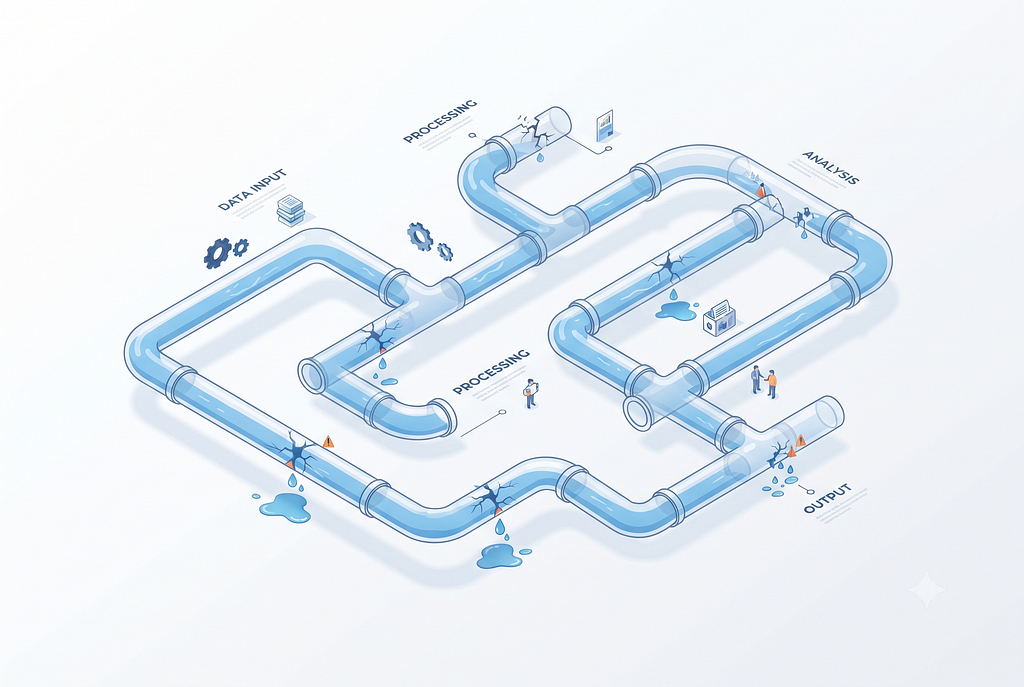
To find the leaks, you need to stop thinking about your business as a set of isolated departments and start thinking about it as a set of interconnected data flows. If the data isn’t flowing automatically, you are manually carrying the buckets.
1. The “Copy-Paste” Trap
Look at your intake process. If a customer fills out a form on your website and your team then has to manually move that data into a CRM, an invoicing tool, or a spreadsheet, you are paying the tax. Every manual entry is a point of failure and a waste of high-value human time.
2. The Report Ritual
How much time does your team spend formatting spreadsheets to generate simple weekly status updates? If it takes more than five minutes to compile your performance metrics, the process is broken. Your data should live in a live dashboard, not a static file that becomes obsolete the moment you save it.
3. The Status Black Hole
How many emails or phone calls do you receive daily asking, “What’s the status of my order?” or “When will this project be done?”. If you do not have a live, self-service portal where customers can check this themselves, you are wasting cycles on repetitive communication that provides zero added value.
Why “Doing It Yourself” Is the Most Expensive Path
Many owners I speak with believe that hiring a large software house is the only way to modernize.
They are wrong.
Big agencies are built for massive, multi-year “greenfield” projects. They bring in layers of project managers, delivery managers, and account executives, all of whom add to your bill while slowing down your decision-making. You don’t need a committee to automate your intake form. You need an architecture that actually works.
In large agencies, your project often “falls” to junior developers. When you work with me, you are working directly with an architect who has spent over seven years in the international corporate and banking sectors — including Citibank, BNP Paribas, and Silent Eight.
I bring that same rigor to your SME.
The “Modernization Roadmap” Approach
My approach is built on Hyper-Lean Architecture. We don’t need to rewrite your entire business logic to save you 20 hours a week. We just need to find the friction and apply targeted logic to it.
Modernization Without Paralyzing Operations
Agencies often push for “greenfield” rewrites because they don’t have the expertise to safely navigate your existing, complex codebase. Rewriting a system from scratch is a massive business risk.
Instead, I use non-invasive modernization. I perform migrations “on the living organism” — your system keeps running and making money while I modernize the architecture in the background.
Nx Monorepo: The Double Efficiency
If you need a web app and a mobile app, agencies often engage two separate teams, charging you double for the same logic. I utilize Nx Monorepo architecture to share libraries, validation, and business logic across web and mobile platforms. This slashes your development time and maintenance costs by up to 40%.

I build using modern Angular ecosystems (including Zoneless Change Detection and Signals) to boost rendering performance by up to 40%. When you have a high-performance frontend, your Core Web Vitals improve, your SEO rises, and your conversion rate increases because users aren’t frustrated by lag.
The Economics of Automation: What It Costs Your Bottom Line
If you aren’t convinced yet, look at the math. If an administrative assistant spends 10 hours a week on manual data entry, that’s 520 hours a year. At a conservative rate, that is significant capital diverted away from revenue-generating activities like sales or product development.
Beyond the dollar amount, there is the Opportunity Cost.
What could your team be doing if they weren’t buried in administrative overhead? They could be improving your customer service, refining your product offering, or closing more deals. By automating the “Manual Tax,” you aren’t just saving time; you are buying back the capacity to scale.
Eliminating the “Hidden Tax”
When you automate, you aren’t just saving hours — you are increasing reliability. Humans make mistakes; automated logic does not. By removing manual intervention, you eliminate the “hidden tax” of fixing errors, managing frustrated clients, and onboarding new staff to handle repetitive tasks.
Stop Guessing. Start Scaling.
If you aren’t sure where to start, you’re likely suffering from “analysis paralysis.”
Don’t let the complexity of your current tech stack stop you from optimizing. The goal isn’t to build a “perfect” system; the goal is to stop paying the “manual tax” starting next week.
I don’t just “write code.” I design systems that leverage AI-augmented development (GitHub Copilot, Claude Code) to move from idea to validated product in as little as 30 days.

Why My Approach is Different
- Direct Access: No more “Chinese whispers” with project managers. You work with me.
- Enterprise-Grade Performance: I bring the same rigor used in Citibank and BNP Paribas to your SME.
- Predictable ROI: We focus on the features that actually move the needle for your business, not just “cool tech”.
Ready to cut your manual tax?
I’ve put together a “Modernization Roadmap” to help you identify the low-hanging fruit in your own systems. Let’s find out where you’re losing hours — and how to get them back.
Book a 30-minute technical session here to start your audit.
Want to see how I think about building scalable systems? Connect with me on LinkedIn or check out my work at karolmodelski.pl.
How many hours a week does your team spend on manual data entry instead of revenue-generating activities? Let’s change that.