You don’t need a corporate budget to have enterprise-grade stability, but you do need to stop treating your infrastructure like a disposable startup experiment.
I’ve spent the better part of a decade inside the belly of the beast. From Citibank to BNP Paribas, I helped build systems where a single millisecond of downtime or a minor data leak isn’t just an “oopsie” — it’s a career-ending disaster.
When I talk to SME owners today, I see a dangerous pattern. You’re either over-engineering your platform because you’re terrified of scaling, or you’re running on a stack held together by duct tape and hope because you think “bank-grade” is only for the big players.
Both approaches are burning your cash.
The “Bank-Grade” Myth
The biggest lie in the software industry is that reliability is expensive.
Most software houses will happily sell you that myth. They’ll build you a bloated, complex system packed with layers of project managers and “delivery experts,” charging you for their overhead while you wonder why your MVP is taking six months to ship.
That’s not “enterprise-grade.” That’s enterprise-priced.
True stability — the kind that handles massive traffic spikes without sweating — doesn’t come from a bigger team. It comes from a smarter architecture.
Why Your Current Infrastructure Is Hurting Your ROI
When I was at Silent Eight or working on banking platforms, we didn’t succeed because we had more meetings. We succeeded because we obsessed over the “density” of the solution.
Every line of code you pay for should solve a business problem. If it’s just there to keep a complicated, multi-layered management structure busy, it’s not an asset. It’s a debt.
When you hire a massive agency, your project often gets passed around like a hot potato. By the time it hits the keyboard, the junior developer who’s actually building it doesn’t understand your business goals at all. They’re just hitting a ticket in Jira.
The Hidden Costs of the “Software House” Model
If you’ve ever felt like your project is moving through molasses, there’s a reason.
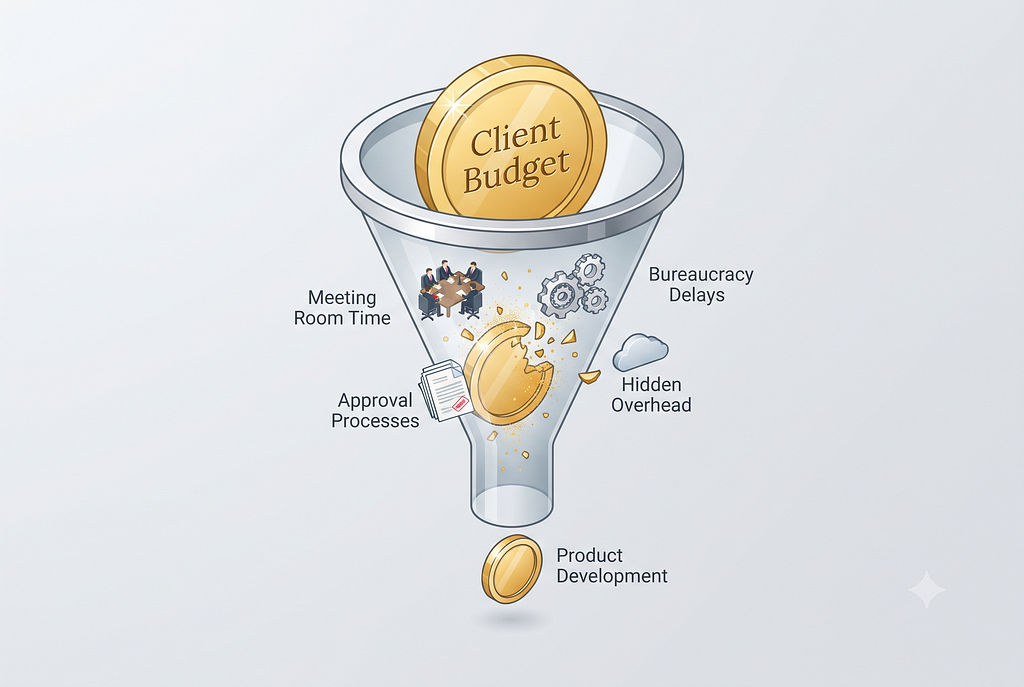
In a traditional software house, your budget is being siphoned off long before a single line of code is written. You are paying for account managers, project managers, office space, and the agency’s marketing budget.
In many cases, up to 50% of your investment is going toward maintaining the agency’s internal structure rather than your product. You aren’t just paying for development; you are paying for an entire bureaucracy that complicates communication and slows down delivery.
Modernizing “On the Fly”
The most common trap owners fall into is the “Rewrite” trap.
Agencies love to tell you your system is garbage and needs to be rewritten from scratch. It’s a high-risk, high-cost gamble that paralyzes your operations.
Having worked on massive migrations, like transitioning GOonline at BNP Paribas from AngularJS to Angular 15, I know there is a better way. We perform modernizations “na żywym organizmie.” We modernize piece-by-piece, ensuring your business never stops earning while we strip away the technical debt in the background.
When I talk about performance, I’m not talking about abstract metrics that only developers care about.
I’m talking about your bottom line.
A 40% boost in rendering speed isn’t just a technical win — it’s a higher conversion rate. A smooth, responsive interface is the difference between a user finishing their purchase and giving up because the app felt “clunky.”
By utilizing advanced techniques like Zoneless Change Detection and Angular Signals, I can strip away the overhead that drags down standard agency-built applications. You get a faster, lighter product that costs less to host and keeps your users happy.

Why “Enterprise-Grade” is Actually Cheaper
It sounds counterintuitive, right? How can “bank-grade” be cheaper than a generic solution?
It comes down to Total Cost of Ownership (TCO).
When you build with an expert who focuses on clean architecture and rigorous testing (I’m talking 95% code coverage with Jest and Cypress), you aren’t paying for “bug-fixing hell” three months later. You are paying for a foundation that lasts.
When you use an Nx Monorepo to share logic between your web and mobile platforms, you stop paying double to build the same features twice. That is where the savings really kick in.
Stop Being a “Ticket” in a Software House
You don’t need another team of developers. You need a partner who treats your project like their own reputation is on the line.
When you work with me, you’re not talking to an account manager. You’re talking directly to the person who architected the system. No “głuchy telefon,” no hidden agency fees, and no waiting weeks for a simple fix.
The Strategy: Architectural Density
Most agencies sell you “hours.” I sell you “outcomes.”
If your goal is to scale, your focus shouldn’t be on adding more developers to the pile. Your focus should be on increasing the architectural density of your product.
This means leveraging modern, reactive patterns that allow your app to handle complex state management without needing a massive, convoluted codebase. By utilizing NgRx Signal Store or TanStack Query, we can keep your data flows clean and predictable.
When the architecture is solid, the product is resilient. It doesn’t break when you add a new feature. It doesn’t crawl to a halt when your traffic spikes. It scales.

Don’t Let “Good Enough” Destroy You
The biggest mistake I see SME owners make is settling for “good enough.”
They think, “It works, it’s just a little slow, maybe we can fix it later.”
But in the digital world, “later” is expensive. The cost of refactoring a broken, tangled, or poorly architected system a year from now will be ten times higher than building it right the first time.
If you are a high-growth company, your software is not just a tool — it is your company’s lifeblood. Treating it as a disposable experiment is a recipe for long-term failure.
The Elite Frontend Difference
You deserve better than the “body shop” model. You need a strategic partner who understands that software is a business driver.
My approach isn’t just about writing code; it’s about building a digital architecture that adapts to your growth. It’s about ensuring that as your revenue scales, your systems don’t become the bottleneck.
I take the rigor of the banking world and combine it with the agility of a startup. You get the stability of an enterprise environment without the corporate drag.
Your Next Step
If you’re ready to stop treating your tech stack like a disposable experiment and start building something that actually scales, let’s talk.
Get Your Free IT Modernization Roadmap — let’s see if your current setup is an asset or a drain.
Check out my latest insights on LinkedIn:
https://www.linkedin.com/in/karol-modelski/
See how we can transform your business:
https://www.karolmodelski.pl/
