In virtually every corporate investment committee, extraordinary Board of Directors retreat, or C-Suite strategic alignment session (CIO/CFO), leadership inevitably confronts what Tier-1 strategy consultants term the "Executive Last-Mile Decision Trap":
A corporation invests hundreds of billable engineering hours, solicits comprehensive Requests for Proposals (RFPs) from global enterprise vendors, or commissions exhaustive due diligence for strategic acquisitions (M&A / Make vs. Buy). Yet the moment these findings reach the boardroom table, the formal evaluation process disintegrates. The ultimate resolution degenerates into rhetorical persuasion driven by executive gut-feeling, vendor sales charisma, departmental confirmation bias, or political compromise.
The economic repercussions of this governance vacuum are severe and systemic:
- The "Cheap Sticker Price" Trap: Awarding mission-critical contracts to the bidder with the lowest initial licensing quote, failing to account for how custom integration, consulting bloat, and rigid support models triple the Total Cost of Ownership (TCO) across a 36-month horizon.
- Illicit Compensatory Scoring: Utilizing simplistic weighted matrices where high marks in secondary, cosmetic attributes (such as a slick user interface or bundled peripheral modules) improperly offset and conceal existential vulnerabilities (such as lack of SOC 2 / ISO 27001 certification, high API latency, or data residency breaches outside sovereign borders).
- Ex-Post Weight Manipulation: Retroactively adjusting pillar weights once commercial bids are unsealed to engineer an artificial mathematical victory for an executive sponsor's favored vendor.
To eradicate these vulnerabilities and insulate high-stakes decisions against scrutiny from audit committees, regulatory authorities, and institutional shareholders, systems engineering and corporate governance formalized two canonical methodologies: the CMMI DAR (Decision Analysis and Resolution) process area and the Kepner-Tregoe (KT) rational management method.
💡 C-Level Executive Resources: Facing a critical ERP/Cloud procurement, M&A selection, or Make vs. Buy dilemma? Access the quantitative Excel engine with Veto Gates, What-If sensitivity stress testing, and an editable 16:9 boardroom presentation at:
👉 Explore Executive Toolkits and Quantitative Templates at Datalaria Resources
1. What is the DAR Matrix? Foundations, Components & Strategic Objectives
Originating in aerospace and defense systems engineering under the CMMI (Capability Maturity Model Integration) standard developed by the Software Engineering Institute at Carnegie Mellon University (formal Level 3 process area: Decision Analysis and Resolution), the DAR matrix pairs with Charles Kepner and Benjamin Tregoe's rational management method (The Rational Manager, 1965).
Its bedrock foundation rests on an uncompromising axiom: the complete separation between non-negotiable binary hurdles (Must-Haves) and weighted desirable attributes (Wants).
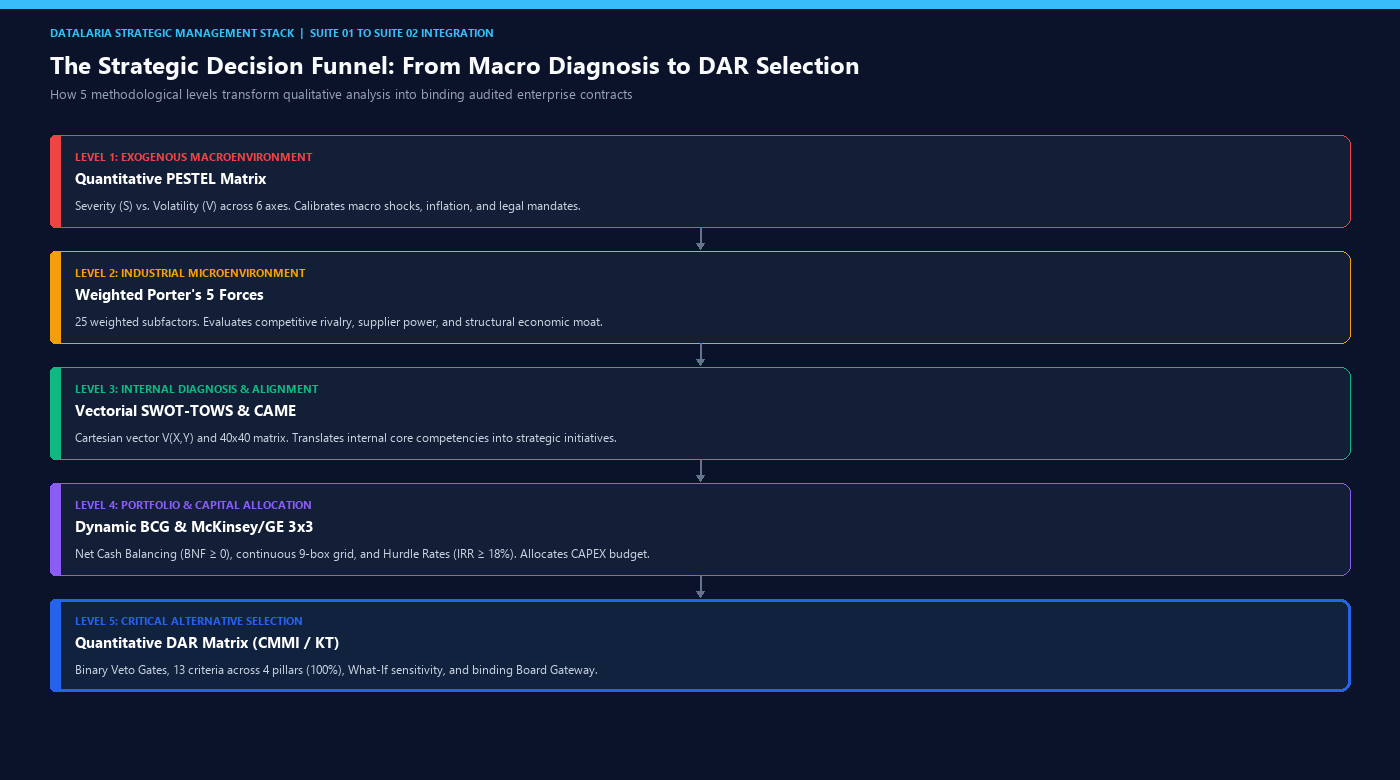
The Strategic Funnel: Connecting Strategy to Procurement
In Tier-1 management consulting (McKinsey, BCG, Bain), quantitative tools do not operate in isolation:
- Level 1 (Macro Scanning - PESTEL): Evaluates exogenous geopolitical, inflation, and regulatory risks.
- Level 2 (Industry Microenvironment - Porter's 5 Forces): Analyzes supplier bargaining power and competitive barriers.
- Level 3 (Internal Positioning - SWOT & CAME): Identifies internal operational bottlenecks requiring software modernization.
- Level 4 (Capital Allocation - BCG & McKinsey/GE 3x3): Allocates the corporate CAPEX investment envelope and hurdle rates.
- Level 5 (Procurement Award - Quantitative DAR Matrix): Executes the binding vendor selection, Make vs. Buy award, or target acquisition.
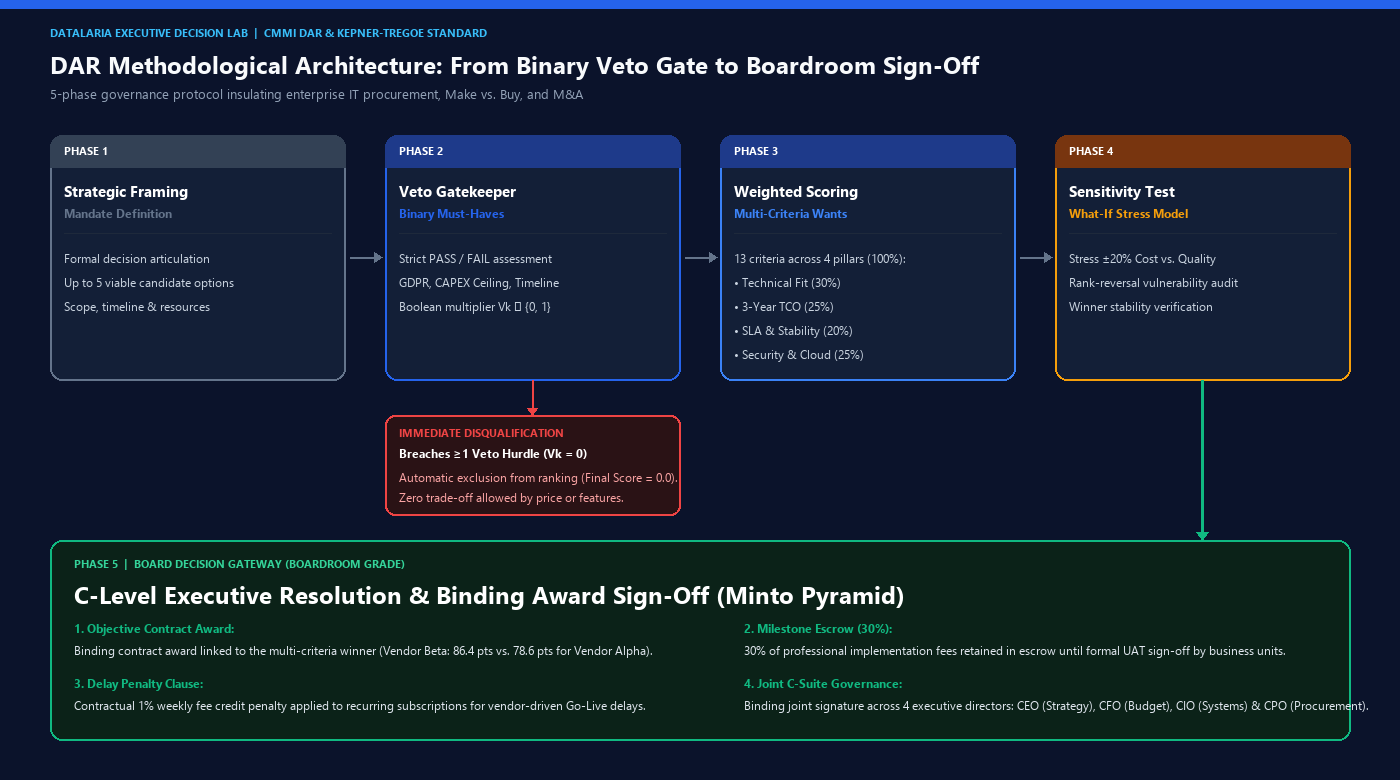
Step 1: The Binary Veto Gatekeeper (Must-Haves)
Let A = {a_1, a_2, ..., a_m} represent the set of candidate alternatives, and let V = {v_1, v_2, ..., v_p} represent the set of mandatory veto criteria.
For each alternative a_k and each veto criterion v_j, the compliance evaluation is strictly Boolean:
v_k,j ∈ {0, 1}
Where 1 = PASS (Fully Compliant) and 0 = FAIL (Non-Compliant)
The Composite Veto Factor V_k for alternative a_k is defined as the Boolean product across all p hurdles:
V_k = ∏ [ v_k,j ] for j = 1 to p
If alternative a_k fails even a single non-negotiable requirement (v_k,j = 0 for any j), then V_k = 0.
Step 2: Multi-Criteria Weighted Scoring (Wants)
Surviving candidates (where V_k = 1) proceed to multi-criteria evaluation across n desirable criteria C = {c_1, c_2, ..., c_n}. Each criterion is assigned a normalized stochastic weight w_i such that:
∑ [ w_i ] = 1.00 (100%) with w_i > 0 for all i
Each alternative a_k receives an audited performance score s_k,i ∈ [1.0, 10.0]. The unconstrained base score is calculated as:
S_base(k) = ∑ [ w_i × s_k,i ] for i = 1 to n
The final audited score S_final(k) couples the Boolean veto gatekeeper with the weighted scalar score:
S_final(k) = V_k × S_base(k) = [ ∏ v_k,j ] × [ ∑ w_i × s_k,i ]
Key Mathematical Property: Because V_k acts as an unyielding multiplicative annihilator, an alternative that scores a perfect 10.0 across all desirable attributes but fails a single veto hurdle (V_k = 0) receives a final score of exactly 0.0, resulting in irreversible disqualification.
Step 4: Marginal What-If Sensitivity Stress Testing
To guarantee that the recommended winner is robust against boardroom skepticism, we model marginal weight variations Δw across pillars:
Δ_1,2(w + Δw) > 0 for all Δw such that ||Δw||_∞ ≤ 0.20
This ensures that any shift of up to ±20% in pillar weights (e.g., doubling Cost weight against Technical Fit) produces zero rank reversal between the 1st and 2nd placed candidates.
3. The 4 Strategic Pillars & 13 Evaluation Criteria
Datalaria's corporate DAR standard structures the 13 weighted criteria into four balanced pillars:
| Pillar | Strategic Dimension | Weight | Core Evaluated Criteria |
|---|
| Pillar 1 | Technical & Functional Fit | 30.0% | Native core feature coverage (10%), UI/UX adoption curve (8%), REST API & webhook architecture (7%), Concurrency & real-time latency (5%). |
| Pillar 2 | 3-Year Total Cost of Ownership (TCO) | 25.0% | Year 1 setup & licensing (10%), Custom integration & data migration (9%), Years 2-3 recurring support & maintenance (6%). |
| Pillar 3 | SLA, Support & Vendor Solvency | 20.0% | Contractual SLA < 2h resolution with financial credits (8%), Vendor financial stability & local support (7%), Technical documentation quality (5%). |
| Pillar 4 | Security, Scalability & Roadmap | 25.0% | Zero-Trust architecture & AES-256 encryption (10%), Elastic cloud auto-scaling (8%), Product vision & generative AI roadmap (7%). |
4. Real Enterprise Case Study: Horizon Global Logistics
Horizon Global Logistics is an international freight forwarder with 1,400 employees, 12 regional hubs, and €185M in annual turnover. The executive committee needed to replace its legacy on-premise ERP with a next-generation Cloud Enterprise platform.
The Board established a strict CAPEX ceiling of €450,000 and an unextendable Go-Live deadline of < 6 months. Five global vendors submitted bids:
| Code | Candidate Alternative | Veto Status | Tech (30%) | TCO 3Y (25%) | SLA (20%) | Sec (25%) | Base Score | Factor V_k | Final Score | Rank | Executive Board Ruling |
|---|
| Alt-01 | Vendor Alpha (Global Core) | PASS | 23.6 | 19.3 | 16.9 | 18.8 | 78.6 | 1.0 | 78.6 | 2nd | Qualified Backup |
| Alt-02 | Vendor Beta (Cloud Enterprise) | PASS | 27.6 | 20.0 | 18.4 | 20.4 | 86.4 | 1.0 | 86.4 | 1st | RECOMMENDED AWARD |
| Alt-03 | Vendor Gamma (Modular Suite) | PASS | 22.7 | 21.4 | 15.0 | 17.5 | 76.6 | 1.0 | 76.6 | 3rd | Rejected (SLA Gap) |
| Alt-04 | Vendor Delta (Legacy Hosted) | FAIL | 24.8 | 16.3 | 16.3 | 18.9 | 76.3 | 0.0 | 0.0 | - | DISQUALIFIED (Veto V-05) |
| Alt-05 | Vendor Epsilon (SaaS Niche) | PASS | 21.1 | 20.1 | 13.0 | 17.6 | 71.8 | 1.0 | 71.8 | 4th | Rejected (Under-Scale) |
Key Executive Findings:
- The Disqualification of Vendor Delta: Despite a solid technical baseline (76.3 pts), compliance discovered that Vendor Delta processed telemetry in US data centers, breaching mandatory veto hurdle V-05 (EU GDPR Data Sovereignty). The Boolean multiplier annihilated its score: V_Delta = 0 ➔ Final Score = 0.0.
- Vendor Beta's Decisive Victory: Vendor Beta achieved 86.4 points, beating Vendor Alpha by +7.8 points (+9.9% relative margin) due to 94% native logistics workflow fit, eliminating 140 custom development days.
- The 3-Year TCO Realities: Although Vendor Beta's year-one subscription was €15k higher than Gamma, automated data migration tools and premium support reduced cumulative 3-year operating costs by €380,000 compared to Vendor Alpha.
5. Boardroom Governance: The Board Decision Gateway
To ensure execution discipline after contract signature, the DAR evaluation links directly to four binding board resolutions:
+-----------------------------------------------------------------------------------+
|                        BOARD DECISION GATEWAY (C-LEVEL)                           |
+-----------------------------------------------------------------------------------+
| 1. Contract Award: Formal procurement mandate awarded to Vendor Beta (86.4 pts). |
| 2. Milestone Escrow: 30% of professional services held until formal UAT sign-off. |
| 3. Delay Penalty: 1% weekly fee credit penalty for vendor-caused Go-Live delays.  |
| 4. Joint C-Suite Sign-Off: Joint execution by CEO, CFO, CIO, and CPO.            |
+-----------------------------------------------------------------------------------+
6. Official Executive Decision Pack: Dual Quantitative DAR Matrix
For executive teams seeking to implement this framework immediately without programming formulas from scratch, Datalaria provides pre-built, production-tested decision engines:
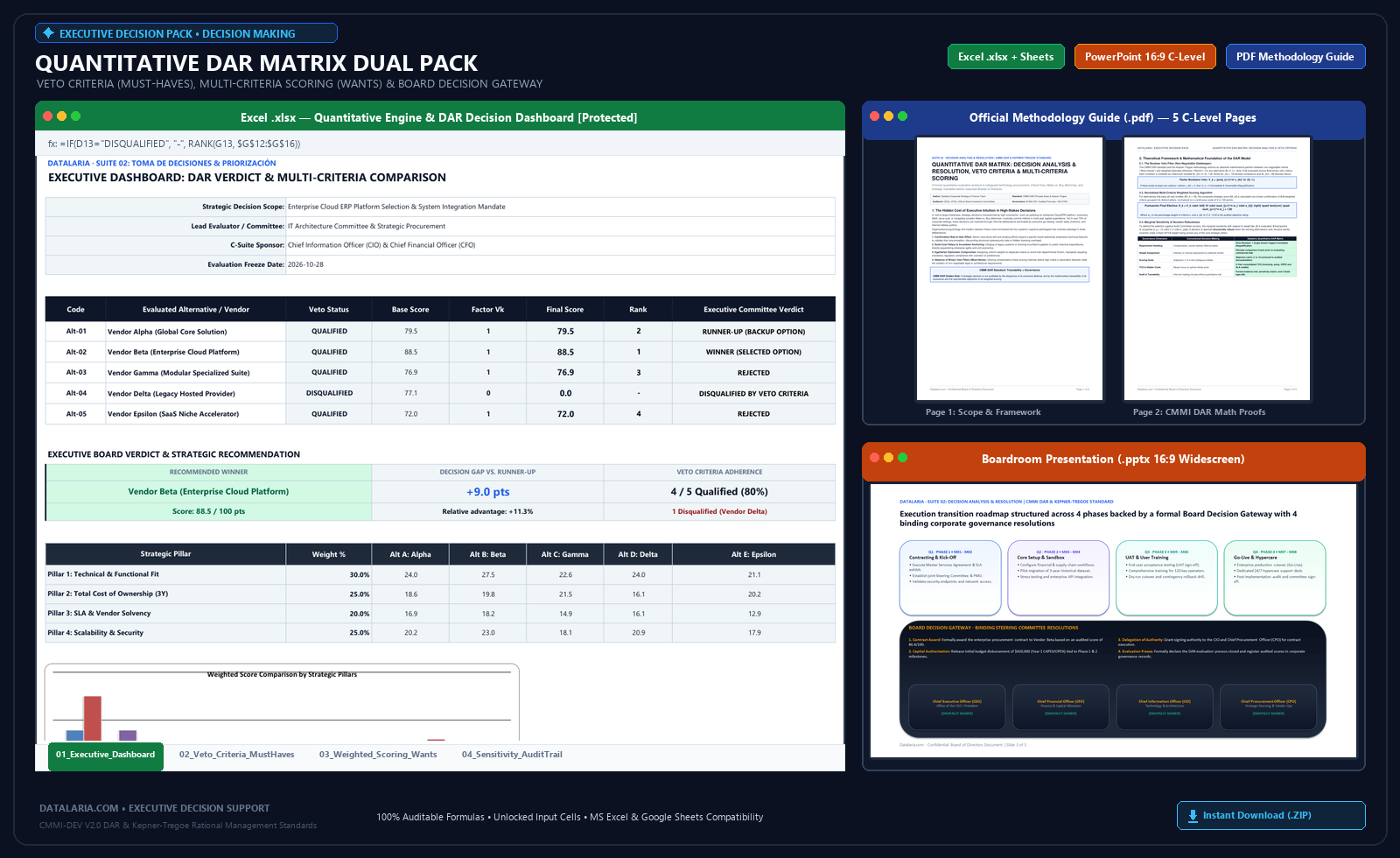
- Quantitative Excel Engine (.xlsx & Google Sheets): Multi-criteria weighted scoring with binary Veto Gatekeepers, 13 criteria across 4 pillars, automated sensitivity analysis, and unlocked input cells.
- Boardroom Presentation Deck (.pptx 16:9 Widescreen): Built under the Minto Pyramid Principle with dynamic trade-off charts and the Board Decision Gateway.
- Executive Methodological Guide (PDF): Mathematical formulations, PMO pre-freeze anti-bias protocols, and the complete Horizon Logistics enterprise case study.
👉 Download the DAR Executive Toolkit at Datalaria Resources
🔗 Explore the Original Master Guide on Datalaria