💡TL;DR
▪️GraphRAG helps most when questions require multi-document relationships, temporal reasoning, or corpus-level synthesis; it does not consistently beat standard RAG on direct factual retrieval.
️️▪️Automatically constructed graphs can omit required entities, weaken abstention, and create new maintenance, provenance, and security risks.
▪️ Treat the graph as a navigational layer over source evidence - not as an AI brain, a source of truth, or a substitute for runtime control.
When Retrieval Infrastructure Became an “AI Brain”
Three GraphRAG posts showed up on my feed today. Not three this week. Three today. Each used some version of the same promise: give an AI agent a knowledge graph, and it will finally understand your organization.
The surrounding claims were broader. One repository mapped an entire codebase into a glowing web of functions and dependencies. Another promised organizational memory that would persist across agents and sessions. Obsidian vaults were becoming self-growing second brains. Vector databases were being pronounced obsolete, sometimes by the same companies that had been promoting them six months earlier.
The phrase AI brain now gets attached to technologies that share surprisingly little beyond the presence of nodes, links, or Markdown files. There are graphs extracted from natural-language documents, formal ontologies maintained by domain specialists, syntax trees exposed to coding assistants, temporal memory systems that record when facts stopped being true, and agent-maintained wikis where a model writes notes for its future self.
Calling all of these a knowledge map is roughly as useful as grouping a bicycle, a forklift, and a jet engine under ways to move things. The category is technically defensible and nearly useless when deciding what to build.
The excitement is not entirely manufactured. Language models lose project history, reread the same files, miss relationships scattered across documents, and waste enormous context windows reconstructing structures that parsers already know. Something more structured could help. The problem is that help has quietly expanded into understanding, and retrieval infrastructure has become a brain before the benchmark results have earned either word.
So I pulled the comparative studies, benchmark appendices, original GraphRAG work, recent agentic-search results, and the technical documentation behind the most visible repositories. Not the launch posts or demo videos. The sources and the numbers underneath them.
The evidence supports a considerably narrower claim:
GraphRAG can be valuable when a question requires relationships to be traversed across documents, temporal or comparative reasoning, or a broad summary of a large corpus.
It does not reliably beat simpler retrieval on straightforward factual questions, and some graph-based designs become substantially worse when the evidence is incomplete.***
Round 1: Does a graph help you find a fact?
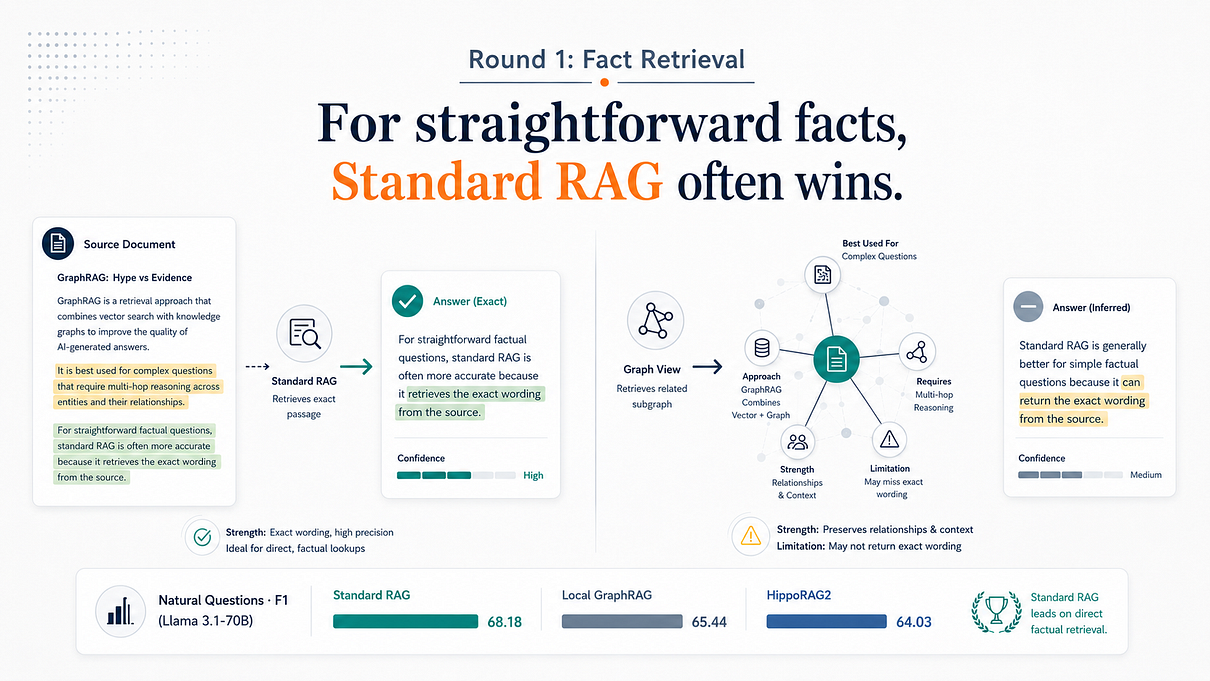
One of the most useful comparisons is Han et al.’s systematic evaluation of RAG and GraphRAG. The researchers standardized preprocessing, retrieval settings, and generation conditions across ordinary RAG and several graph-based systems instead of letting every architecture arrive with its own preferred benchmark setup. 1
Using Llama 3.1–70B, they reported:
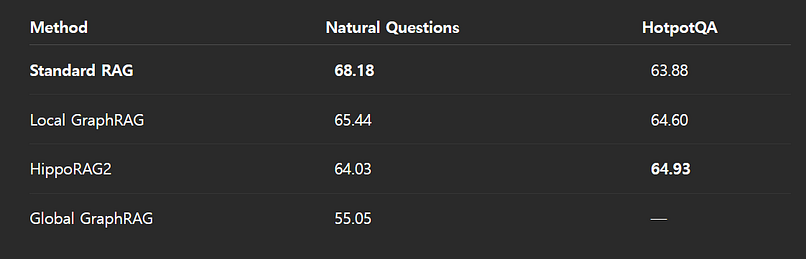
Plain retrieval beat every graph-based method on Natural Questions. On HotpotQA, the graph systems moved ahead, although the difference was less than one point.
This is not the comparison GraphRAG demonstrations usually foreground. Demonstrations tend to begin with questions graphs were designed to handle: How is this person connected to that project? What sequence of events led to this decision? Which modules depend on this function?
Real users also ask for an exact clause, one number from a report, the current owner of a system, or the sentence containing an exception.
A direct question is often best answered by a passage that still contains its original wording, scope, qualifications, and awkward “except when” condition. Converting that passage into an entity and an edge may preserve the relationship while losing the language that determines whether the relationship applies.
You get the relationship. You lose the sentence.
Round 2: Where the graph earns its cost
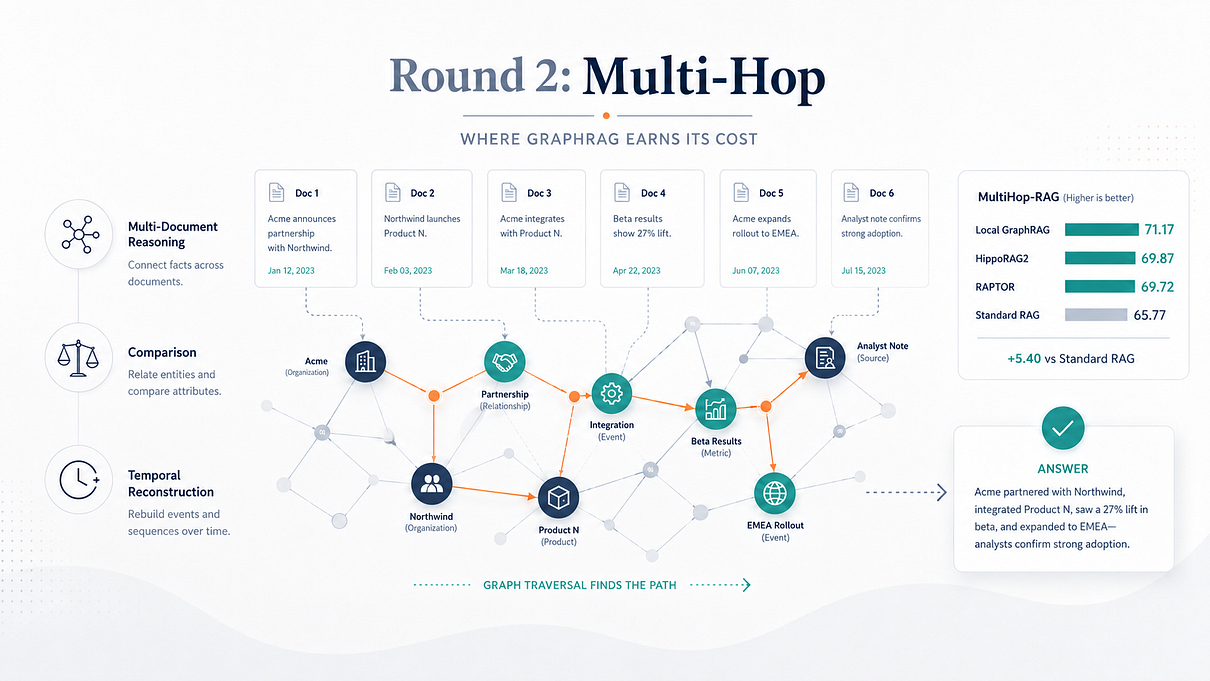
The result changes when the question is deliberately constructed to require evidence from several documents.
On MultiHop-RAG, the same study found:
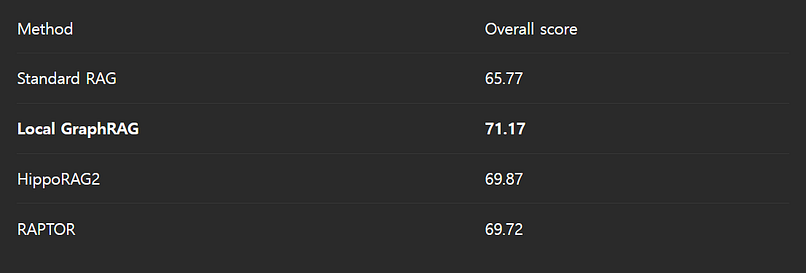
This is a meaningful gain. Graph structure helped when the model had to connect entities, compare facts, reconstruct temporal order, or combine evidence unlikely to appear together in one similarity search.

Figure 1. GraphRAG’s advantage depends on the task.
A separate 2026 study, Do We Still Need GraphRAG?, asked whether an agent capable of decomposing a question and searching repeatedly could recover the benefits of explicit graph structure.
Agentic search strengthened dense RAG and narrowed parts of the gap. GraphRAG retained an advantage on complex multi-hop problems and showed more stable retrieval behaviour when its offline construction cost could be amortized. 4
Its detailed results make the task boundary difficult to ignore:
Average improvement on general QA:
+0.47 points
Average improvement on selected multi-hop QA benchmarks:
+27.23 points
This does not support a general replacement story. It shows that explicit structure becomes more valuable as the answer depends on relationships that ordinary retrieval would otherwise have to rediscover through repeated searches.
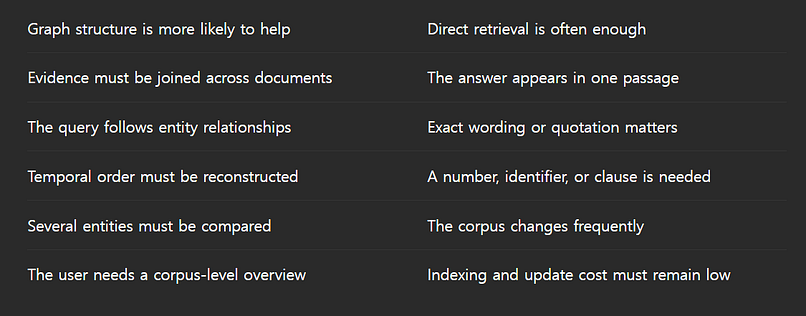
The useful question is how much relational work exists in the actual workload, and whether that work repays the graph’s construction, maintenance, and information loss.
A company whose users mostly ask for quotations, figures, and current policy clauses may spend heavily to build a system optimized for questions it rarely receives.
Round 3: The number that rarely appears in a demo
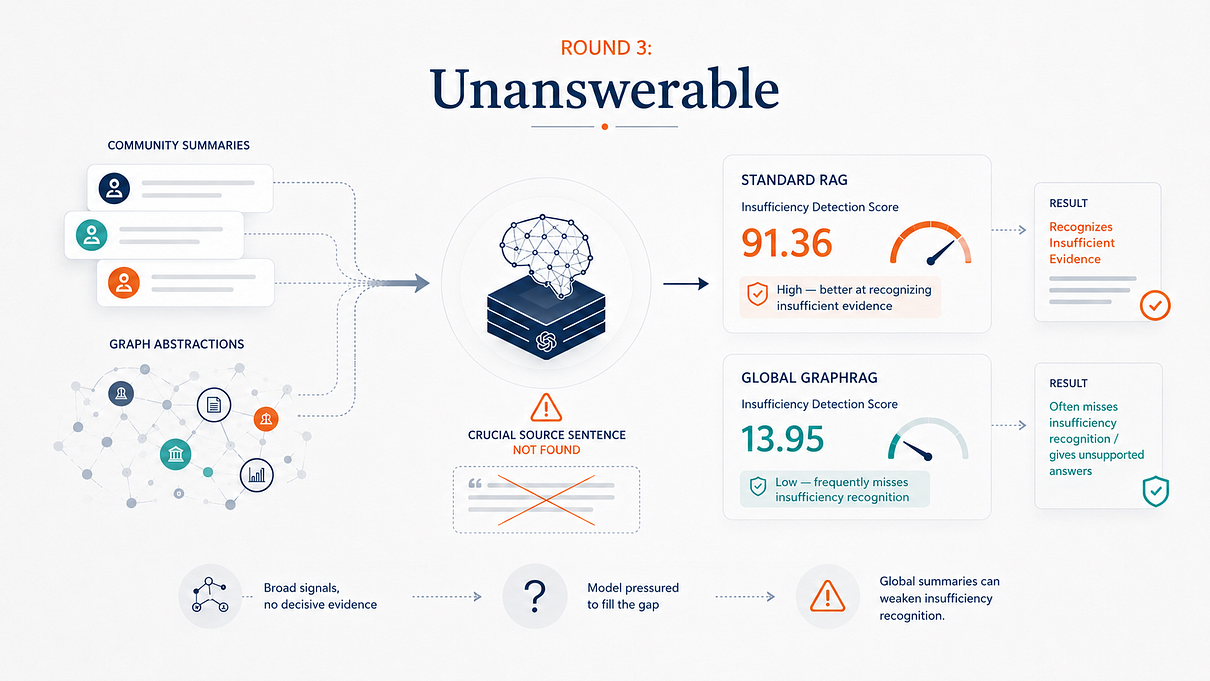
The most consequential result concerns questions that the source corpus cannot answer.
Han et al. included “Null” questions designed to test whether a system recognized that the available evidence was insufficient.

The score collapsed from 91.36 to 13.95.
This should not be translated casually into “Global GraphRAG hallucinated confidently 86 percent of the time.” The benchmark score does not establish that every failure was a confident fabricated answer.
It establishes something serious enough without embellishment: the global system repeatedly lost the ability to recognize that its evidence did not support an answer.
The mechanism is understandable. Microsoft’s original GraphRAG design was built in part for global sensemaking over large corpora. It extracts entities, detects communities, produces community summaries, and uses those abstractions to answer broad questions about themes and relationships. 2
Those summaries can cover far more of a corpus than a handful of retrieved chunks. They can also remove the precise detail needed to determine that a particular question is unanswerable. The system receives enough thematic material to sound informed, while the sentence, date, qualification, or missing connection that should force abstention is no longer visible.
Two different properties are being confused:
- Comprehensiveness measures how much relevant territory an answer covers.
- Evidence sufficiency asks whether the available material actually supports the claim being made.
A system can improve the first while damaging the second.
That trade-off becomes more serious once the model is an agent. A broad but unsupported conversational answer is undesirable. A broad but unsupported plan that leads to a code modification, database update, email, payment, or deployment belongs to a different risk class, and retrieval quality alone does not tell us whether the agent will cross that boundary.
Your graph may be missing a third of the answers before you query it
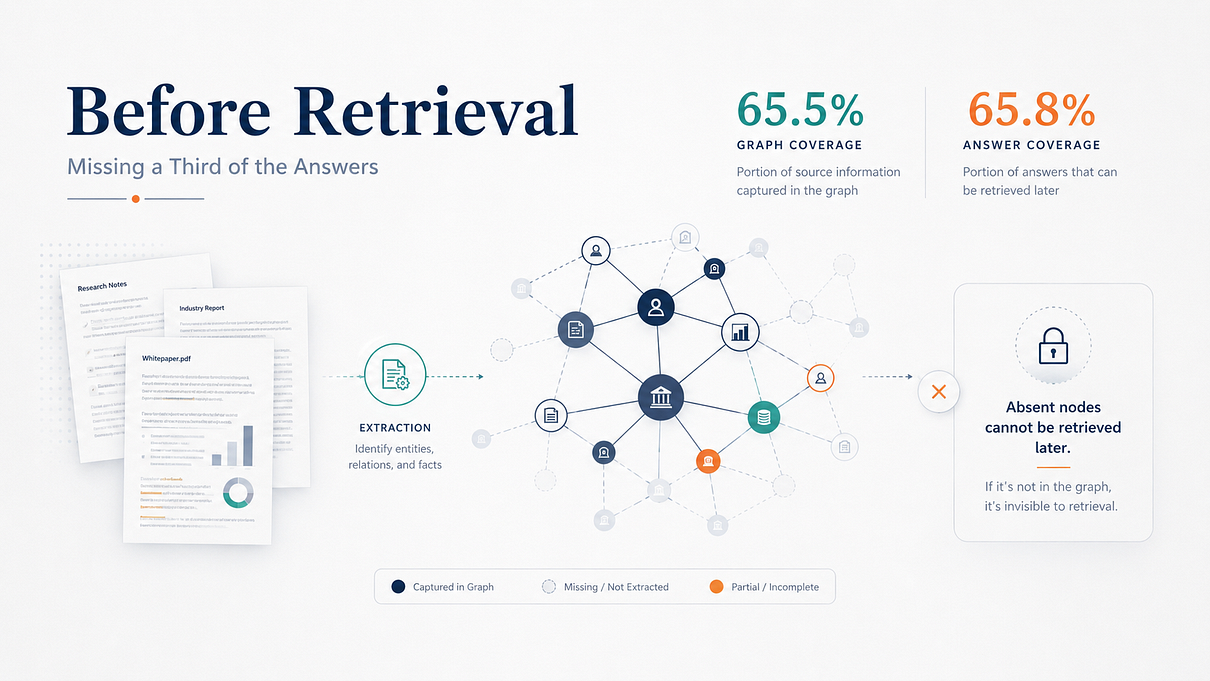
Graph construction is often presented as preprocessing, as though the source corpus were simply being rearranged into a more useful shape.
It is closer to prediction.
Han et al. checked whether the required answer entity existed anywhere in the automatically generated graph. Coverage reached:
- 65.8% on HotpotQA
- 65.5% on Natural Questions
Roughly one in three required answer entities never entered the graph.
No retrieval algorithm, graph traversal policy, reranker, or agentic search loop can walk to a node that was never created. The retriever may still find neighbouring concepts and produce an answer that appears structurally grounded, but its searchable world was already narrowed during extraction.
Failures enter through ordinary, unglamorous mechanisms. An entity is missed. Two entities are merged because their names look similar. A relationship loses its date range. An exception disappears. The direction of an edge is reversed.
A hypothetical statement is stored as an assertion. An inferred connection survives without enough source evidence to justify it. None of these failures needs to crash the pipeline; most leave behind a graph that still renders cleanly and accepts queries.
The model used to build the graph also changed final performance:
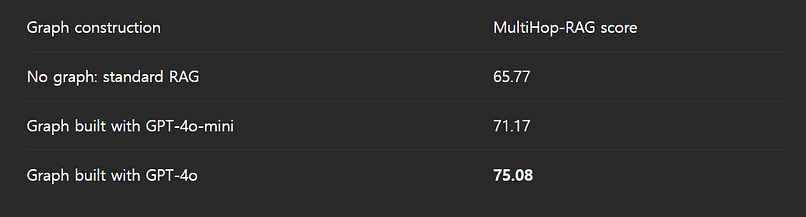
The retrieval design remained comparable, but replacing the extraction model produced almost a four-point difference between the two graph configurations.
The uncertainty did not disappear when the system moved to a graph. Part of it moved upstream, into a stage that organizations may run once, trust implicitly, and reuse across thousands of later queries.
Microsoft’s own GraphRAG repository and documentation warn that indexing can be expensive, recommend starting small, explain that default prompts may not produce optimal results, and describe the code as a demonstration rather than an officially supported Microsoft offering. 7
That is a more sober description than most third-party launch posts.
The cost table nobody leads with
In the controlled MultiHop-RAG comparison, construction and retrieval time varied sharply by architecture:
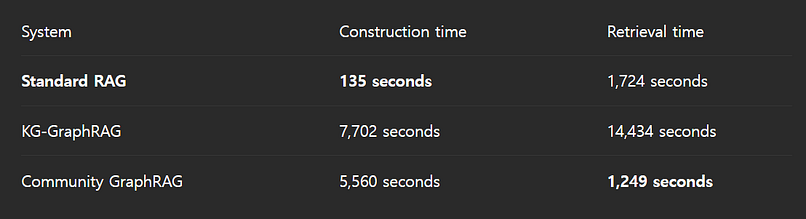
“GraphRAG is slow” and “GraphRAG is fast” are both incomplete claims.
Community GraphRAG paid a heavy upfront construction cost and then retrieved faster than standard RAG across the measured run. That may be a reasonable trade for a stable corpus queried repeatedly.
KG-GraphRAG performed graph expansion during retrieval and accumulated more than eight times the total retrieval time of standard RAG in that experiment.
The operational result depends on where the cost is paid.
A static archive may absorb expensive preprocessing once. A changing repository, policy library, product catalogue, or incident log may trigger continuous graph repair.
Entities must be reconciled, edges updated, communities recalculated, summaries regenerated, and derived indexes refreshed. When incremental updating and invalidation are unreliable, the system either rebuilds too much or tolerates stale structure.
Neither option appears in the first screenshot.
The maintenance burden also changes what should count as success. A five-point benchmark gain may be attractive when the corpus is stable for a year. The same gain can disappear operationally if the graph is rebuilt every night, arrives several hours behind the source, or requires a stronger extraction model whose indexing bill overwhelms the savings produced during retrieval.
What happens when you combine RAG and GraphRAG?
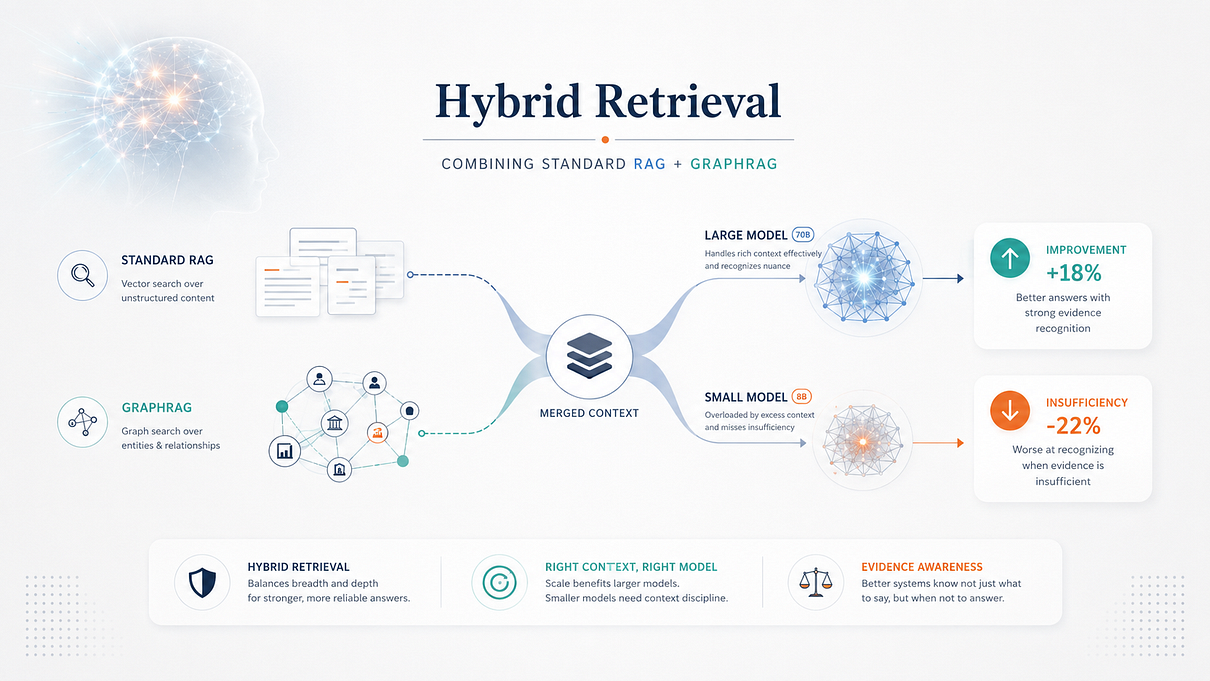
The obvious response to task sensitivity is hybrid retrieval.
Simple questions can go to standard RAG. Relationship-heavy questions can go to GraphRAG. A third option runs both and merges the evidence.
Han et al. called these approaches Selection and Integration.
With Llama 3.1–70B on MultiHop-RAG, the results were encouraging:
- Selection improved on the strongest single baseline by 1.1%.
- Integration improved it by 6.4%.
- Integration reached an overall score of 77.62.
Then the researchers repeated the experiment with Llama 3.1–8B.
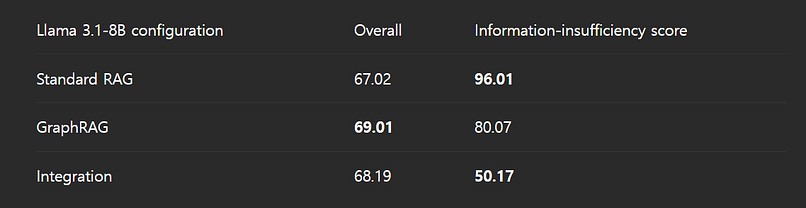
The smaller model received more retrieved material and became dramatically worse at recognizing when that material was insufficient. Its overall score did not improve over GraphRAG alone, while the insufficiency score fell from 96.01 under standard RAG to 50.17 under integration.
More retrieval does not simply add information. It also adds repeated fragments, graph abstractions, partial contradictions, and linguistic pressure to produce a synthesis.
Larger models may manage that mixture better. Smaller ones may interpret the volume of related context as evidence that an answer must exist, especially when several retrieved objects describe the same neighbourhood without supplying the missing fact.
A later paper, Is GraphRAG Needed? From Basic RAG to Graph-/Agentic Solutions with Context Optimization, compared nine standardized RAG scenarios and reported token reductions of 19–53 percent through improved context management. Its results also suggest that retrieval-side gains do not always translate into proportional improvements in final generation quality.
I use retrieval–generation gap here as analytical shorthand for that mismatch; it is not presented as the paper’s own formal term. 5
This is the finding to keep in view when a product leads with recall, graph coverage, or token savings:
Better retrieval coverage does not guarantee better epistemic behaviour.
The generator still has to distinguish evidence from noise, recognize contradiction, preserve qualifications, and stop when the answer remains unsupported. A hybrid retrieval system without an explicit evidence-sufficiency test may produce a larger context and a weaker decision.
The field is already revising the original story
One of the most interesting recent papers does not present the graph as a replacement for the source.
PAGE-RAG: Evidence-Grounded Adaptive Graph Retrieval for Long-Document Question Answering begins from the premise that automatically constructed graphs are incomplete projections of source documents.
It treats the graph as a semantic skeleton used to organize and navigate the source, routes questions according to their evidence needs, and introduces a knowledge-boundary mechanism intended to abstain when accessible evidence remains insufficient. 6
That design reflects a correction already becoming visible across the research.
The first wave often implied:
Documents → Graph → Knowledge
The more defensible model is:
Documents → Incomplete graph projection
                 ↓
          Navigate back to evidence
The graph can reduce a search space, expose a relationship, organize candidates, or identify material that deserves closer inspection. It should not become an independent authority merely because an LLM converted prose into structured storage.
This changes the design obligation. A node must lead back to the passage that supports it. An inferred edge should remain distinguishable from an extracted one. A community summary should behave like a navigation aid rather than a canonical replacement for the documents it compressed. If the source and graph disagree, the source must remain available and the discrepancy must be visible.
Structure does not upgrade an inference into a fact.
Why code graphs deserve a separate category
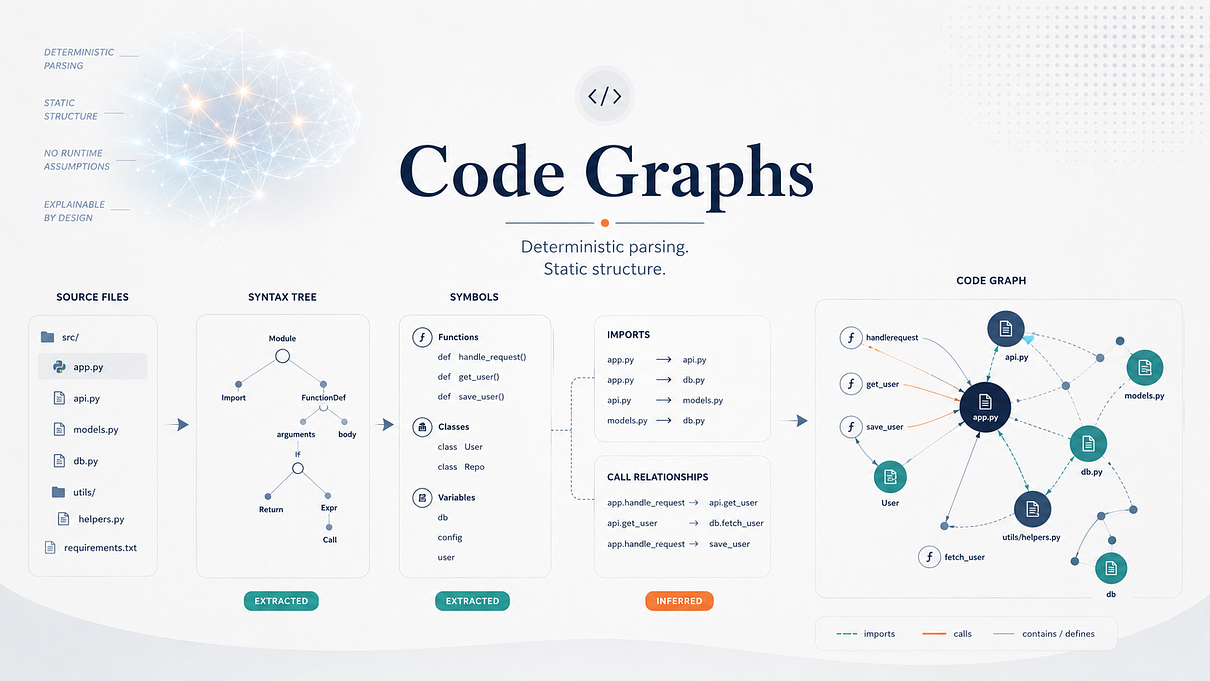
Some of the fastest-growing “GraphRAG” repositories are primarily code-intelligence systems, and their reliability profile differs from graphs extracted from prose.
Source code has formal grammar. A parser can determine that one module imports another, a class inherits from a parent, or a function references a symbol without asking a language model to interpret a paragraph.
- Graphify, which had accumulated roughly 94,000 GitHub stars at the time of this review, parses supported code locally with Tree-sitter. Its repository distinguishes
EXTRACTED relationships explicit in source structure from INFERRED relationships produced through later resolution. Documents, PDFs, images, and media still require semantic model processing, so the deterministic advantage applies most strongly to parseable source code rather than every input the project accepts. 8
- GitNexus similarly parses functions, classes, methods, and interfaces through Tree-sitter, resolves calls and imports across files, clusters related symbols, and exposes execution flows and impact-analysis tools to agents through MCP. 9
This is useful engineering. Coding agents often burn context reconstructing relationships already available through static analysis. Returning the callers, dependent modules, and likely change surface of a symbol can be far more efficient than opening dozens of files.
The underlying techniques are old. Abstract syntax trees, call graphs, symbol indexes, dependency analysis, and code-query systems predate LLM agents by decades. The recent innovation lies in packaging those structures as context interfaces for autonomous tools.
The remaining evidence gap concerns the final work. Does the agent modify the correct files more often? Does it introduce fewer regressions? Does lower token usage preserve the configuration, runtime dispatch, generated code, framework convention, or exception that would have prevented a mistake?
Most public claims still come from developer-run benchmarks and product demonstrations. I found no independent controlled comparison showing that these tools improve end-to-end coding success across repositories, languages, and agent models when compared under the same conditions with grep, language-server navigation, static analysis, vector retrieval, and iterative agent search.
A tool may use fewer tokens because it located the correct dependency quickly. It may also use fewer tokens because the graph omitted the runtime path that mattered. Those outcomes look identical in a token dashboard and entirely different in production.
Why 90,000 stars do not settle the question
GitHub popularity explains part of the GraphRAG mood, but it cannot resolve technical quality.
The expanded version of the Carnegie Mellon-led StarScout study identified about six million suspected fake stars across 26,254 repositories before post-processing. Socket Inc participated through one co-author and later collaboration, but the study was not simply “Socket research.” 12
That finding does not show that Graphify, GitNexus, or any other GraphRAG repository purchased stars.
It shows that star counts are vulnerable to coordinated inflation and should not be treated as standalone evidence of retrieval quality, graph completeness, maintenance reliability, or production value.
Even authentic stars measure attention, timing, accessibility, and distribution. They do not tell us how many answer entities were lost during indexing, whether inferred edges are supported by source text, how the system behaves after a schema change, or whether an agent finishes more tasks correctly.
Stars tell us what developers are looking at.They do not tell us whether the graph contains the answer.
The second hype wave: an AI that writes its own memory
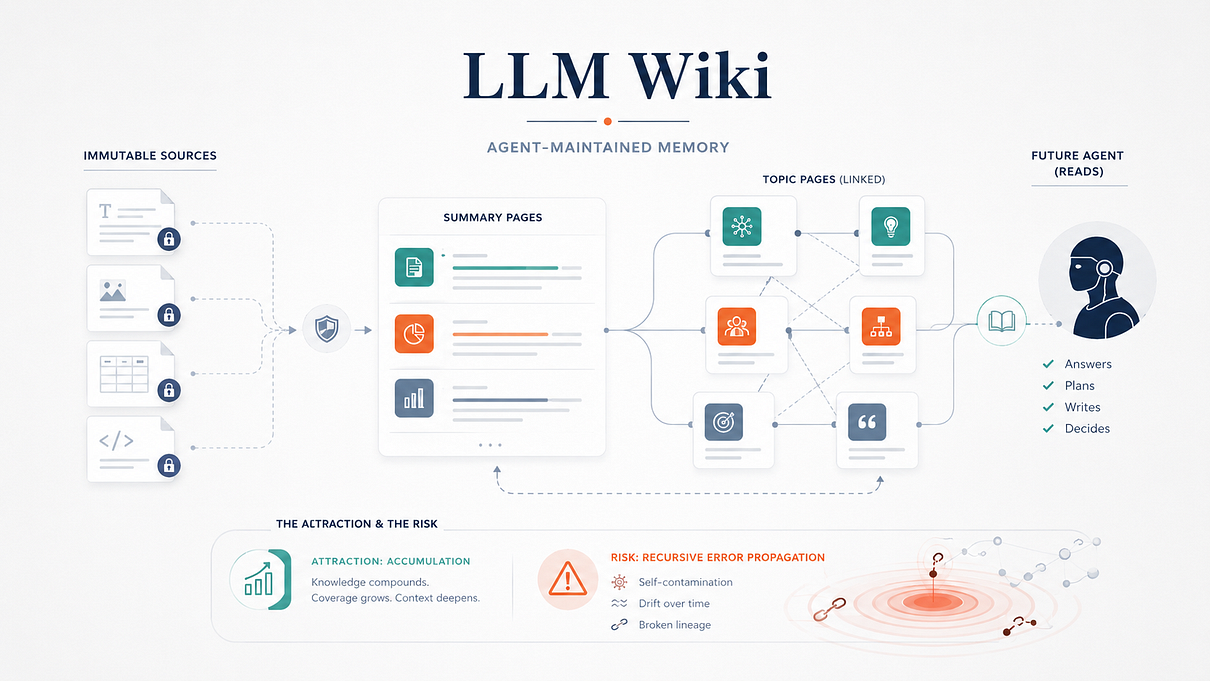
GraphRAG still begins with source material and creates a representation used for retrieval. The newer LLM-wiki pattern goes further: the agent writes a persistent knowledge layer that its future self will read.
Andrej Karpathy’s LLM Wiki pattern describes a system with immutable raw sources, an LLM-maintained directory of summaries and topic pages, and a schema telling the agent how to ingest, query, cross-reference, and maintain the knowledge base. The attraction is accumulation. Instead of rediscovering the relationship among five documents every time, the model can preserve a synthesis and build on it later. 10
This can be genuinely valuable. It also creates a recursive failure mode that ordinary RAG does not have.
The retrieved material now includes the model’s own earlier interpretations.
Six problems follow:
- Self-contamination: one incorrect summary is copied into later pages and begins to resemble independent corroboration.
- Append-only drift: new evidence is added while obsolete conclusions survive elsewhere.
- Missing canonical authority: several pages disagree and nothing identifies which one governs the current state.
- Summary-lineage collapse: a claim passes through enough rewrites that its original source becomes difficult to recover.
- Connectivity–truth confusion: a frequently linked page appears credible because it is central, although centrality measures connection rather than validity.
- Propagation failure: the source changes while dependent summaries, recommendations, and plans remain untouched.
These failures compound. One inaccurate summary enters three topic pages. Those pages are later compressed into a higher-level overview. The original error now appears in several places, linked from several directions, and may be retrieved as though multiple notes independently support it. The workspace looks increasingly organized while the provenance underneath it becomes harder to reconstruct.
This architecture exchanges repeated raw retrieval for a maintenance problem. The trade may be worthwhile, but only when the system preserves immutable sources, records derivation, identifies canonical pages, and can invalidate every downstream artifact affected by a correction.
Otherwise the agent can quote its own error back to itself with several links attached.
The graph itself becomes a sensitive asset
Turning documents into a connected structure creates another problem: the relationships may be more sensitive than the individual records.
The 2026 GraphSteal study treated GraphRAG systems as structural oracles. Through adaptive black-box interaction, the researchers reported reconstructing more than 90 percent of the original knowledge graph in representative generic and healthcare scenarios, exposing entities, relationships, topology, and structural dependencies. Existing guardrails offered limited protection in their experiments. 11
This does not establish that every deployed GraphRAG system is readily extractable. It establishes a new attack surface that document-centric access control may not cover.
A collection of files contains sensitive facts. A graph may additionally reveal which people bridge teams, which records form hidden clusters, which entities are unusually central, and which dependency path would cause the most damage if exposed. Individual documents may be innocuous when viewed separately, while the graph assembled from them reveals a relationship that no user was meant to observe in one place.
Organizations considering GraphRAG therefore need to review the derived graph, query interface, traversal behaviour, rate limits, logs, and inference leakage as assets in their own right. Permission inheritance from source documents may not be enough when the graph produces new aggregates, paths, and structural inferences.
The edges may be more sensitive than the nodes.
A knowledge map still does not control an agent
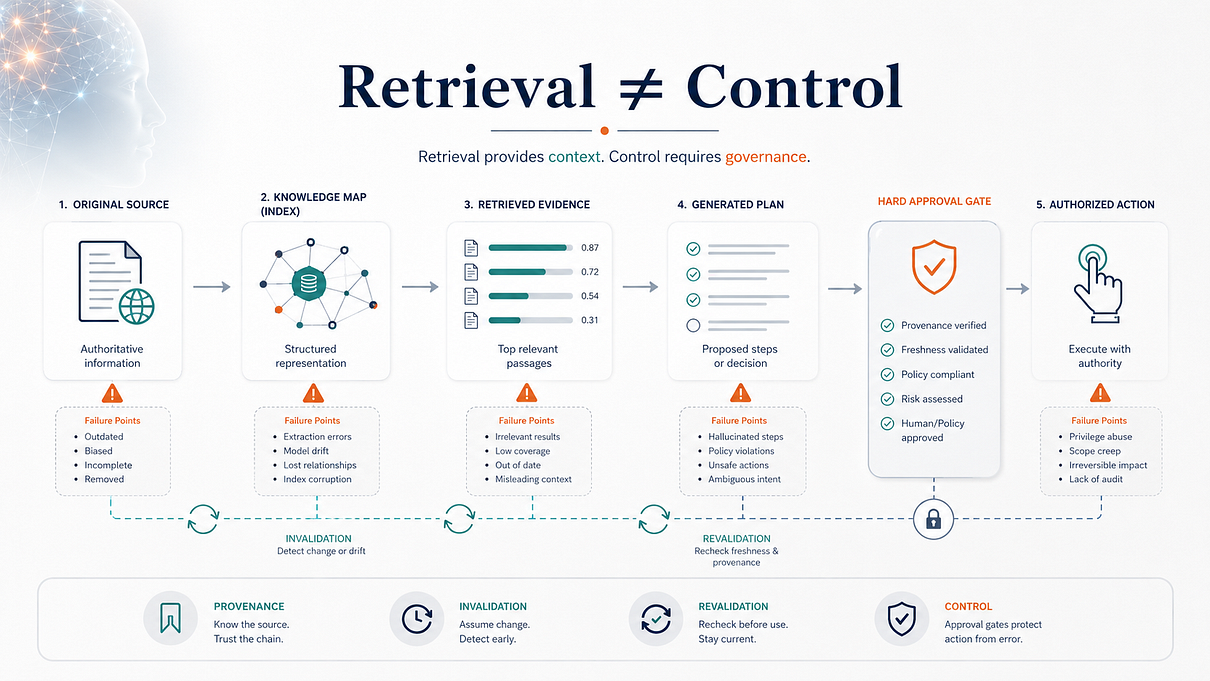
Underneath all the benchmark results sits a more basic limitation.
A knowledge map tells an agent what it can inspect. It does not determine what the agent will believe, how it will resolve conflicting evidence, or whether it is allowed to act.
A graph edge can say that production deletion requires human approval. The sentence may be retrieved correctly and placed directly in the model’s context. None of that prevents the model from ignoring the condition or calling an API that performs the deletion without checking for an approval token.
The system contains several boundaries:
Original source
      ↓
Graph, index, or wiki
      ↓
Retrieved evidence
      ↓
Generated answer or plan
      ↓
Authorized action
Information can be lost or transformed at every arrow.
The source may be incompletely represented. Retrieval may select the wrong version. Generation may overstate what the evidence supports. The runtime may accept an action that policy should have blocked.
GraphRAG primarily improves parts of the middle. It does not automatically provide:
- Provenance: every node, edge, summary, and recommendation traceable to its source, source version, and construction method.
- Invalidation: a way to identify every derivative that becomes suspect when the source changes.
- Revalidation: recomputation, quarantine, downgrade, or explicit historical labeling before stale material returns to active use.
- Hard enforcement: server-side permission and approval checks that do not depend on whether the model read or interpreted a policy correctly.
These controls are difficult precisely because derived knowledge propagates. A policy paragraph creates an edge. The edge enters a community. The community summary influences a wiki page. The wiki page supplies an agent plan. The original policy changes, while the plan remains in memory. Updating the source file solves only the first step in that chain.
Without provenance and dependency tracking, the system cannot reliably determine what else became stale.
Without enforcement, even a correct answer remains advice.
What should you deploy?
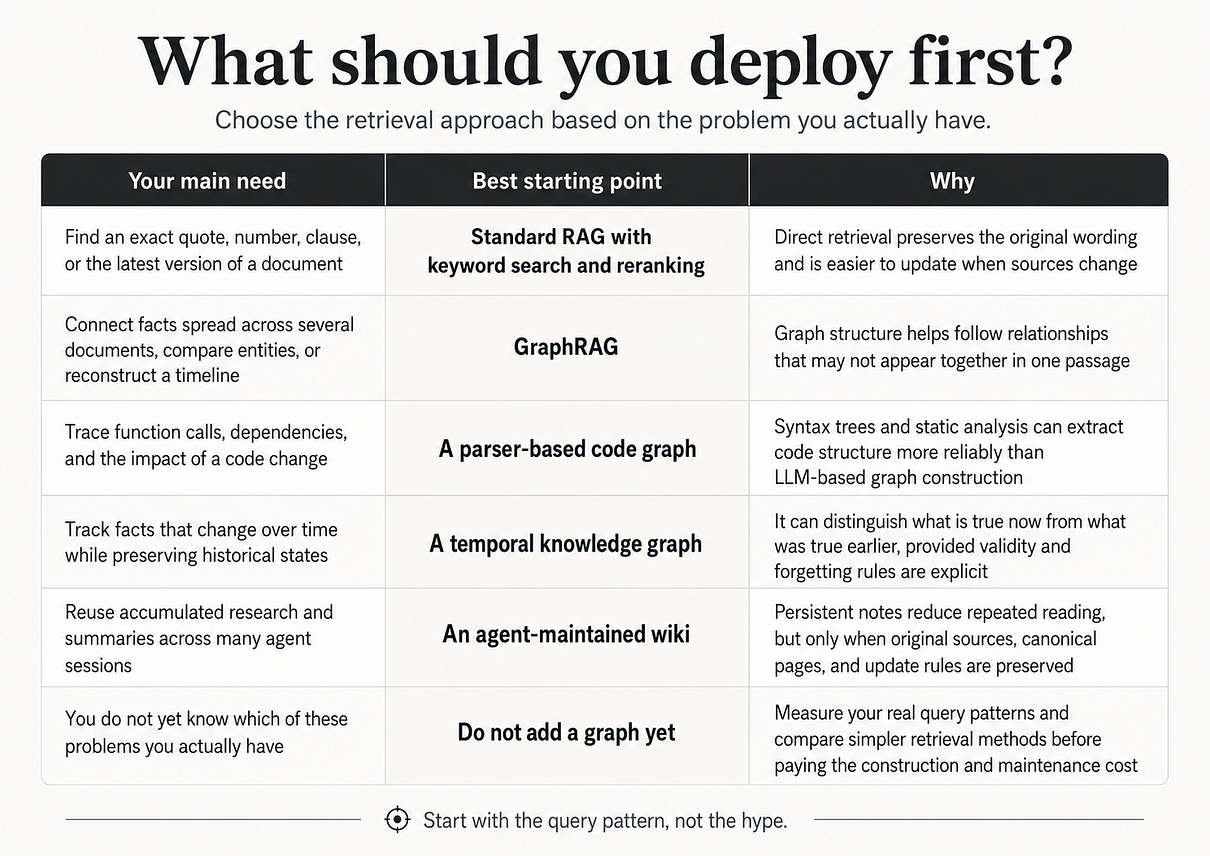
The answer depends on the workload, which is less satisfying than buying the newest architecture and much cheaper than discovering the workload afterward.
Before deploying any of them, require answers to six questions:
- What percentage of real queries genuinely require relationship traversal?
- How complete is the graph against the original sources?
- What happens when the graph and source disagree?
- How are dependent edges, summaries, and plans invalidated after updates?
- Does improved retrieval increase final task success, or only retrieval metrics and token efficiency?
- What happens when the corpus cannot answer the question?
The final question is the one vendors are least likely to volunteer.
It is also the one most likely to tell you what you bought.
A credible pilot should include questions whose answers are absent, documents that conflict, facts that have expired, and source updates that invalidate existing graph structures.
It should compare GraphRAG with keyword search, dense RAG with reranking, and an agent allowed to search iteratively. The evaluation should measure final task success and unsupported claims, rather than stopping at retrieval recall or token reduction.
The evidence is stronger than hype, and weaker than certainty
GraphRAG is no longer supported only by demos. There are systematic comparisons, accepted conference work, agentic-search benchmarks, efficiency analyses, and an emerging second generation of systems that explicitly address incomplete graph projections and evidence boundaries.
Xiang et al.’s When to Use Graphs in RAG, for example, was accepted as an ICLR 2026 Poster and reports results often unfavourable to broad GraphRAG claims. 3
That is meaningful evidence.
It is not yet mature consensus. Among the studies reviewed here, I found no GraphRAG performance claim that had reached full independent reproduction by a separate team under comparable conditions across production workloads. Much of the research remains developer-led, benchmark-specific, or dependent on the same authors who designed the evaluated framework.
That is normal for a young field. It also means that “peer reviewed,” “open source,” “popular,” and “independently reproduced” should not be treated as interchangeable labels.
The appropriate response is narrower confidence.
The verdict
GraphRAG is not vaporware. It is also not a new artificial brain.
It can earn its cost when questions depend on relationships scattered across documents, temporal order, entity comparison, or corpus-level structure. It may lose to a much simpler retriever when the user needs one precise fact. Its graph can omit required information before retrieval begins.
Its summaries can damage abstention. Combining it with ordinary RAG can give a smaller model more evidence and worse judgment. Its maintenance introduces cost and staleness, while its structure creates a new security asset that must be protected.
Code graphs are often more deterministic because code has formal syntax, although their end-to-end value for agent performance remains less independently tested than their popularity suggests. LLM-maintained wikis may compound useful knowledge across sessions while also allowing the model’s earlier mistakes to become future evidence.
The useful production architecture is unlikely to be GraphRAG alone. It will combine keyword search, vector retrieval, reranking, graph traversal, direct source access, and iterative agent search, selecting among them according to the question and verifying the evidence before action.
GraphRAG has earned a place in that stack.
The larger claim — that structuring information gives an agent understanding, judgment, and control over its own behaviour — is not supported by the studies reviewed here.
Retrieval infrastructure with unresolved lifecycle governance does not fit comfortably into a launch post.
So it gets called a brain instead.
💡Further technical reading
This article focuses on the benchmark evidence and practical deployment boundary. For a more detailed technical examination of GraphRAG, persistent agent memory, provenance, invalidation, revalidation, and the gap between available knowledge and controlled action, see my full report:
GraphRAG, Persistent Agent Memory, and the Distance Between Available Knowledge and Controlled Action
References
1 Han, H. et al. RAG vs. GraphRAG: A Systematic Evaluation and Key Insights. arXiv:2502.11371, revised March 2026.
2 Edge, D. et al. From Local to Global: A Graph RAG Approach to Query-Focused Summarization. arXiv:2404.16130.
3 Xiang, Z. et al. When to Use Graphs in RAG: A Comprehensive Analysis for Graph Retrieval-Augmented Generation. ICLR 2026 Poster; arXiv:2506.05690.
4 *Do We Still Need GraphRAG? Benchmarking RAG and GraphRAG for Agentic Search Systems*. arXiv:2604.09666.
5 Chen, L. et al. Is GraphRAG Needed? From Basic RAG to Graph-/Agentic Solutions with Context Optimization. arXiv:2606.25656.
6 Chen, X. et al. PAGE-RAG: Evidence-Grounded Adaptive Graph Retrieval for Long-Document Question Answering. arXiv:2607.19301.
7 Microsoft. GraphRAG Repository and Documentation. GitHub.
8 Graphify Labs. *Graphify: Local Code and Document Knowledge Graphs for AI Coding Assistants*. GitHub.
9 Patwari, A. GitNexus: The Zero-Server Code Intelligence Engine. GitHub.
10 Karpathy, A. LLM Wiki: A Pattern for Building Personal Knowledge Bases Using LLMs. GitHub Gist, April 2026.
11 Gu, J. et al. GraphSteal: Structural Knowledge Stealing from Graph RAG via Traversal Reconstruction. arXiv:2605.28645.
12 He, H., Yang, H., Burckhardt, P., Kapravelos, A., Vasilescu, B., and Kästner, C. Six Million (Suspected) Fake Stars in GitHub: A Growing Spiral of Popularity Contests, Spams, and Malware. ICSE 2026; arXiv:2412.13459v2.