I've been working on ForgeZero, a modern build system designed to replace traditional make with a faster, zero-config approach.
With the release of ForgeZero 4.1, I benchmarked it against GNU Make on multiple machines to answer one simple question:
Can a modern build system still significantly outperform make in 2025?
Turns out: yes.
Benchmark setup
GNU Make
make -j4
ForgeZero
./fzt -dir . -out fz_out
Benchmarks were run using hyperfine:
hyperfine './fzt -dir . -out fz_out' 'make -j4'
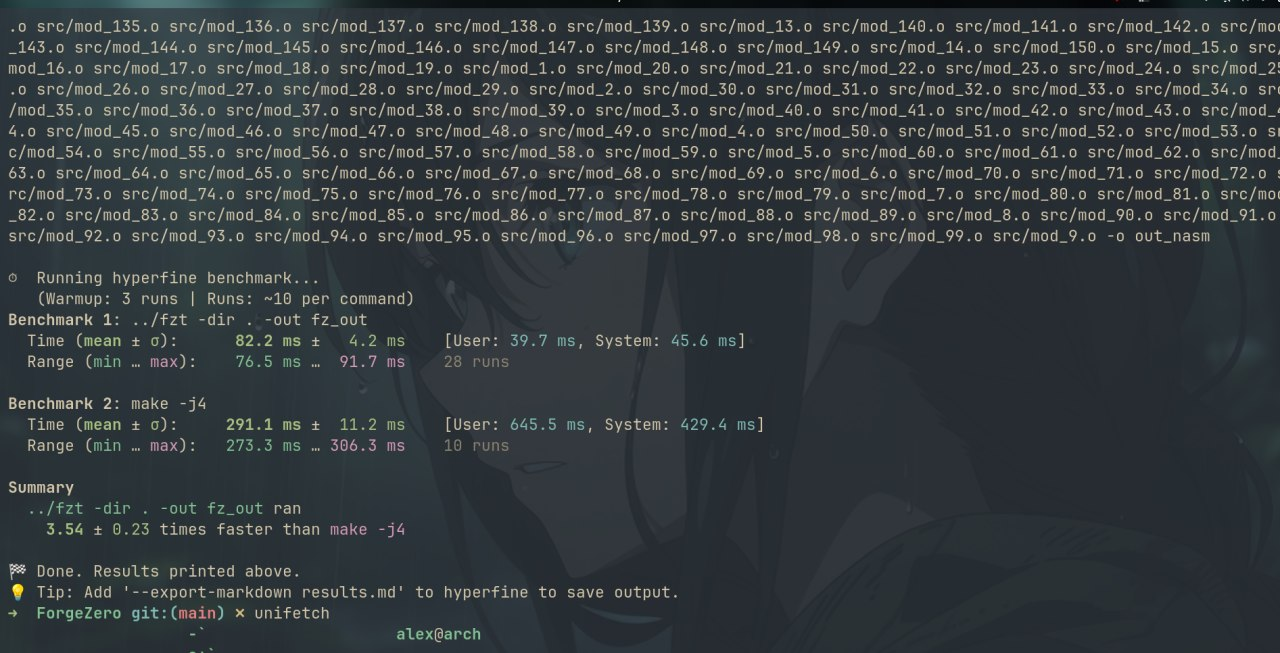
Results
| Platform | ForgeZero | GNU Make | Speedup |
|---|
| Ryzen 9 7950X3D (KVM, 1 vCPU) | ~80–84 ms | ~350–364 ms | 4.1x–4.5x |
| Intel Core i5-10310U | 82.2 ms | 291.1 ms | 3.54x |
| AMD FX-8370E (AM3+) | 111.0 ms | 238.5 ms | 2.15x |
Across very different CPUs and environments, ForgeZero consistently outperformed GNU Make.
Example benchmark output
Ryzen 9 7950X3D
Benchmark 1: ./fzt -dir . -out fz_out
Time (mean ± σ): 84.5 ms ± 7.6 ms

Benchmark 2: make -j4
Time (mean ± σ): 350.4 ms ± 16.4 ms

Summary:
4.14x faster than make -j4
Intel i5-10310U
Benchmark 1: ./fzt -dir . -out fz_out
Time (mean ± σ): 82.2 ms ± 4.2 ms

Benchmark 2: make -j4
Time (mean ± σ): 291.1 ms ± 11.2 ms

Summary:
3.54x faster than make -j4
AMD FX-8370E
Benchmark 1: ./fzt -dir . -out fz_out
Time (mean ± σ): 111.0 ms ± 17.9 ms

Benchmark 2: make -j4
Time (mean ± σ): 238.5 ms ± 24.4 ms

Summary:
2.15x faster than make -j4
Why is ForgeZero faster?
1. No shell overhead
GNU Make spends a surprising amount of time spawning shell processes (fork/exec) for build commands.
ForgeZero executes the build pipeline directly.
No unnecessary shell orchestration.
2. Lightweight dependency graph
make still carries decades of legacy behavior:
- Makefile parsing
- implicit rules
- pattern matching
- recursive variable expansion
ForgeZero builds a direct dependency graph and updates only what actually changed.
3. Better task scheduling
Instead of the classic make -j job model, ForgeZero uses a lightweight internal scheduler with lower synchronization overhead.
4. Zero-config design
No giant Makefiles.
No boilerplate.
ForgeZero analyzes project structure automatically and starts building immediately.
Why this matters
make was introduced in 1976.
Almost 50 years later, many developers still accept build-system latency as unavoidable.
These benchmarks suggest otherwise.
If your team runs hundreds of builds per day—locally and in CI—even saving 100–250 ms per build adds up quickly.
ForgeZero 4.1 is available
GitHub:
https://github.com/forgezero-cli/forgezero
I'd love feedback from developers still using make, ninja, or other build systems.