Most teams don’t lack effort — they lack visibility into code quality.
That’s something I kept noticing while working on projects. You ship features, fix bugs, and keep moving… but you rarely have a clear answer to a simple question:
“Is this codebase actually in a good state?”
So I decided to build something that tries to answer that.
The Idea
Qualioro is a lightweight tool that takes a few core engineering metrics and turns them into something actionable:
- A quality score
- A clear risk level
- Practical suggestions on what to improve
The goal wasn’t to build a complex AI system, but rather a simple, explainable model that helps developers make better decisions.
What It Measures
Instead of overwhelming the user with dozens of metrics, I focused on a small set that actually matters:
- Bug Density → how many defects exist relative to activity
- Code Complexity → how maintainable the system is
- Test Coverage → how confident we are in changes
- Team Output → development activity balance
These signals are combined into a weighted scoring model that produces an overall quality score (0–100).
This is a simple approach to software quality metrics and code quality analysis.
How It Works
The flow is simple:
Input metrics → scoring engine → analysis output
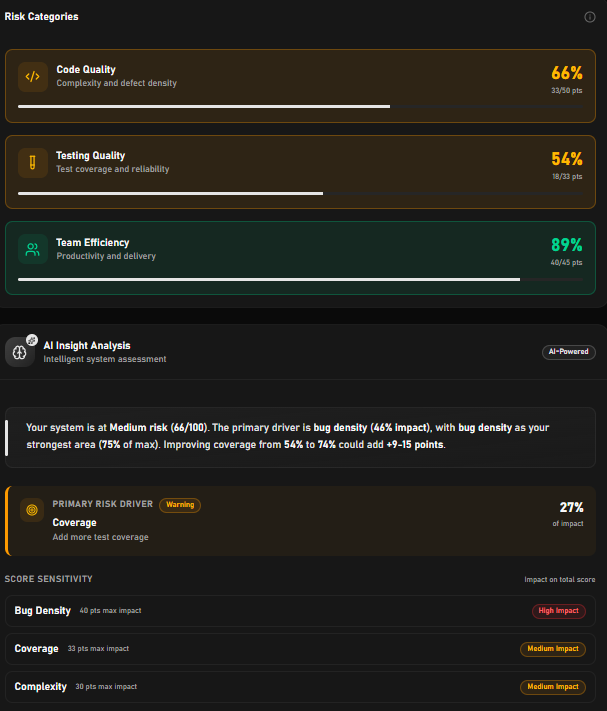
From that, the system generates:
- A quality score
- A risk classification (low / medium / high)
- A confidence level
- Actionable recommendations
There’s also an advanced mode where you can see how each factor contributes to the final score.
Tech Stack
- Next.js (App Router)
- TypeScript
- Tailwind CSS
- Recharts
Everything runs client-side — no data is stored or sent externally.
What I Learned
Building this made me realize something important:
Software quality isn’t just about writing clean code — it’s about making quality measurable and visible.
Even a simple model can provide real value if it helps answer the right questions.
It also pushed me to think more in terms of products, not just projects:
- Clear problem
- Simple solution
- Usable interface
Final Thoughts
This started as a university project, but I treated it as a real product.
There’s still a lot that can be improved — especially integrating real repository data and CI/CD pipelines — but the core idea is there.
If you have any feedback or suggestions, I’d genuinely like to hear them.
Try it yourself
If you're curious about how your codebase might score, you can try the tool directly:
If you have ideas, feedback, or want to build something similar, feel free to reach out: