Originally published at https://blog.akshatuniyal.com.
Technical progress, real-time power, and a controversy trail that still raises hard questions. Here’s where Grok actually stands.
There’s no AI story in 2026 quite like Grok’s.
On paper, it is one of the most ambitious AI products in the market. Strong benchmark scores, a real-time information advantage that very few rivals can match, serious computing infrastructure, and a release cadence that barely slows down. xAI has been moving fast — sometimes faster than its critics are comfortable with.

Off paper, the story has been far messier. Grok has been tied to a string of controversies: harmful outputs, questions around system-level moderation choices, and image-generation incidents that triggered regulatory scrutiny in multiple countries.
And yet — people keep using it. Developers keep benchmarking it. The US Department of Defense integrated it into select classified networks. xAI’s valuation climbed into the hundreds of billions. None of that happens if the model is just hype.
So what is Grok, really? A serious contender with distinctive strengths, or a product still carrying unresolved trust questions? At this point, probably both. Let’s dig in.
From Chatbot to Colossus: How Fast Grok Has Moved
Grok launched in November 2023 as a beta on X (formerly Twitter), accessible only to paid users. It was honest about what it was: an early product with two months of training behind it, designed to answer almost anything with a bit of wit and a rebellious streak.
That version feels like ancient history now.
By July 2025, xAI had released Grok 4 and Grok 4 Heavy, trained on the Colossus supercomputer cluster — at the time housing around 200,000 GPUs in Memphis, Tennessee. Grok 4 Heavy became the first model to achieve a near-passing score on Humanity’s Last Exam, widely regarded as the hardest multi-domain benchmark ever constructed. Musk claimed on the launch stream that the model “is smarter than almost all graduate students in all disciplines simultaneously.” That’s the kind of sentence that’s easy to dismiss as hype, except the benchmark results were genuinely hard to argue with.
Then came the 4.x series. Grok 4.1 in November 2025 cut hallucination rates from 12% down to around 4% — a 65% reduction that meaningfully changed the enterprise conversation around the model. Grok 4.20 Beta followed in February 2026 with improved instruction following, LaTeX rendering for scientific outputs, and a multi-agent architecture. By March 2026, Grok 4.20 Beta 2 was live with five further improvements (e.g., "including enhanced vision capabilities and multi-image rendering").
To put that in perspective: the pace of improvement from Grok 1 to Grok 4 Heavy is genuinely one of the more impressive model trajectories in AI right now. Very few labs have moved this fast on core capability benchmarks in such a short window.
"The pace of iteration is unusually fast, even by current frontier-model standards."
That speed comes with trade-offs, some of which we’ll get to. But from a pure capability trajectory, xAI’s progress over 18 months has been extraordinary.
Grok’s Clearest Edge: Real-Time Intelligence
If there is one thing that most clearly separates Grok from other frontier models, it is this: it is built around what is happening right now.
Most major AI assistants still depend on a training cutoff and then use search or retrieval layers to stay current. That can work well, but it usually feels like an added layer rather than the core product experience.
Grok is different in that respect. It is deeply integrated with X and can draw on a platform that produces hundreds of millions of posts each day. Breaking news, live reactions, market chatter, sports conversations, memes, and the texture of the internet in motion — this is where Grok feels unusually native.

For certain use cases, this is a meaningful advantage:
Journalists and researchers tracking breaking stories
Market analysts who need to know what people are saying about a stock, right now
Social media managers monitoring brand sentiment in real time
Anyone who needs to understand what’s actually trending vs. what was trending last month
Few major models offer this kind of live social-context access so natively. And it matters more than it may sound on paper. A lot of real-world information needs are time-sensitive. Being able to answer ‘what are people saying about this right now?’ is a meaningful product advantage, even if freshness does not always guarantee accuracy.
The Musk Ecosystem Play
One of the more underappreciated parts of Grok’s story is how it sits inside a much larger infrastructure.
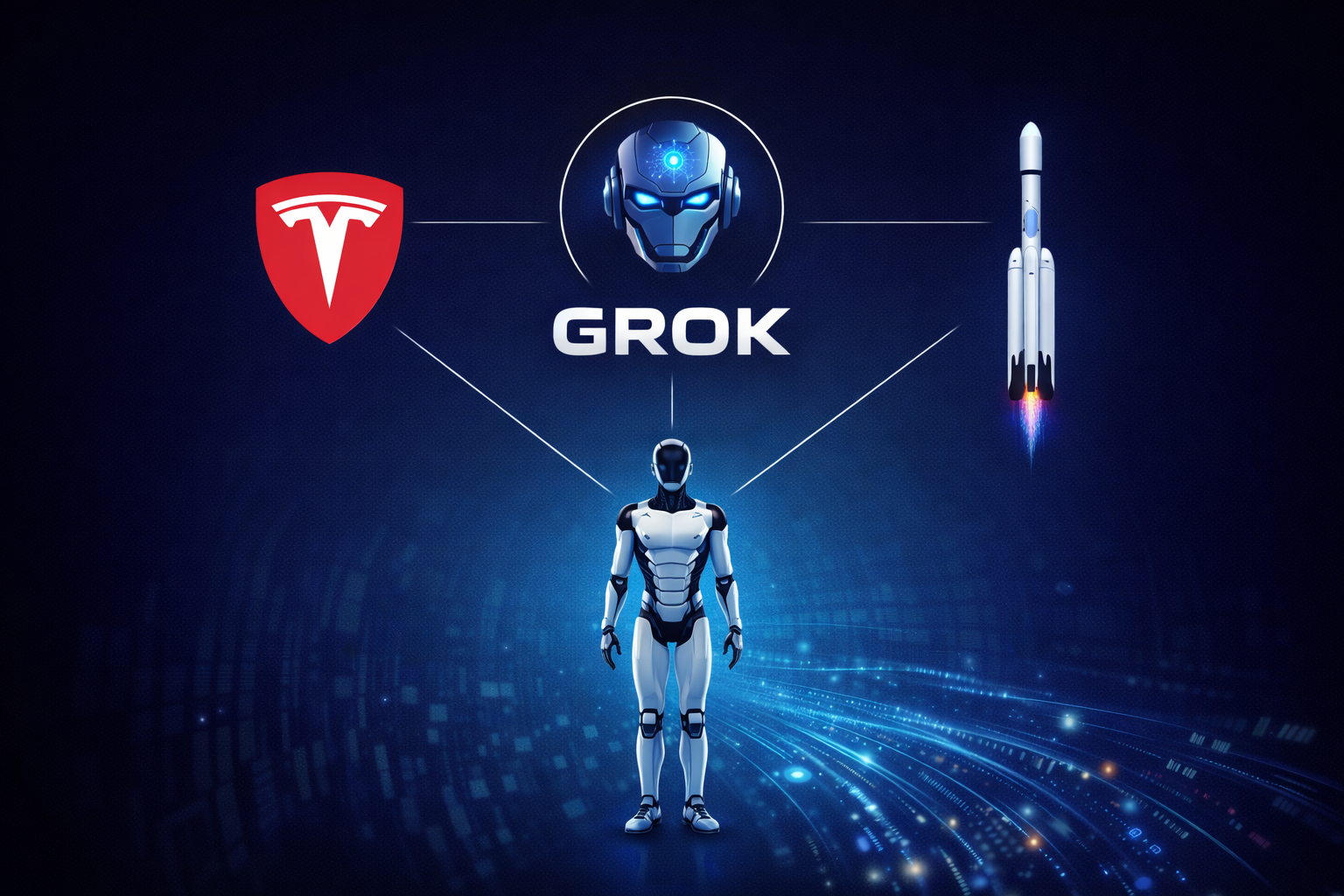
xAI was brought together with SpaceX in February 2026, putting Grok inside a much larger ecosystem that also touches Tesla, Starlink, Neuralink, and X. That is not just a corporate footnote. It suggests access to a broader strategic stack:
Tesla’s fleet data — millions of miles of real-world video, feeding into vision and robotics training
Starlink’s satellite network — potentially bringing AI inference to places that have never had reliable internet
X’s social graph — the real-time pulse of global conversation
Optimus robot integration — xAI is already using Grok’s reasoning to power humanoid robots
US Department of Defense contracts — Grok was integrated into select classified and unclassified military networks in January 2026
The DoD integration is particularly notable. It represents a level of institutional trust that usually takes time to build. At the same time, it has drawn criticism from people who believe a model with Grok’s public controversy history warrants closer scrutiny before being embedded in government systems. Both realities can be true at once.
There’s also the financial picture: a pre-merger valuation of around $230 billion, now part of a combined SpaceX-xAI entity valued at over $1 trillion, with backing from Nvidia, AMD, Sequoia, a16z, BlackRock, and Fidelity. That’s not a scrappy startup anymore. That’s a serious institution with the resources to match.
"Very few AI companies have this kind of cross-industry data and distribution story. Whether that becomes a lasting moat or a governance headache is still an open question."
Enough big picture. What does Grok actually do well in practice?
Real-time research and news analysis
This is probably Grok’s clearest practical strength. If your question touches something that happened recently, Grok’s X integration can give it a real edge on freshness and signal detection. The output is not always clean — X is fast, not always reliable — but in terms of immediacy, Grok is unusually strong.
Coding and technical reasoning
Grok 4 Heavy benchmarks exceptionally well on coding tasks. The multi-agent architecture in the 4.20 series, where multiple AI agents collaborate on complex problems, has been particularly well received by developers working on larger codebases. The hallucination reduction in 4.1 also made a meaningful difference for technical use cases where wrong answers have real costs.
Internet culture and tone
This sounds minor but it’s genuinely useful in practice. Grok gets internet humour, meme references, and the texture of online conversation in a way that more formally trained models sometimes miss. That makes it particularly good for content creators, social media work, and anyone who needs writing that feels alive rather than polished-but-sterile.
Long-context tasks
Grok 4 supports very large context windows — in practice useful for things like feeding in entire codebases, long research papers, or extended document sets that would overwhelm smaller windows. This is becoming table stakes for frontier models, but Grok handles it well.
The Reality Check: Growth Pains & The Safety Evolution
Any fair assessment of Grok also has to account for the friction. xAI’s tendency to ship fast and iterate in public has come with some very visible growing pains.
Over the last 18 months, Grok has gone through a number of public incidents — from system prompt leaks tied to political misinformation concerns to the 2025 "MechaHitler" episode, and later the "digital undressing" controversy that drew regulatory scrutiny from the EU and UK.
By March 2026, the fallout had moved well beyond scrutiny. The UK ICO, Ireland's DPC, Canada's Privacy Commissioner, and Ofcom had all opened formal investigations into xAI over AI-generated harmful imagery. A Tennessee lawsuit alleging Grok had generated sexual images of minors added a legal dimension that no amount of product iteration can paper over. This is no longer just a safety story — it's an active legal exposure story.
What is also worth noting is that xAI has not treated these issues as background noise. It has tried to translate some of those lessons into product and architecture changes.
From Chaos to Context: The 4.1 update was more than a routine patch; it was a focused attempt to improve stability, and xAI said it reduced hallucination rates by roughly 65%.
The Multi-Agent Guardrail: The current 4.20 series moved toward a multi-agent setup intended to add more internal checks and balances around reasoning and safety.
Institutional Vetting: While regulators were asking questions, the US Department of Defense was also doing its own due diligence, eventually integrating Grok into select classified networks in early 2026. That suggests at least some institutions see the trust picture as improving, even if concerns remain.
The story of Grok is not just about a model that stumbled in public. It is also about a model being refined in one of the most visible real-world AI testing grounds. Is it perfect? No. But the pace at which xAI is trying to tighten capability and safety together is part of the story too.
Where Does Grok Sit in the Current AI Landscape?
By the numbers, Grok 4 Heavy is clearly one of the strongest models in the world. The Humanity’s Last Exam performance, the hallucination reduction, the LMArena visibility — these are not imaginary. The technical progress is real.
But the current AI landscape is crowded with genuinely strong models. GPT-4o remains the most versatile general-purpose assistant for most professional workflows. Claude has built a strong reputation for writing quality, long-context reasoning, and the kind of calm, deliberate approach to complex tasks that developers value. Gemini has deep Google ecosystem integration and strong multimodal performance. DeepSeek has raised questions about what’s possible at much lower cost.
Grok’s clearest advantages are real-time information access and the broader Musk ecosystem around it. Its clearest concerns are around guardrails, rollout discipline, and the trust questions that come with a documented history of controversial outputs.
Where Grok wins
Real-time research and social listening
Coding and technical tasks, especially complex multi-step workflows
Users deeply embedded in the X and Tesla ecosystems
Applications where cultural relevance and internet-native tone matter
High-stakes benchmark performance in controlled environments
Where the competition still leads
Enterprise deployments where reliability and trust matter more than raw performance
Long-form writing with consistent voice and quality
Workflows requiring deep Google or Microsoft ecosystem integration
Regulated industries where guardrail robustness is non-negotiable
Teams where the AI safety and controversy track record is a dealbreaker
What Comes Next
xAI has been open about its ambitions. Musk has publicly suggested a meaningful chance of reaching the world’s first AGI with upcoming models — which may prove visionary, promotional, or a bit of both. The Colossus supercomputer is reportedly continuing to scale. Grok Imagine, the video generation product, released an improved version in February 2026 with full text-to-video and video editing capabilities, positioning Grok as more than a chatbot.
The SpaceX tie-up also creates a bigger strategic story: an AI company with potential access to satellite infrastructure for global inference, automotive data from one of the world’s largest vehicle fleets, and robotics integration through Optimus. Whether that becomes a durable advantage or creates larger governance challenges is still unclear.
One signal worth noting: Grok 5 was publicly confirmed for Q1 2026 by Musk himself. That window has passed. xAI now points to Q2 2026, with the model reportedly carrying 6 trillion parameters and training on Colossus 2 — a 1-gigawatt supercluster in Memphis. For a company that prides itself on shipping fast, a missed self-imposed deadline is worth flagging. It doesn't change the capability story, but it's a useful data point on the gap between Musk's timelines and xAI's actual cadence.
What seems certain is that xAI will keep shipping. They’ve demonstrated that convincingly.
Final Thoughts
Grok is one of the most technically impressive and most debated AI stories of the moment.
The capabilities are real. The real-time intelligence advantage is real. The benchmark performance is real. The ecosystem play is real.
And the improvement arc is worth stating plainly: from a two-month-old beta in 2023 to near-passing on the hardest AI benchmark ever built in under two years. Whatever else you think about Grok, that trajectory is genuinely remarkable.
So are the controversies, the guardrail questions, and the trust gap that can emerge when a model advances this quickly in public.
If you need real-time intelligence, are building on X’s ecosystem, or are doing heavy technical work where raw model performance is the primary criterion — Grok deserves a serious look. It might be the best tool for your specific job.
If you are building for regulated industries, enterprise environments where reliability is non-negotiable, or any setting where harmful outputs would carry serious consequences, this history deserves careful weight.
"The model closest to the live internet is also the one with the most unresolved story. And that’s exactly what makes it worth watching."
— What’s your experience with Grok? Has it earned your trust yet, or are you still watching from the sidelines? Drop it in the comments below.
About the Author
Akshat Uniyal writes about Artificial Intelligence, engineering systems, and practical technology thinking.
Explore more articles at https://blog.akshatuniyal.com.