The Moment I Stopped Believing Numbers
I found a trending repository with 4,000+ stars. Clean code. Decent architecture. But something nagged at me.
“If I lock myself in for four days, skip sleep, and order noodles twice, I could probably build this myself.”
Not arrogance. Calibration.
The star count didn’t match the engineering weight. So I hesitated.
A week later: 4,800 stars. Same code. Only the number had moved.
That discrepancy planted a question I couldn’t ignore. What if popularity itself had become… manufactured?
The Research That Confirmed My Suspicion
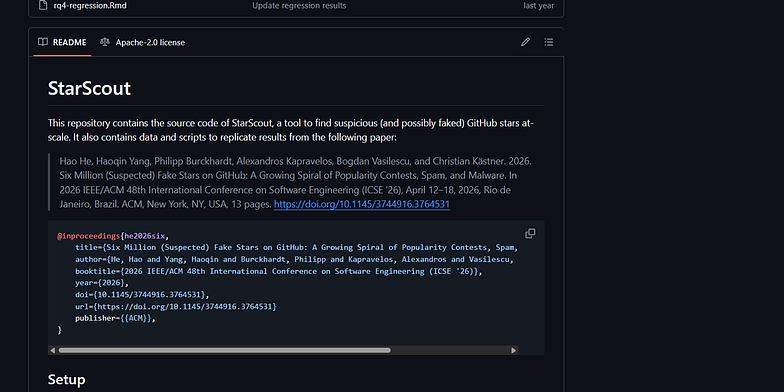
A joint team from Carnegie Mellon, NC State, and Socket analyzed 20 TB of GitHub event logs using a detection tool called StarScout. What they found wasn’t subtle:
- 4.5 million suspicious stars initially flagged
- 3.1 million confirmed fake after filtering
- 278,000 accounts involved across 15,835 repositories
- Updated models suggest closer to 6 million fake stars in circulation
- Roughly 15–16% of repos with 50+ stars show manipulation signs
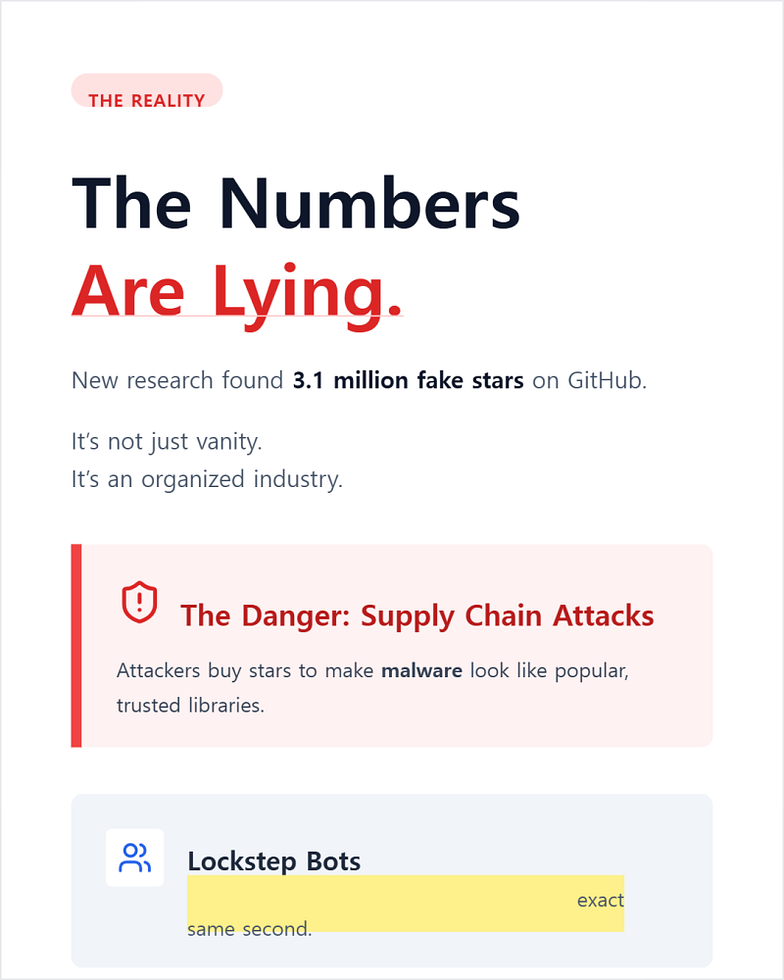
But here’s what stopped me cold as an engineer: they detected lockstep behavior — thousands of accounts starring the same repo within the same second.
Statistical anomalies humans simply don’t create.
That one pattern transforms this research from “interesting” to “unmistakable.”
Have you ever looked at a repo’s star history and noticed an unnatural spike? I used to dismiss it as “going viral.” Now I know better.
The Star Black Market Is More Industrial Than You Think
We like to imagine open-source as pure meritocracy: good code rises, weak code fades.
Underneath, another market has grown:
1) Direct star vendors
Websites, Telegram groups, Discord channels — even mainstream e-commerce platforms selling star packages like commodities.
2) Star-exchange networks
A circular ecosystem of “You star me, I star me.” Zero engineering value. Pure theater.
3) Marketing bundles
Agencies including GitHub star boosts in “launch packages,” as if stars were interchangeable promotional assets.
This isn’t a fringe side hustle. It’s a supply chain of popularity, increasingly optimized and automated.
The question that haunts me: If popularity can be bought, what signal can’t?
GitHub Fights Back, But Attackers Evolve Faster
To GitHub’s credit, they’ve removed many fake-starred repos and accounts after reports. Their policies explicitly prohibit ranking abuse.
Still, any security engineer recognizes the eternal cycle:
Detection improves → attackers adapt → detection improves → attackers adapt.
GitHub can catch broad campaigns. But subtle, slow-drip manipulations evade even strong filters.
Which means the burden shifts to us: How do we evaluate trust when popularity can be manufactured?
I learned this the hard way. A repo I’d dismissed as “over-hyped” turned out to be legitimately useful. Another I’d trusted because of its star count? Abandoned malware.
Stars stopped being signal. They became noise.
Why People Buy Stars (And Why It’s Dangerous)
Motivations vary, but they follow predictable incentives:
1) Social proof
A repo with 2,000 stars looks “safe,” especially to newcomers and decision-makers outside engineering.
2) Algorithmic visibility
Star counts still influence GitHub’s trending and search surfaces.
3) Camouflage for attacks
This is the crucial one. Fake stars aren’t just vanity — they’re a tool in supply chain attacks. A malicious package with 3,000 stars looks like a desirable dependency, tricking developers into installing it.
4) “Early traction” for honest projects
Some creators call it “marketing.” But the research is blunt: fake-star boosts last weeks, not months, and leave a long-term trust scar.
What bothers me most isn’t the deception — it’s how normalized it’s become.
Do Stars and Forks Still Matter?
They matter for visibility, not quality.
Stars measure discoverability. Forks measure curiosity. Neither measures security, maintainability, or long-term reliability.
Modern ecosystems already accept this reality:
- OpenSSF Scorecard: evaluates security posture and review habits
- LFX Health: measures contributor activity, release cadence, and adoption
These are significantly harder to fake. They require actual engineering work.
Maybe that’s the real lesson: You can fake popularity. You can’t fake craftsmanship.
A Practical 5-Minute Trust Test I Now Use
Here’s the checklist I developed — optimized for both engineers and security teams:
1) Activity rhythm
Recent commits? Healthy issue discussions? Organic contribution curve vs. one explosive spike?
2) Documentation maturity
Clear problem statement, usage examples, explicit limitations.
3) Engineering hygiene
Tests. CI/CD. Semantic releases. Dependency transparency.
4) Adoption footprint
Packages on PyPI/npm/Docker? Are real projects depending on it?
5) Security posture
Scorecard results. SECURITY.md. Responsible disclosure channels.
6) Bus Factor
If the maintainer disappears tomorrow, does the project survive? Is it a one-person miracle — or a resilient team effort?
If these look good, stars are decorative.
If they don’t, stars become a warning light.
Does this feel too paranoid? Maybe. But I’ve been burned enough times to prefer paranoia over convenience.

A Better Future: Separating Trust from Popularity
The solution isn’t removing stars. It’s giving trust its own metrics.
Imagine GitHub showing:
- Stars: 4.8k (trusted estimate: 3.1k)
- Project Health: 82/100
- Security Practices: Pass
- Bus Factor: Moderate
- Adoption Level: Medium
Suddenly the ecosystem becomes legible again. Stars remain a signal of interest. But trust becomes measurable.
I may be wrong about the exact implementation — probably am. But the direction feels right.
Closing: I Wasn’t Being Cynical — I Was Being Accurate
When a 4,000-star repository felt like a 400-star project, I assumed I was misjudging something.
The research showed I wasn’t. My instinct simply noticed a mismatch.
In hindsight, that moment taught me a useful lesson: The real signals haven’t changed. Good code, real adoption, consistent maintenance, transparent governance — these still matter more than any counter on a webpage.
You can fake popularity.
You can’t fake craftsmanship.
A question for you:
When you evaluate a GitHub repository, what signal do you trust most — beyond stars? Is it the commit history? The issue tracker? The contributor graph? Or simply the intuition refined over years of engineering?
Your perspective might shape how we think about trust in open source. I’d be grateful to learn from your experience in the comments.
