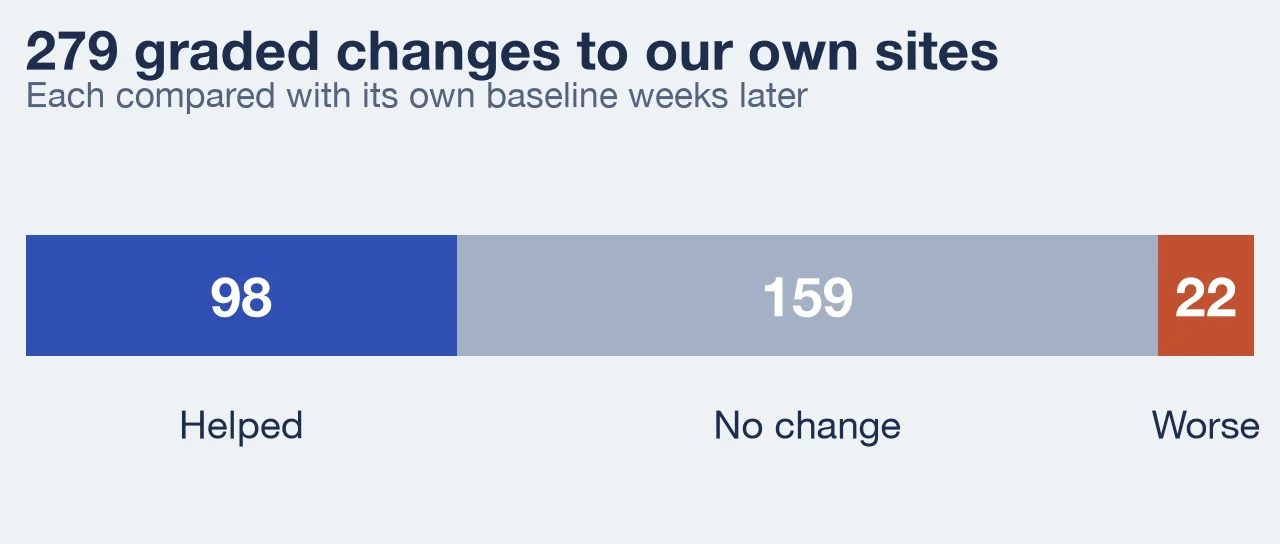
Since August we have shipped a little over 1,300 changes across about a dozen small websites we run: a couple of browser games, a small online store, a few content and service sites. For each change we recorded a baseline, waited a few weeks, and then checked whether the number it was supposed to move had actually moved. So far 279 of those changes have been around long enough to grade. About a third clearly helped. Fewer than one in ten made things worse. The rest, 159 of them, did nothing we could measure.
The 159 is the number that bothers us. If you change your site every week and never check, more than half of what you ship is noise, and some of it is quietly hurting you. Below are the patterns that held up for us, including the ones that surprised us by going the wrong way.
Fix what is broken before you polish what works
The biggest jump we saw came from fixing a mistake. One site had been built from another site's template, and its canonical tag, its og:url, its structured data and its sitemap all still pointed at the old domain. Google was indexing the other site instead. After we pointed everything at the right domain, impressions went from 7 to 1,219 over the following four weeks.
It isn't much of a growth tactic, but it beat every title rewrite we did combined. If you copied a template, a starter kit or another project's config at any point, open your page source and check that the canonical, og:url and sitemap URLs name your own domain.
Broken links worked the same way. Almost none of them were typos in content. On one site, every guide page pointed its share image at a route that returned 404, which made 92 broken links from a single template line. On the store, the wishlist page doubled the region prefix in its hreflang and canonical tags, which made 81. An image proxy that answered 404 when an upstream thumbnail disappeared produced 155. Each of those went to zero, or close to it, with a single fix in a shared component. When your crawler reports dozens of broken links, look for the one template that produces them before you fix them one by one.
Old URLs that still get visits are the cheapest win of all. Every time we found a path that real people were hitting and getting a 404 (an old signup link, a moved lessons section, a product that was discontinued), a permanent redirect to the closest live page cleared it, and none of those redirects ever graded badly.
Answer the question near the top of the page

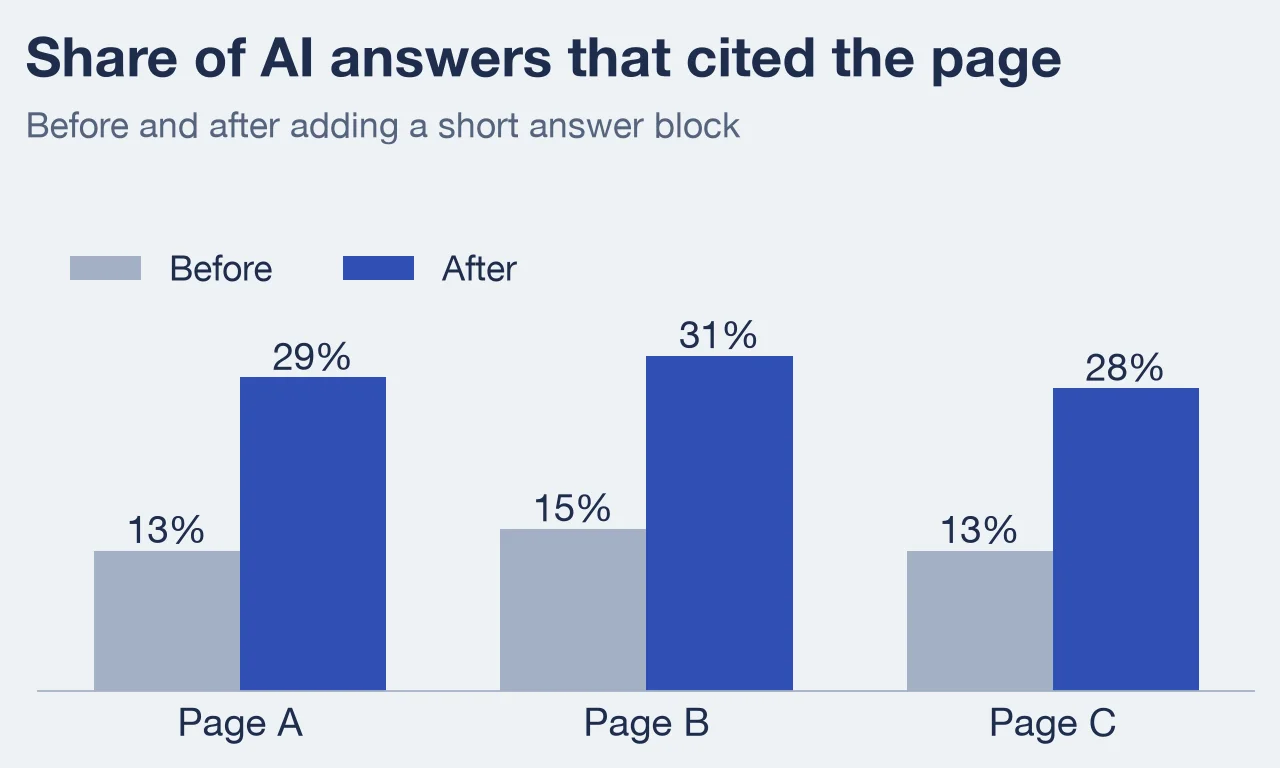
For AI answers (ChatGPT, Perplexity, Google's AI results and the like) the change that worked most reliably was a simple one. On three pages we added a heading that repeats the question people actually ask, followed by a short answer of about 50 to 60 words that makes sense on its own, with the concrete facts in it (how many players, how long a round lasts, how many words are in the dictionary), placed in the first screen. We reused the same text as an FAQ entry in the structured data.
On all three pages, the share of AI answers that cited the page roughly doubled: from 13% to 29%, from 15% to 31%, and from 13% to 28%. The samples are a few hundred answers each, so we don't think it's chance.
It did not work everywhere. We tried the same pattern on a finance page and the citation share stayed flat, although on a sample too small to say much. Our guess is that the answer block only helps pages AI tools were already willing to quote.
On the search side, content changes were mixed. One page jumped from around position 30 to around position 5 after we moved the exact phrase people search for into the title, the description, a short direct answer and the first subheading, and pointed a few internal links at it with that phrase as the anchor text. Four other rewrites, on pages already sitting around positions 5 to 7, did basically nothing. The page that moved was the one that had been ranking for the wrong phrase.
Titles matter less than people think, on small sites
We rewrote a lot of titles and meta descriptions, because it feels like the obvious lever. Of the title rewrites we could grade, about a third clearly helped (one comparison page went from 0.8% to 2.3% click-through after we put the thing people were searching for first and the brand last), most were flat, and a couple got slightly worse.
On pages with only a few hundred impressions a month, the noise in click-through rate is bigger than most of the effects you can create with wording. We now leave titles alone unless the page has real impressions and the current title clearly misdescribes the page. We also stopped touching a page's title again while an earlier change is still being measured, because otherwise you never learn which edit did what.
Speed: measure each change on its own, on real devices
Some speed changes helped real visitors in a way we could see. Giving images an accurate sizes attribute, so phones download the small version instead of the desktop one, was the clearest. Loading below-the-fold images only when they get close to the viewport and taking a render-blocking font stylesheet off the critical path also helped.
Three changes that looked right on paper made the largest contentful paint worse for real visitors: inlining the whole CSS file into the HTML, marking a strip of hero images as eager and high priority, and trimming an axis from a variable font to cut its size. Each one improved some lab number while making the field number worse.
Those techniques may well work on other sites. We only saw the damage because we shipped them one at a time and checked real-visitor data afterwards, and we reverted them.
Users tell you what is broken through rage clicks
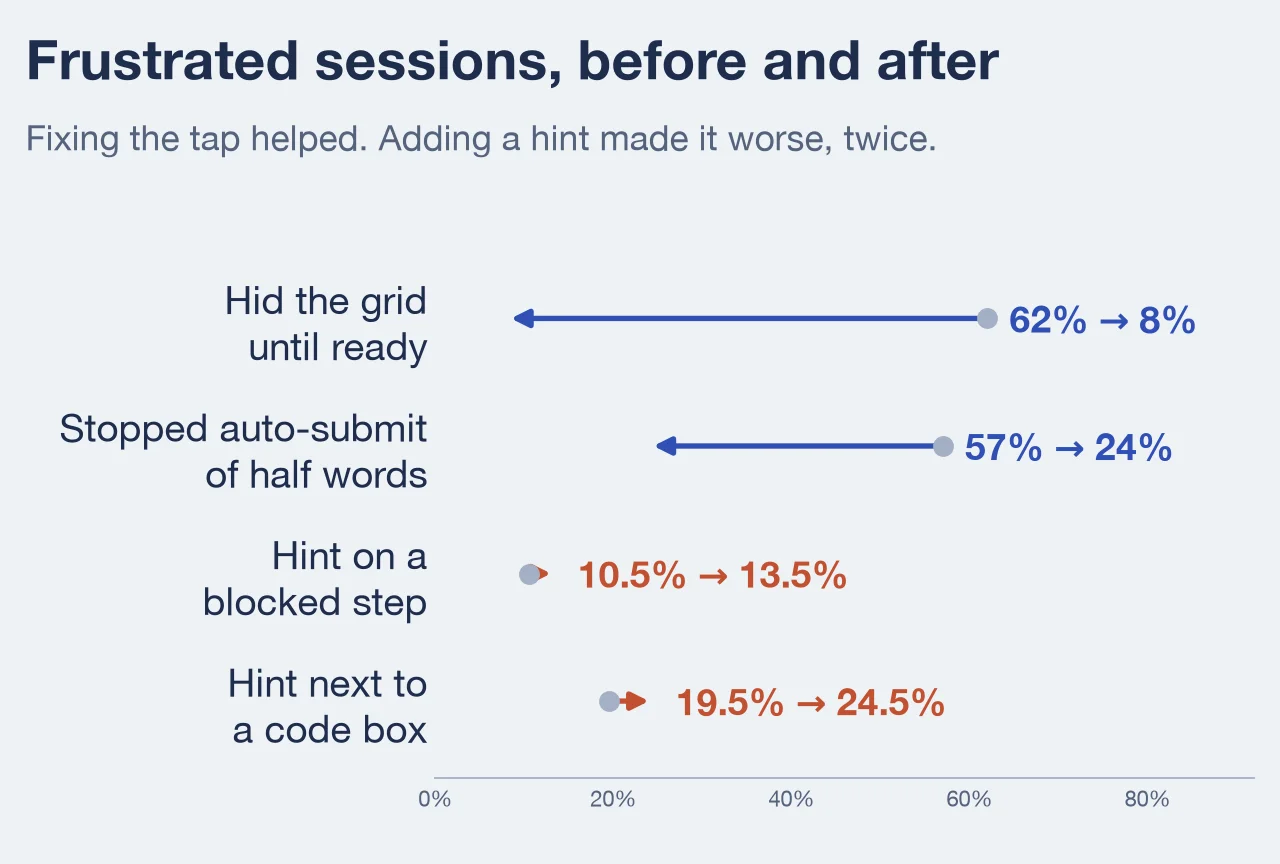
We track rage clicks and dead clicks per screen, and fixing the screens with the worst rates produced some of our biggest swings. In one multiplayer game, the letter grid was visible a moment before it became interactive, so players tapped it and nothing happened. Hiding it behind a solid splash until the round started took the share of frustrated sessions on that screen from 62% to 8%. In a daily puzzle, deleting a letter re-armed an auto-submit timer, which submitted half-typed words. Fixing that took the frustrated share from 57% to 24%.
Two attempts went the wrong way. In both cases we responded to confused users by adding an explanatory hint (on a blocked wizard step, and next to a room-code input), and in both cases frustration went up. A hint didn't help people who were tapping something that wasn't responding. What helped elsewhere was changing what happens when they tap.
The same idea applied to empty states. In a party game, a host who opened an empty lobby used to see "add bots" as the most prominent button. Making "invite friends" the main action and demoting bots took conversion through that step from about 1% to 11%.
Look at errors by client, not just by count
Two of our biggest error drops came from problems that only some visitors ever hit. One was a sign-in flow that could deadlock inside the auth library's lock. The other was a set of translation files that returned an empty 404 to browsers that do not accept brotli compression. Fixing them cut that site's error count roughly in half and by almost two thirds. The second one only shows up in browsers that don't ask for brotli, so testing in a current desktop browser would never reveal it.
What we do differently now
Before a change ships, we write down which number it is supposed to move, and we look at that number again a few weeks later. That habit is what stopped us from doing a fifth title rewrite on a page with 200 impressions a month. On any page we care about we change one thing at a time, so that when a number moves we know which edit moved it, and the changes that made things worse stay in the same log as the ones that worked.
An AI agent drafted this post from our own change log, and every number in it was checked against that log. We build Growth Radar, which keeps this kind of before-and-after record for a site.