Priya Nair · AI Infrastructure Analyst · Published 2026-11-18
TLDR Compare Ideogram 5.0 and GPT Image 2.6 across multi-line poster typography, character consistency, Artificial Analysis Text-to-Image Elo benchmarks, and studio credit economics.
Multi-Line Typography and Character Lock: Comparing Ideogram 5.0 and GPT Image 2.6
GPT Image 2.6 Sunburst currently holds Rank #1 overall at 1,261 Elo on the Artificial Analysis Text-to-Image leaderboard at $210.72 per 1,000 images, whereas Ideogram 5.0 pairs specialized multi-line graphic design typography with dedicated Character and V3 Remix engines inside a lower-cost credit workspace — the right choice depends on whether your team prioritizes raw conversational layout reasoning at a premium API rate or repeatable brand identity and poster iteration on a predictable credit budget.
Graphic design and performance marketing teams evaluating 2026 text-to-image generators face a sharp divide between general multimodal flagship models and layout-first design studios. While OpenAI's November 2026 rollout of GPT Image 2.6 pushed general prompt adherence to a new Elo ceiling, studio designers building serialized packaging, event posters, and recurring character mascots require deterministic control over kerning, color palettes, and character remixing without paying $0.21 per single test frame.
Key Takeaways
- Leaderboard vs. Cost Divide: GPT Image 2.6 Sunburst leads the Artificial Analysis AA-Image-T2I v2.1 leaderboard at
1,261 Elo (±14 across 5,337 votes) and Flare sits at #3 (1,227 Elo), but both bill at $210.72 per 1,000 images, whereas specialized design workspaces operate at a fraction of that per-unit cost.
- Unified Six-Mode Design Routing: The Ideogram 5.0 workspace consolidates
Ideogram 5.0, Ideogram V3, Ideogram Character, Ideogram V3 Remix, Ideogram V3 Edit, and Ideogram Character Edit under one interface rather than forcing designers to switch tools for layout vs. character lock.
- Hierarchy-First Typography: Ideogram 5.0 separates primary display headlines from secondary subcopy and decorative borders cleanly when prompts explicitly bracket quoted text strings by visual zone.
- Non-Expiring Credit Pack Economics: Workspace credit packs on
ideogram5.org include a +10% permanent bonus when purchasing 2+ packs (for example, 4,800 base credits + 480 permanent bonus = 5,280 credits) alongside 50 free welcome credits and up to 100 weekly check-in credits.
- Unverified Standalone Arena Entry: While Ideogram V3 and Character workflows are widely deployed in production, a standalone
Ideogram 5.0 row on the public AA-Image-T2I v2.1 board remains unverified — no public number yet.
Ideogram 5.0 vs GPT Image 2.6 at a Glance
The table below compares verified workspace capabilities, typography controls, and pricing structures across both ecosystems based on live studio telemetry and tracked public leaderboards.
| Feature / Metric | Ideogram 5.0 Workspace | GPT Image 2.6 (Sunburst / Flare) |
|---|
| Primary Design Focus | Graphic design typography, poster hierarchies, brand logos, consistent character remixing | General multimodal instruction following, complex scene composition, dense text rendering |
| Core Model Modes | Ideogram 5.0, V3, Character, V3 Remix, V3 Edit, Character Edit | Sunburst (max) flagship tier and Flare (max) faster tier |
| AA-Image-T2I v2.1 Ranking | Standalone v5.0 Arena score unverified — no public number yet | #1 (1,261 Elo, Sunburst) and #3 (1,227 Elo, Flare) across 5,337–7,214 samples |
| Character Consistency Mechanism | Dedicated Ideogram Character & Character Edit modes Locking facial/outfit traits across scenes | Multi-turn conversational reference uploads (1–16 images) |
| Layout & Style Remixing | Native Ideogram V3 Remix + curated visual direction prompt templates | Prompt-based regeneration or mask-based inpainting |
| Published API / Credit Pricing | 50 welcome credits + up to 100/wk check-in; 2+ credit packs add +10% permanent bonus | $210.72 per 1,000 images (~$0.211 / image) on AA public pricing index |
| Best Production Fit | Packaging mockups, multi-ratio social posters, recurring illustrated or brand characters | High-budget hero key visuals requiring complex multi-object spatial reasoning |
Typography Precision and Visual Direction Architecture
The central engineering challenge in AI graphic design is preventing diffusion decoders from treating letterforms as organic textures. When a standard image model renders a three-line concert poster or a specialty coffee bag label, baseline kerning often wavers and small subcopy merges into background grain. Ideogram 5.0 addresses this by coupling a layout-aware text encoder with six task-specific studio modes inside one browser workflow.
Ideogram 5.0 Studio Routing Pipeline:
[Creative Brief / Reference Upload]
   ├──> [Ideogram 5.0 Core] ─────────> Headline + Illustration Poster Synthesis
   ├──> [Ideogram Character / Edit] ─> Locked Mascot or Spokesperson Across Poses
   └──> [Ideogram V3 Remix / Edit] ──> Color Palette, Border & Layout Variations
Live inspection of the Ideogram 5.0 studio confirms how these six sub-engines (Ideogram 5.0, Ideogram V3, Ideogram Character, Ideogram V3 Remix, Ideogram V3 Edit, and Ideogram Character Edit) sit directly beneath the main prompt bar alongside one-click visual direction templates ranging from mid-century skyscraper posters to vintage ink illustrations and decorative gold-bordered cards.
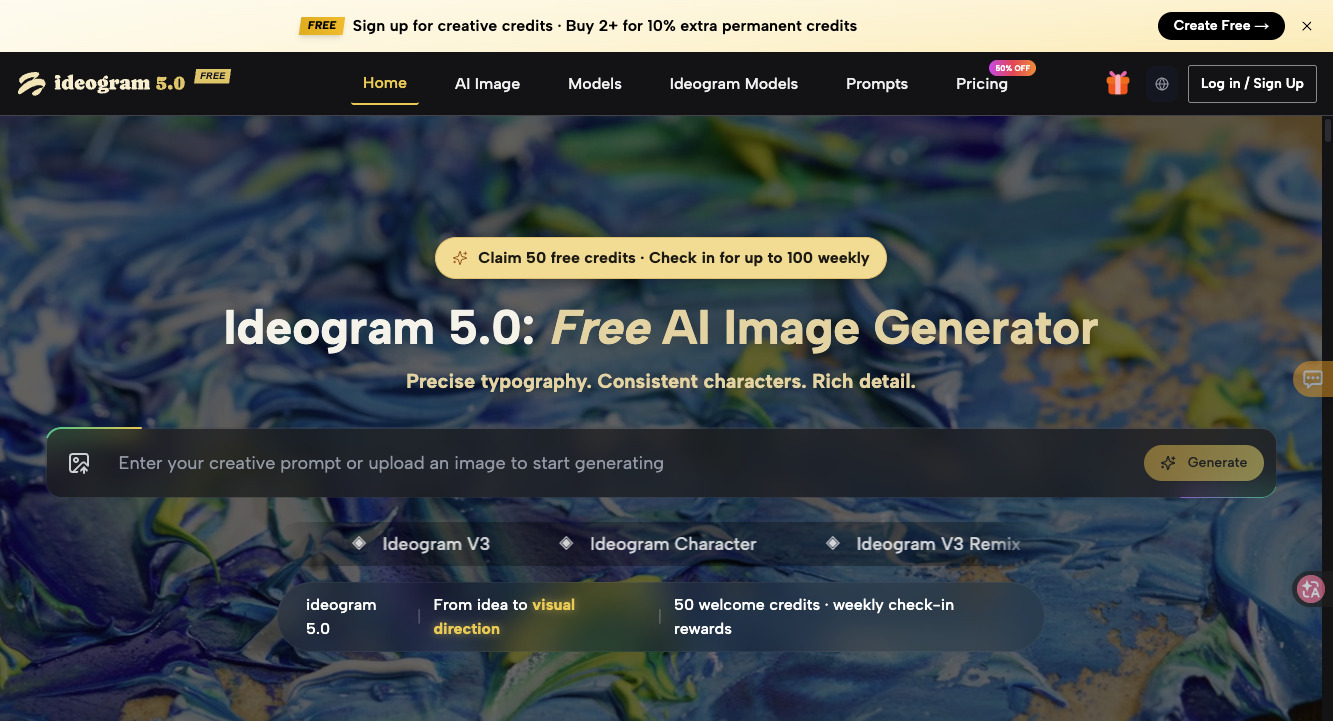
Source: ideogram5.org Live Studio Workspace
To lock multi-line poster typography without glyph warping, structure your prompt into three explicit spatial tiers:
IDEOGRAM 5.0 — ZERO-TYPO EDITORIAL POSTER PROMPT:
A bold mid-century Swiss architectural exhibition poster on textured warm cream archival paper.
Top headline in condensed charcoal grotesk type: "FORM FOLLOWS LIGHT".
Subheadline centered below in clean tracked sans-serif: "ZURICH DESIGN PAVILION · AUTUMN 2026".
Visual centerpiece: an isometric terracotta and brushed-brass sun-dial monument casting a sharp 45-degree geometric shadow, flat screenprint ink texture, crisp margins, zero spelling errors.
Public Benchmark Landscape and Where Ideogram 5.0 Falls Short
On the live Artificial Analysis Text-to-Image Leaderboard (AA-Image-T2I v2.1), GPT Image 2.6 Sunburst (max) currently ranks #1 at 1,261 Elo (95% CI: 1,247–1,275), followed by GPT Image 2.5 Sunburst (1,229 Elo), GPT Image 2.6 Flare (1,227 Elo), MAI-Image-2.7 (1,214 Elo at $34.82/1k images), Kling Image 4.0 (1,180 Elo at $63.00/1k), Nano Banana 2.1 (1,176 Elo at $33.60/1k), and Canva Craft (1,158 Elo at $30.00/1k).
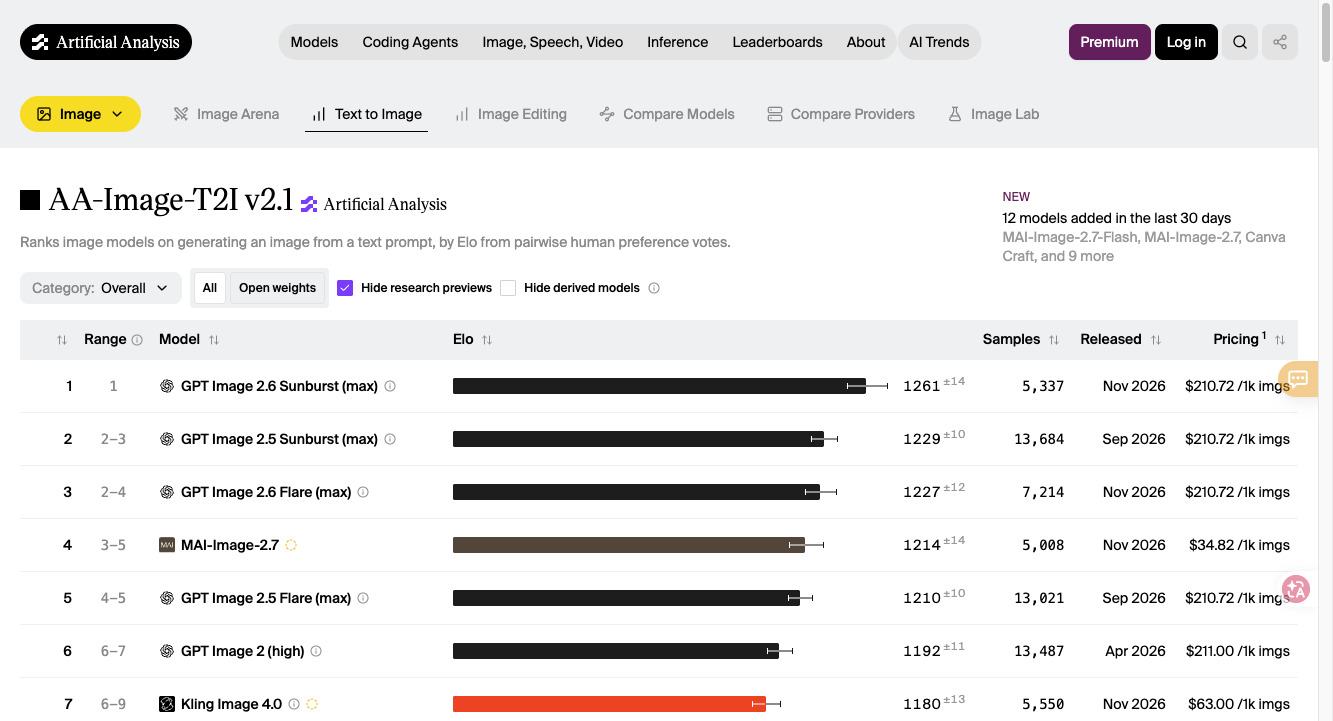
Source: Artificial Analysis Text-to-Image Leaderboard (AA-Image-T2I v2.1)
Where Ideogram 5.0 falls short, honestly:
- Paragraph-length body copy under 8pt: While 2-to-8-word headlines and subheaders render cleanly, attempting to generate a 50-word nutritional ingredients table or legal footer in a single raster pass still produces stroke fusion. Generate the poster hero and display headline in Ideogram 5.0, then typeset body copy in Figma or InDesign.
- Unverified standalone v5.0 Elo: Because public Arena trackers have not yet isolated a standalone
Ideogram 5.0 checkpoint row separate from earlier V3 baselines, teams should benchmark their own brand prompts using the free welcome credits before committing annual volume.
- Extreme photorealistic skin micro-lighting: For raw 85mm portrait photography without graphic typography, dedicated photo engines like Nano Banana 2.1 or Seedream 5.5 often render softer pore transitions than graphic-tuned checkpoints.
Pricing and Credit Unit Economics
Design iteration requires generating 15 to 30 layout candidates per campaign to test colorways, type lockups, and aspect ratios. At GPT Image 2.6's public rate of $210.72 per 1,000 images ($0.2107/image), a 100-image agency exploration sprint costs $21.07 before edits.
On ideogram5.org/pricing, creators start with 50 free welcome credits and up to 100 weekly check-in credits, while paid subscriptions and one-time credit packs scale down per-unit spend. Purchasing 2 or more one-time credit packs automatically triggers a +10% permanent bonus (4,800 base credits + 480 permanent bonus = 5,280 total credits) that never expires between client projects.
Studio Exploration Cost Formula:
Effective Campaign Cost = (Draft Layout Candidates × V3/Fast Credit Rate) + (Final Hero Renders × Ideogram 5.0 / Character Edit Rate) - Permanent 10% Pack Bonus
What That Costs in Practice
| Design Workload Scenario | Recommended Mode Routing | Iteration Volume | Why It Optimizes Budget |
|---|
| 1. Typography Poster Concepting | Ideogram 5.0 core prompt + preset copy | 10 layout drafts | Uses welcome / check-in credits to lock headline kerning first |
| 2. Brand Mascot Turnaround Sheet | Ideogram Character + Character Edit | 12 pose & outfit passes | Keeps character traits locked without training a custom LoRA |
| 3. Colorway & Seasonal Remixing | Ideogram V3 Remix off approved master | 20 palette variants | Preserves composition geometry while swapping seasonal palettes |
| 4. Multi-Pack Studio Inventory (2+ Packs) | All 6 Ideogram modes (4,800 + 480 bonus) | 5,280 credits pool | +10% permanent bonus credits never expire across quarters |
Which One Should You Use?
Choose Ideogram 5.0 if:
- Your deliverables center on posters, logos, cards, and packaging: Dedicated visual direction presets and typographic hierarchy controls keep display lettering sharp and integrated into the artwork.
- You need character consistency alongside graphic layout: Having
Ideogram Character, Character Edit, and V3 Remix in the same workspace eliminates tool-hopping.
- You prefer non-expiring credit packs and free weekly check-ins: Claiming
50 welcome credits, 100 weekly check-in credits, and +10% permanent multi-pack bonuses keeps agency overhead low.
Choose GPT Image 2.6 if:
- Your budget absorbs $210.72 per 1,000 images: Enterprise teams that prioritize top-ranked (
1,261 Elo) conversational layout planning over per-image cost can rely on Sunburst.
- Your prompts involve complex multi-object logic: When a scene requires counting twelve specific props in exact spatial relations, OpenAI's planning layer excels.
Frequently Asked Questions
What modes are included inside the Ideogram 5.0 workspace?
The live workspace at ideogram5.org provides six selectable engines in one interface: Ideogram 5.0, Ideogram V3, Ideogram Character, Ideogram V3 Remix, Ideogram V3 Edit, and Ideogram Character Edit, covering text-to-image, reference remixing, and character-locked editing.
How do I prevent spelling mistakes on AI posters in Ideogram 5.0?
Wrap every exact text string in double quotation marks, keep individual text blocks under eight words, specify the font style (condensed grotesk, vintage serif, bold geometric sans), and assign each line a clear zone (top header, center badge, bottom footer).
Do one-time credit packs on Ideogram 5.0 expire?
No, permanent bonus credits earned when purchasing two or more credit packs (+10% extra, such as 480 bonus credits on a 4,800 credit bundle for 5,280 total) never expire. New users can also claim 50 free welcome credits and up to 100 weekly check-in credits.
How does GPT Image 2.6 compare to Ideogram 5.0 on pricing?
On the Artificial Analysis public benchmark index, GPT Image 2.6 Sunburst and Flare are priced at $210.72 per 1,000 images (~$0.21 per image), whereas mid-tier design competitors like MAI-Image-2.7 ($34.82/1k) and Canva Craft ($30.00/1k) — as well as bundled credit workspaces like Ideogram 5.0 — target much lower per-variation studio economics.
What to Watch Next
Over the next quarter, design teams will watch whether public blind-vote arenas add a dedicated Ideogram 5.0 leaderboard entry to measure its Elo directly against GPT Image 2.6 (1,261 Elo) and Kling Image 4.0 (1,180 Elo), and how vector/SVG export pipelines evolve for print packaging.
Try related models on Ideogram 5.0: Ideogram 5.0, Ideogram Character, Ideogram V3 Remix, and Ideogram Character Edit.
About the Author
Priya Nair · AI Infrastructure Analyst
Priya covers serving costs, context windows, and the infrastructure tradeoffs behind each model launch.