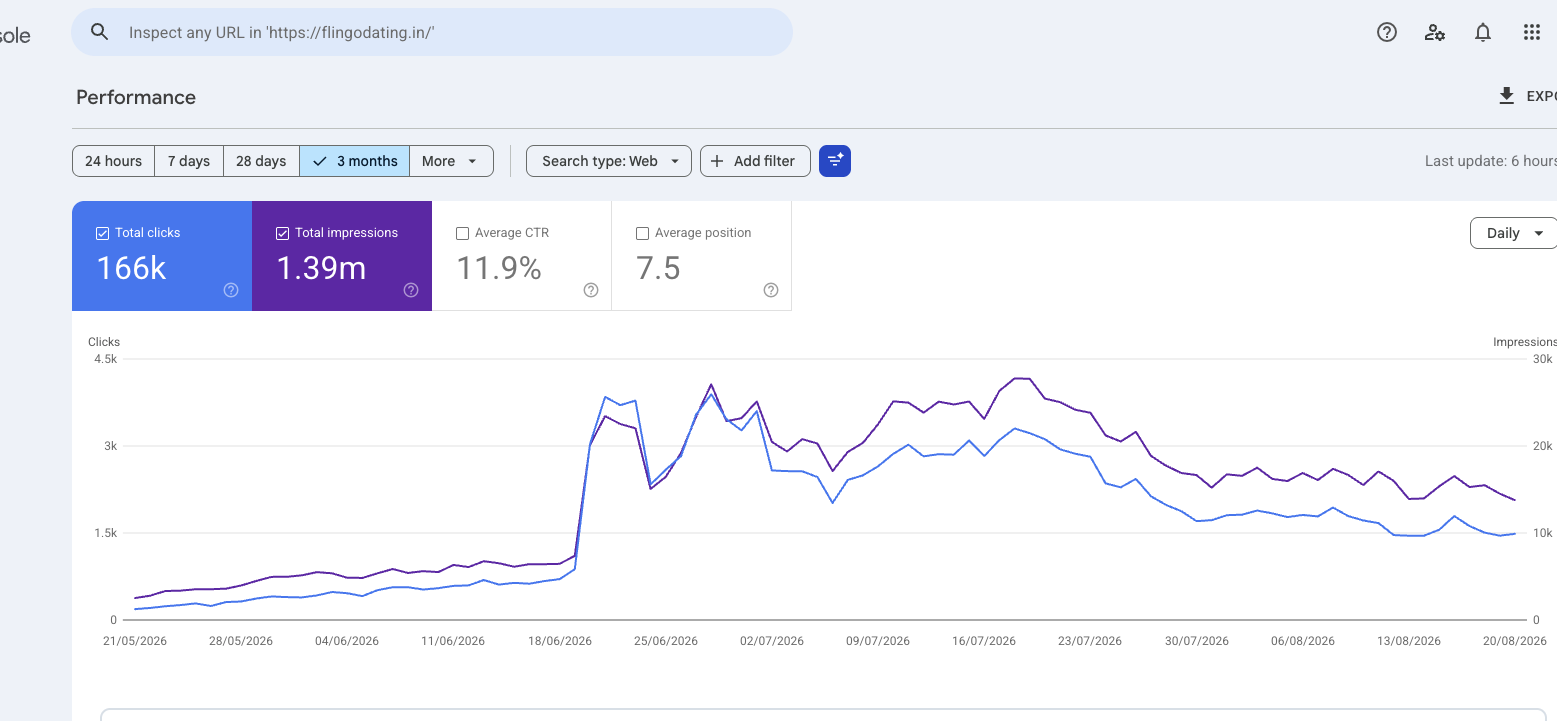
 Over three months, my static website generated 166K Google clicks from 1.39M impressions, with an 11.9% CTR and 7.5 average position.
The graph also shows traffic declining after its peak. That is important: AI did not create automatic, permanent growth. What helped was using AI inside a measurable SEO workflow—and reverting ideas when the data disagreed.
Here is the loop I now use.
1. Use Keyword Planner for discovery, not decisions
I start with broad product terms in Google Keyword Planner and export the results.
Search volume and competition help me find possible clusters, but a high-volume keyword is not automatically a reason to create a page.
Before choosing one, I ask:
- Does it match my product?
- Is its intent different from pages I already have?
- Does an existing URL already rank for it?
- Can I create something genuinely useful for the searcher?
This prevents keyword research from becoming a factory for thin pages.
2. Check keyword ownership with GSC MCP
I use a Google Search Console MCP connection to pull query-and-page data directly into my workflow.
This is more useful than looking only at a keyword report. A keyword may appear to be an opportunity while an existing page already ranks in positions 1–3.
Creating another page could split its signals and cause keyword cannibalization.
My basic decision record contains five fields:
Query: target keyword
Current URL: ranking page or none
Evidence: clicks and position from a settled GSC window
Intent: informational, local, comparison or action
Decision: improve, create or reject
If the intent already belongs to an existing page, I improve that page instead of creating another URL.
3. Use Claude skills as reviewers, not autopilot
I use Claude SEO-audit and keyword-research skills to inspect proposed changes.
They help me check:
- Duplicate keyword targets
- Titles, descriptions, H1s and canonicals
- Indexability and internal links
- Thin or repetitive content
- Unsupported product and pricing claims
- Possible performance regressions
AI can investigate, compare and draft—but it cannot replace evidence or editorial judgment.
I reject templated pages that only swap a keyword or city name.
4. Fix what Search Console actually flags
When clicks fall, I do not immediately rewrite the entire site.
I first separate incomplete recent Search Console data from settled data. Then I decompose the loss:
- Compare equivalent date ranges.
- Find which page lost clicks.
- Pull that page’s query-level changes.
- Check its indexing, canonical and crawl status.
- Review the commits made before the decline.
- Revert only when the evidence supports it.
This has saved me from treating every ranking fluctuation as a technical emergency.
5. Audit before and after deployment
Before every SEO commit and deployment, I run the repository SEO audit.
After deployment, I inspect the live HTML—not just the local source file—to verify:
- Title
- Meta description
- Canonical
- Robots directive
- H1
- Sitemap entry
Only after the production page passes those checks do I submit it through Search Console and begin its validation window.
The main lesson
My best results did not come from asking AI to “write SEO content.”
They came from giving AI access to structured evidence and enforcing a release process:
Keyword Planner → GSC ownership check → human intent decision → SEO audit → deploy → live verification → measure or revert
That is the process I use on Flingo, a product website with hundreds of static pages.
AI makes research and diagnosis faster.
Search data decides whether an idea deserves to ship.
How are you using AI in SEO without handing it the steering wheel?
