Hey everyone — this one's for the builders in this community who keep asking me "what's actually in your toolkit right now." I've been heads-down shipping side projects with AI coding agents all year, and 2026 has been the year the tools around the AI finally caught up to the AI itself. Not another chatbot. Actual infrastructure for people who are trying to ship real software, alone or in a tiny team, without a full engineering org behind them.
Here are the four tools I keep coming back to, in the order I actually reach for them when I start a new build.
Starting point: the coding agent itself — Kimchi
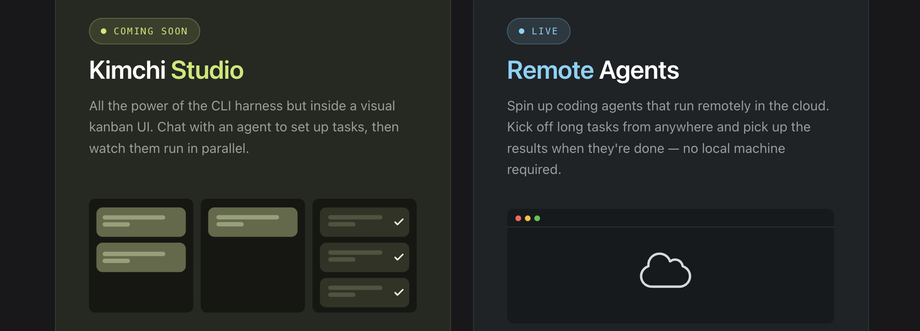
Most of my week still lives in a terminal coding agent, and lately that's Kimchi. What sold me isn't that it's "another Claude Code competitor" — it's genuinely different in how it thinks about cost. Instead of hammering one frontier model for every single task, Kimchi runs a multi-model orchestration layer: it looks at what you're asking for and routes it to the model that actually fits, saving the expensive frontier model for the genuinely hard stuff and letting cheaper open-weight models handle routine execution.
As a solo builder paying for my own tokens, this is the difference between a $40 debugging session and a $15 one. Kimchi also just went general availability with claims of about 2.5x lower cost than running commercial models only, and it added support for MiniMax M3 as a builder model, which has been noticeably fast on long, boring refactor tasks. There's also built-in budget governance — hard spend caps, automatic shutdown of runaway loops — which matters a lot more than I expected the first time an agent got stuck in a retry loop overnight.
Before I even open the terminal: BrainGrid
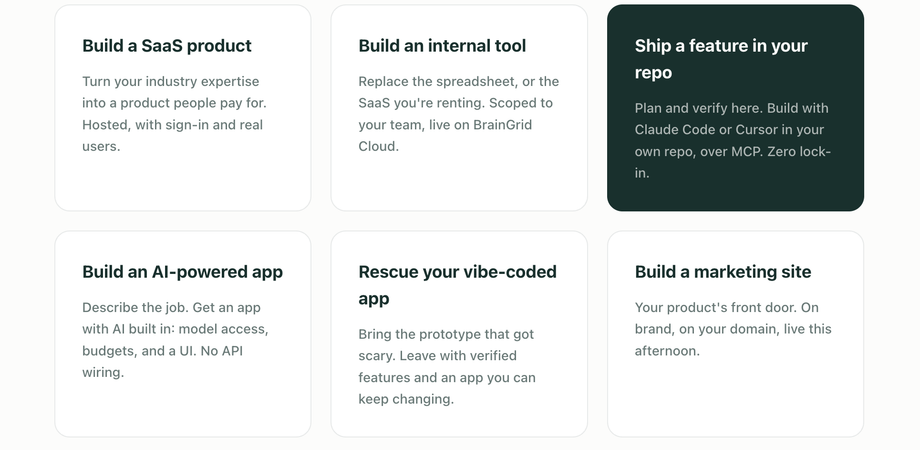
Honestly, my biggest failure mode this year wasn't bad code, it was bad specs. I'd describe something vaguely, the agent would build something, and three features later the whole thing would collapse under its own weight — conflicting logic, half-finished integrations, features that quietly broke each other.
BrainGrid is the tool I now run before I touch a coding agent. It acts like a product manager you don't have: it interviews you about what you actually want, asks the clarifying questions you didn't think of, and turns that conversation into a real spec — acceptance criteria, data model, a "readiness score" — before generating a sequence of small, hyper-specific tasks that a coding agent can execute one at a time without losing the plot. It's built by former Twilio engineers, raised a pre-seed round this year, and has already been used by 500+ solo builders and small teams to ship real, revenue-generating SaaS products, not just demos. For anyone in this community who's non-technical but has a product idea, this is genuinely the closest thing I've seen to "hire a PM for a few dollars."
Making sure it actually works: Maestro
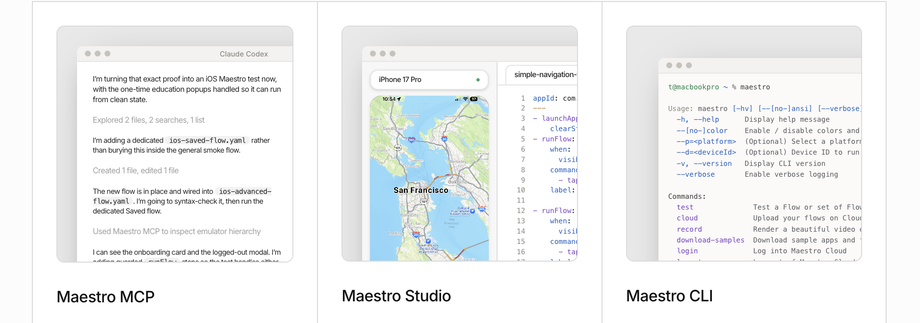
Here's the thing nobody tells you about agent-built features: the agent will confidently tell you it's done. Whether the button actually works on a real device is a different question entirely. Maestro is how I close that gap. It's open-source, agentic UI testing for mobile and web apps, and it plugs directly into my coding agent through MCP — meaning my agent can literally look at the running app, tap through it, take screenshots, and write proper end-to-end tests in plain readable YAML.
I've had it catch things I would have shipped broken — a setting that didn't persist after restart, a screen that broke under a bigger font size for accessibility. It's free to run locally through the CLI or their Studio app, and there's a cloud tier if you ever need to run tests across a real device matrix instead of one emulator. For solo builders especially, this is the closest thing to having a QA person on staff.
Staying on top of it all: Git Digest
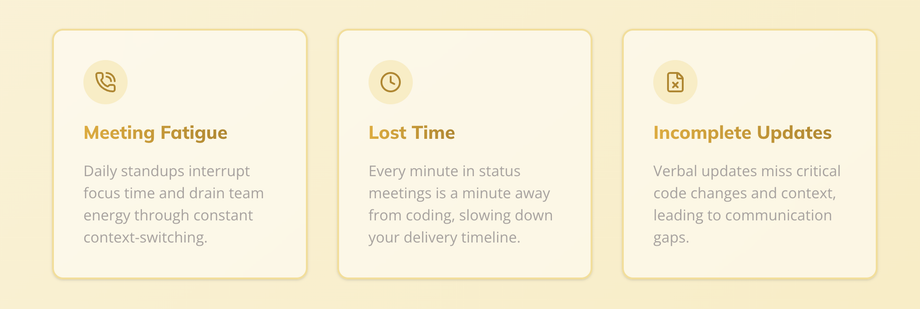
Last one, and it's less flashy but it's saved me real time: Git Digest. When you've got agents opening PRs across a few repos while you sleep, it's genuinely hard to keep a mental model of what actually changed. Git Digest reads your GitHub activity and sends a plain-English summary — daily or weekly, by email or Slack — that tells you what shipped, what got fixed, and what's trending in terms of velocity and "hotspot" files that keep needing rework.
I mostly use it as a gut check before I look at anything else in the morning: did anything weird happen overnight, is one part of the codebase getting touched way more than it should. It's a small habit but it's replaced what used to be me anxiously scrolling through commit history with coffee.
The honest takeaway
None of these four things are hype products. They're all solving a genuinely boring, unglamorous problem: making AI-built software not fall apart. If you're building solo or in a small team in 2026, my honest advice is start with the plan (BrainGrid), pick a coding agent that doesn't bankrupt you (Kimchi), verify what it actually built (Maestro), and stay aware of what's happening across your codebase (Git Digest). Happy to go deeper on any one of these in a future post if people want it — just drop a comment.