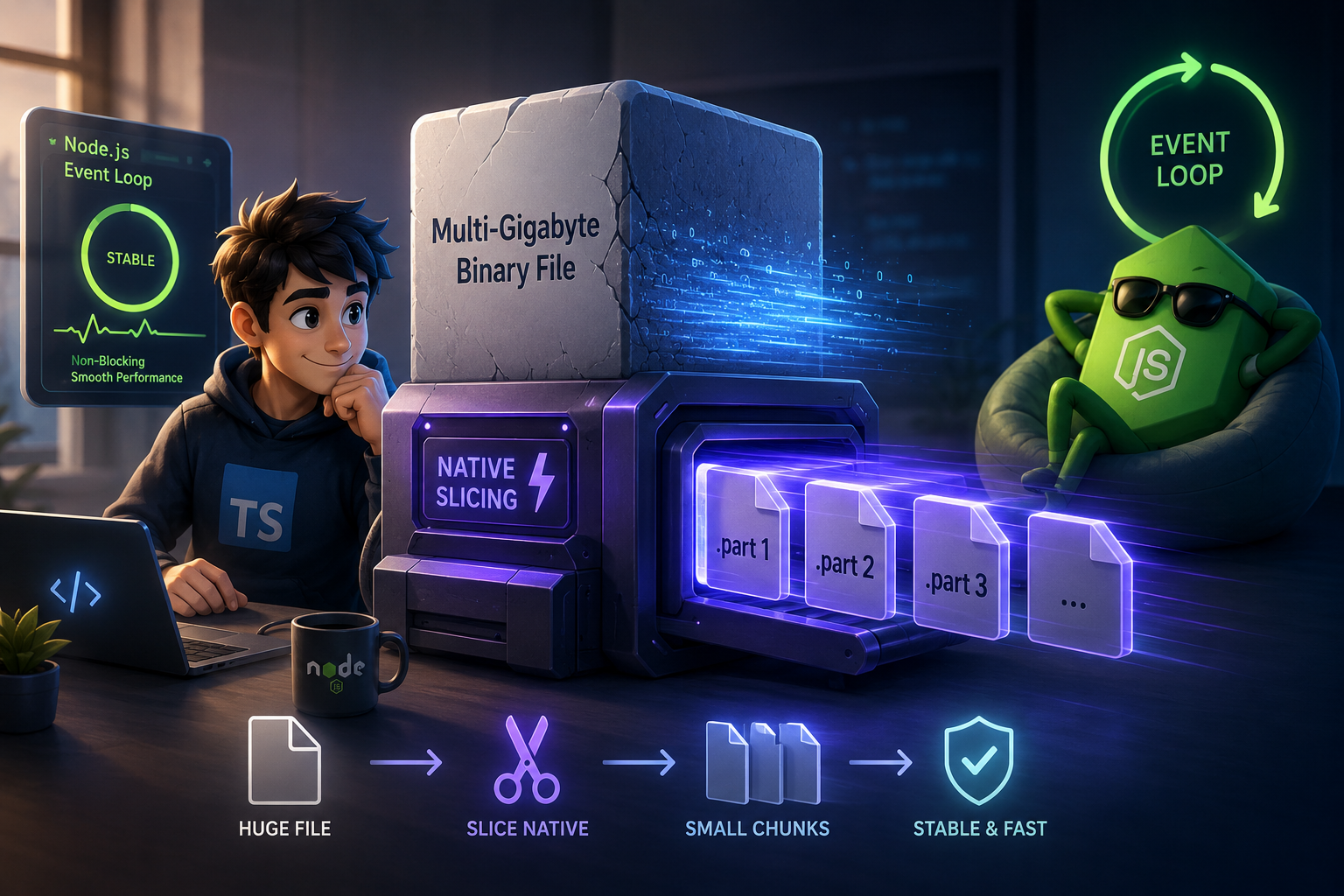
Introduction
Handling massive media datasets, virtual machine images, or database backups within a TypeScript backend is notoriously challenging. If you attempt to slice or process a multi-gigabyte file incorrectly, your server can hit an Out-Of-Memory (OOM) error or completely block incoming user traffic.
In this tutorial, we will explore how to natively split large files into fragments and reassemble them seamlessly using XyPriss. This framework achieves with a single line of code what normally takes dozens of lines of delicate, error-prone stream logic.
1. What is Binary Chunking and Why Does It Matter?
Binary Chunking is the process of breaking down a single massive file into smaller, fixed-size physical segments (e.g., slicing a 1GB file into one hundred 10MB fragments) and merging them back together later.
Critical Industry Use Cases
- Resumable Network Uploads: Uploading files in fragments allows you to safely retry a single failed 5MB block instead of restarting a failed 5GB file upload from scratch.
- Distributed Cloud Storage: Mirroring file fragments across separate AWS S3 buckets or local disks to establish high availability and data redundancy.
- Parallel Cloud Processing: Allowing multiple background worker threads to analyze distinct chunks of a massive dataset simultaneously.
2. The Traditional Approach: How Other Environments Do It
In standard Node.js runtime environments, slicing a binary file safely requires managing complex internal buffers, tracking read/write offsets, and listening to active stream events. If you make a single error in handling stream pointers or backpressure, you risk leaking resources or blocking the main JavaScript execution thread.
import fs from 'fs';
/**
 * Traditional approach to split a large file into 10MB chunks
 */
function splitFileOldWay(sourcePath: string, chunkSize: number): Promise<number> {
  return new Promise((resolve, reject) => {
    // ⚠️ Warning: if you omit handling backpressure, this will leak memory
    const stream = fs.createReadStream(sourcePath, { highWaterMark: chunkSize });
    let chunkIndex = 0;
    stream.on('data', (chunk) => {
      // Manually tracking chunk index and creating unique chunk files on disk
      fs.writeFileSync(`${sourcePath}.part${chunkIndex}`, chunk);
      chunkIndex++;
    });
    stream.on('end', () => resolve(chunkIndex));
    stream.on('error', (err) => reject(err));
  });
}
Architectural Drawbacks
- High JavaScript heap usage during active mutations.
- High boilerplate complexity for foundational filesystem tasks.
- Prone to stream memory leaks if backpressure builds up or errors are uncaught.
3. The XyPriss Paradigm Shift
XyPriss completely changes this workflow by introducing its Go-backed XHSC (Hyper-System Core).
When you issue a file manipulation command in XyPriss, the execution breaks out of the JavaScript V8 runtime entirely. The operation is handled at the kernel-system level inside an optimized, multi-threaded Go routine.
[JS V8 Runtime] --(Delegates Task)--> [XHSC Kernel-Level Go Subsystem]
       |                                              |
       | (Near-Zero Memory Footprint)                 | (Processes Multi-GB Slices)
       v                                              v
[Stable Event Loop] <------------------------ [Task Complete]
Because your data payload never enters the JavaScript memory array heap, your web server maintains a near-zero memory footprint during massive file transformations.
4. Step-by-Step Implementation Guide
Step 1: Initialize Your Project Layout via XFPM
Before writing code, we need to initialize our ecosystem. Instead of using standard package managers, XyPriss utilizes its own dedicated command-line interface tool called XFPM (XyPriss Fast Package Manager).
What is XFPM?
Built entirely in Go, XFPM is the official high-performance CLI tool for project orchestration, dependency resolution, and runtime isolation in the XyPriss ecosystem. It acts as a lightning-fast replacement for standard package managers, complete with built-in zero-trust security audits.
Open your terminal and create a new project environment:
xfpm init secure-file-pipeline
(To explore how XFPM manages strict package isolation and neural dependency matching, dive into the official XFPM CLI Documentation).
Step 2: The Complex Slicing Action (In 1 Line)
Instead of dealing with high-water marks, data events, or streams, you call the global system filesystem interface sys.fs.split().
Create a route file (e.g., routes/upload.ts) and drop this code into your pipeline:
import { createServer } from "xypriss";
app.post("/video/process-chunks", async (req, res) => {
    try {
        const largeVideoPath = "./storage/raw/raw_4k_footage.mp4";
        const tenMegabytes = 10 * 1024 * 1024; // 10,485,760 bytes
        // Natively splits the file into exact 10MB parts on disk in a single operation
        const chunkPaths: string[] = await __sys__.fs.split(largeVideoPath, tenMegabytes);
        // The Go engine returns an array of the newly created chunk files automatically:
        // ["./storage/raw/raw_4k_footage.mp4.part0", "./storage/raw/raw_4k_footage.mp4.part1", ...]

        res.success({
            message: "Binary file divided successfully outside the JS heap.",
            fragmentsCreated: chunkPaths.length,
            chunks: chunkPaths
        });
    } catch (error) {
        res.error(`Failed to execute system split operation: ${error.message}`);
    }
});
Step 3: Reassembling Your Fragments (In 1 Line)
When it is time to stitch those files back into the original video asset, pass your chunk paths array right back into the merge pipeline via sys.fs.merge().
app.post("/video/merge-chunks", async (req, res) => {
    try {
        const structuralChunks = [
            "./storage/raw/raw_4k_footage.mp4.part0",
            "./storage/raw/raw_4k_footage.mp4.part1",
            "./storage/raw/raw_4k_footage.mp4.part2"
        ];
        const destinationFile = "./storage/distribution/final_delivery.mp4";
        // Natively merges chunks into a perfect binary file duplicate
        await __sys__.fs.merge(structuralChunks, destinationFile);
        res.success({ message: "File reassembled with structural integrity." });
    } catch (error) {
        res.error(`Merge pipeline failed: ${error.message}`);
    }
});
Conclusion
By transferring heavy-duty file manipulations to a native Go subsystem, XyPriss keeps your application architecture simple while unlocking maximum performance.
From initializing a clean ecosystem with XFPM to executing intensive disk I/O operations, you no longer need to compromise between code readability and infrastructure safety. Complex binary tasks that used to require extensive logic now fit cleanly into a single line of readable code.
Want to explore more? Dive deeper into zero-memory optimizations by reading the official XyPriss Filesystem Core documentation.
Want to explore more? Dive deeper into zero-memory optimizations by reading the XyPriss Filesystem Core documentation.
Benchmark: https://xypriss.nehonix.com/docs/performance/benchmarks
Blog: https://blog.nehonix.com/how-to-handle-multi-gigabyte-binary-slicing-in-typescript-without-crashing-your-node-js-event-loop