I Kept Losing Context Switching Between AI Tools — So I Built a Browser Extension That Remembers Everything
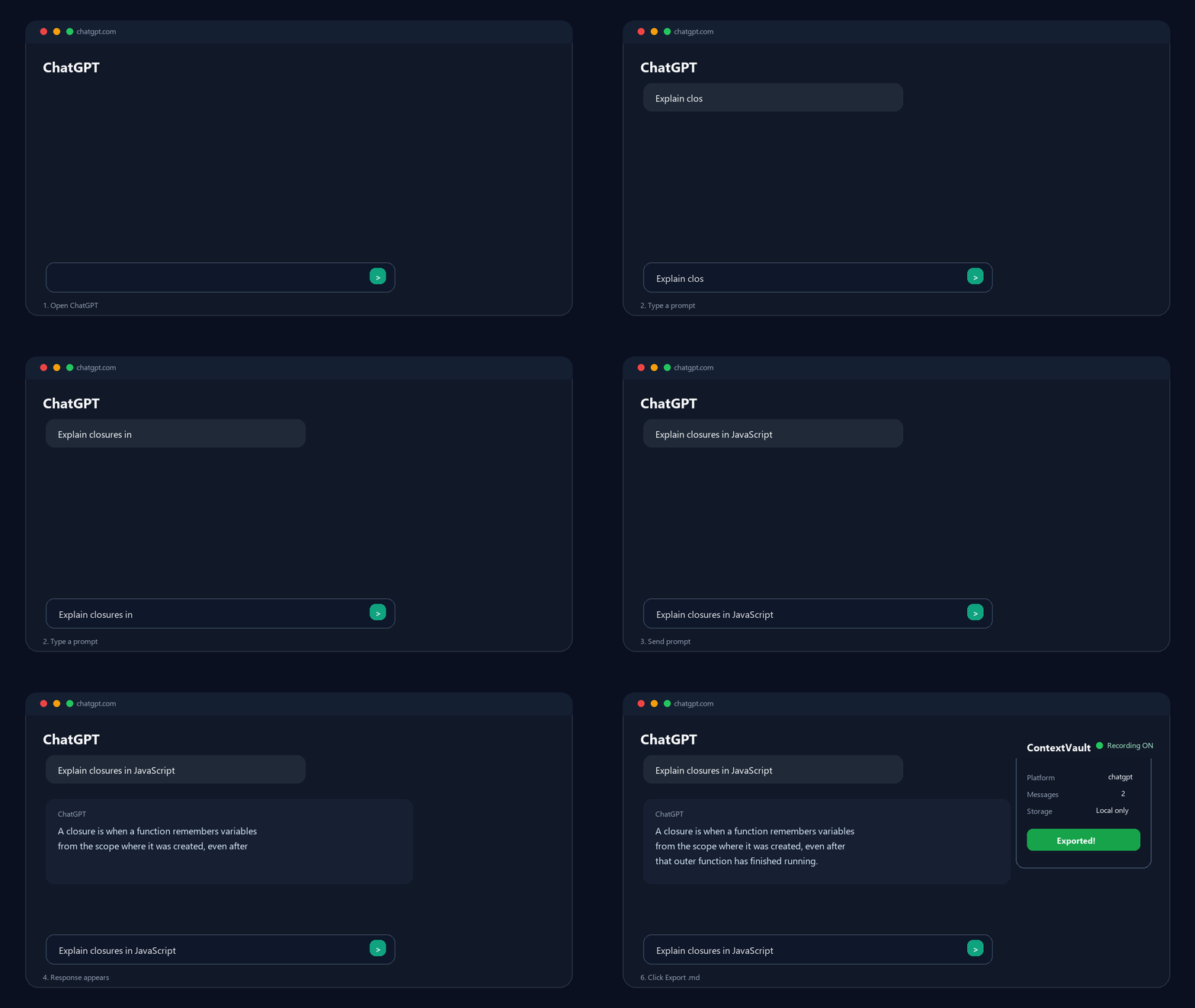
Your AI conversations should not be trapped inside platforms.
The Problem
By 2025, most developers use multiple AI tools every day.
- ChatGPT for quick questions
- Claude for long reasoning
- Gemini for research
- Perplexity for analysis
But every platform stores conversations separately.
That creates a frustrating workflow:
- Conversations get cut when context windows fill up
- Switching platforms destroys continuity
- Exporting chats is painful or incomplete
- Your history is tied to accounts you don’t control
- There’s no unified search across platforms
In short:
The knowledge you build with AI is trapped inside isolated silos.
Why Existing Solutions Didn’t Feel Right
Some tools try solving this problem, but they usually require:
- Paid APIs
- Backend servers
- Account linking
- Cloud syncing
- Monthly subscriptions
I wanted something simpler.
A question kept bothering me:
What if every AI conversation stayed entirely inside the browser?
No backend. No accounts. No tracking.
The Solution: ContextVault
ContextVault is an open-source Chrome extension that captures AI conversations locally while you use platforms like:
- ChatGPT
- Claude
- Gemini
- Perplexity
- Poe
- DeepSeek
- Grok
- Microsoft Copilot
Everything stays on your machine.
No telemetry. No external storage.
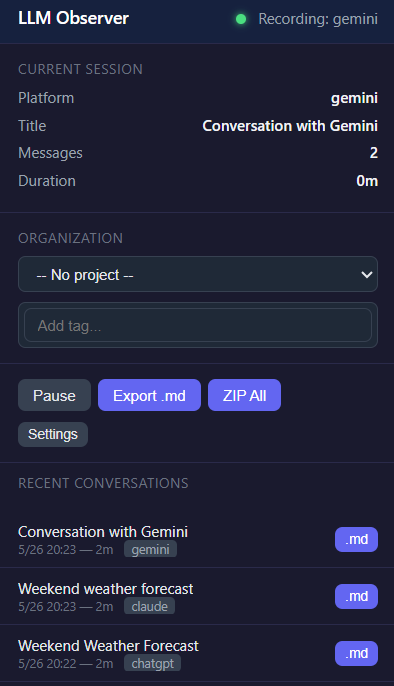
How It Works
Capturing AI conversations reliably turned out to be harder than expected.
There were two major problems:
Selectors, layouts, and rendering logic differ completely between ChatGPT, Claude, Gemini, and others.
2. AI responses stream in real time
Messages arrive token-by-token instead of all at once.
To solve this, ContextVault uses a 6-layer architecture:
Adapters → Capture → Stream Assembler → Background Worker → Storage → Export
1. Adapters Layer
Each platform has its own adapter implementing a shared interface:
interface LLMAdapter {
  platform: Platform
  urlPattern: RegExp
  messageContainer: string
  userSelector: string
  assistantSelector: string
}
Each adapter knows how to:
- Detect the platform
- Locate messages
- Handle UI differences
2. Capture Layer (DOM + Network)
This is the core system.
DOM Observer
A MutationObserver watches the conversation UI in real time.
It detects:
- New messages
- Streaming updates
- Edited content
Network Monitor
The extension also patches:
- fetch
- XMLHttpRequest
- WebSocket
This provides early access to streaming responses directly from network traffic.
Why both?
- DOM reflects exactly what the user sees
- Network capture improves streaming accuracy
Using both together dramatically reduced missed messages.
3. Stream Assembler
AI responses arrive in chunks like:
"Hel"
"lo "
"world"
The Stream Assembler rebuilds complete messages while handling:
- Chunk merging
- Duplicate removal
- Completion detection
4. Background Worker
The background worker manages:
- Active sessions
- Conversation lifecycle
- Deduplication
- Streaming updates
- Conversation linking
It also prevents duplicate saves during rapid streaming events.
5. Storage Layer (IndexedDB)
Everything is stored locally using IndexedDB.
Stored data includes:
- Conversations
- Drafts
- Settings
- Projects
Each conversation stores:
- Platform
- Messages
- Timestamps
- Model information
- Tags
- Conversation chains
No external database is used.
6. Export Layer
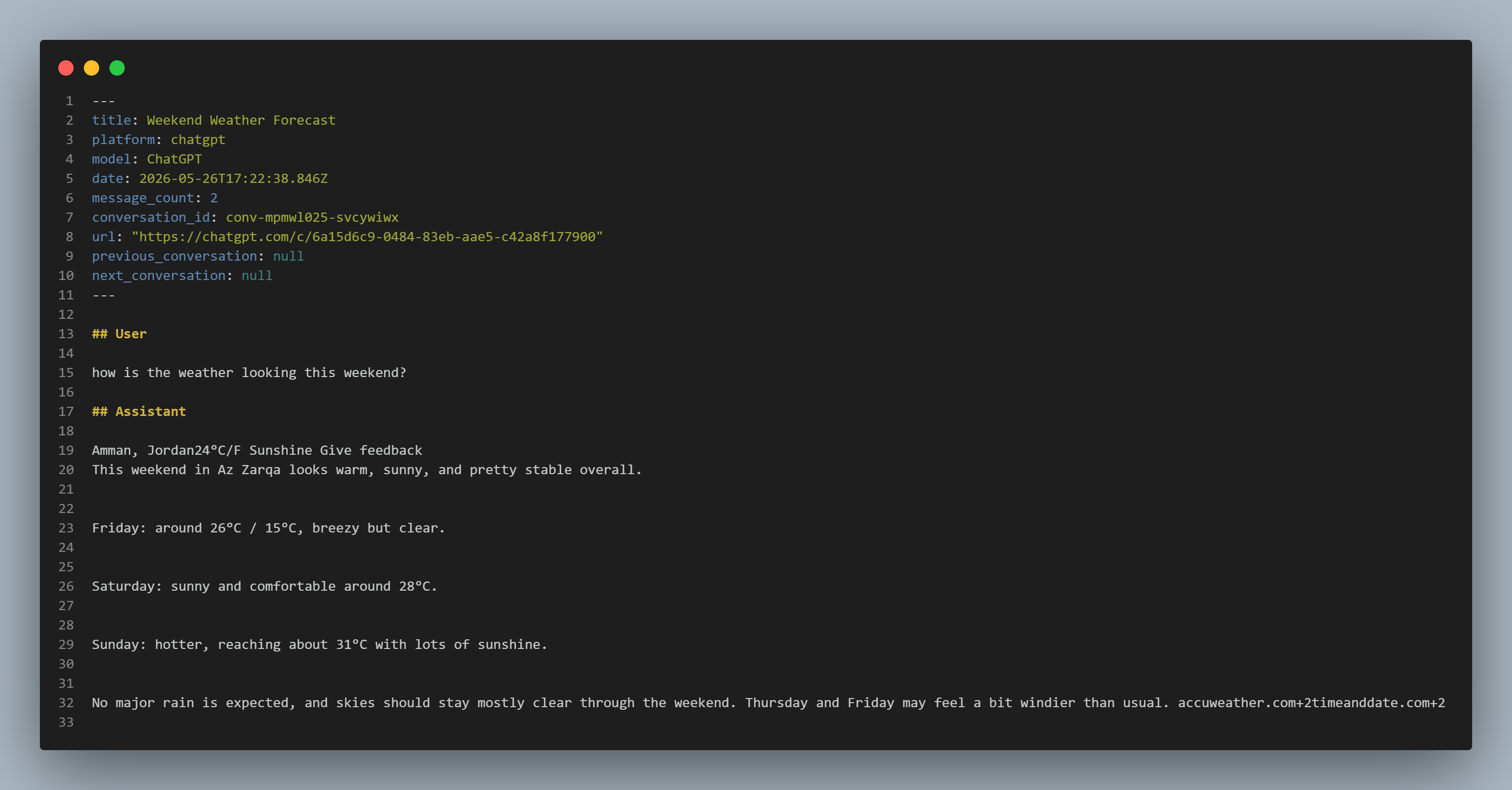
Conversations can be exported as:
Example output:
## User
How do I design a secure API?

## Assistant
Start with authentication, validation, and rate limiting...
Privacy First
ContextVault was designed around one principle:
Your conversations belong to you.
So the extension:
- Has no backend server
- Uses no analytics or telemetry
- Works fully offline
- Only activates on supported AI domains
- Never sends your conversations anywhere
Tech Stack
- TypeScript
- Manifest V3
- CRXJS + Vite
- IndexedDB
- MutationObserver
- JSZip
- Vitest
Final Thoughts
AI tools are becoming part of how we think, not just how we code.
But memory between tools is still broken.
Every platform acts like a closed silo where conversations disappear the moment you switch workflows.
ContextVault is my attempt to fix that.
A lightweight browser extension that keeps your AI conversations portable, searchable, and fully yours.
Links
GitHub: https://github.com/aliabdm/ContextVault
Demo: https://context-vault-two.vercel.app/
Portfolio: https://senior-mohammad-ali.vercel.app/
LinkedIn: https://www.linkedin.com/in/mohammad-ali-abdul-wahed-1533b9171/
