When you first start writing smart contracts on the EVM chains, your journey usually begins in Remix. It is a powerful, open-source web and desktop application for writing, compiling, testing, and deploying code, making it a fantastic tool for quick iterations and local simulations. But eventually, you outgrow it. Even with its robust features, a localized environment does not perfectly replicate how your contract will interact with live mainnet state.
To truly test a protocol, you move to a public testnet. This is where the engineering friction begins.
You suddenly need to set up an Alchemy or Infura account just to get an RPC URL. Then comes the faucet fatigue. You scour Discord or click traffic lights on web pages just to beg for a fraction of Sepolia ETH. Many faucets now require a minimum mainnet balance to prevent spam. This is a massive roadblock if you are following basic security practices.
To protect your real-world funds, you should never paste your primary wallet's private key into a local .env file where an accidental GitHub push or a malicious package could expose it. Instead, you use fresh, $0-balance "dummy" accounts. But when a faucet requires a mainnet balance, it breaks this safety measure, forcing you to either risk your real wallet or fund a dummy account with real money just to get testnet tokens. Others force you to connect your personal social media and tweet just to get a single drop.
If you are designing a system that requires multiple actors like a Client, a Provider, and an Arbiter in an Escrow, this friction multiplies. You either have to repeat this frustrating process for three separate wallets, or manually transfer tokens between them. And ironically, those manual transfers still cost you the precious testnet gas you just spent time trying to collect.
The testing infrastructure quickly becomes more exhausting than writing the actual architecture.
Recently, I began exploring ways to reduce this environmental friction and found a highly practical workflow using contract.dev. It provides the visual simplicity of a tool like Remix, but on a globally accessible, private EVM testnets that replay mainnet state and come with built-in tools for testing, analysing, and simulating smart contracts before launch.
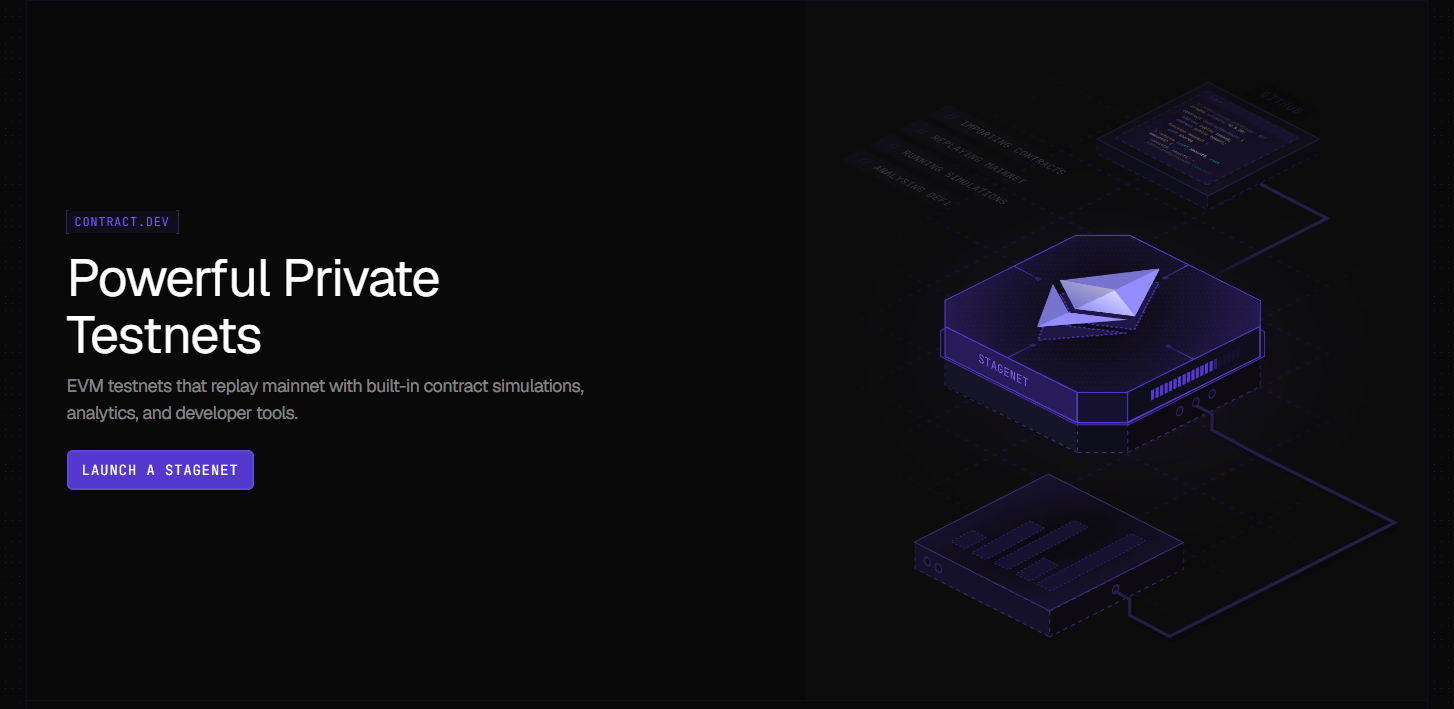
Here is a look at how I approach testing a 3-actor Escrow system visually, eliminating local node overhead and faucet fatigue so I can focus purely on protocol behavior.
The Architecture: A Trust-Minimized Escrow
To demonstrate this workflow, I built TrustEscrow.sol. The architecture is designed to be reusable and relies on strict access control across three distinct roles:
- Client: Funds the escrow.
- Provider: Executes the work and receives the funds.
- Arbiter: A neutral third party that resolves disputes.
Because the state transitions depend entirely on who is calling the function, verifying role transitions is critical. I explicitly designed this contract with a resetEscrow function to allow continuous lifecycle testing without needing to redeploy the contract. Here is the core state machine governing the escrow:
enum Stage {
    AwaitingFunding, // 0 - deployed or reset, waiting for client
    Funded,          // 1 - ETH held; work in progress
    Completed,       // 2 - client released funds; ready for reset
    Disputed,        // 3 - either party raised a dispute; arbiter needed
    Resolved         // 4 - arbiter settled dispute; ready for reset
}
Stage public stage;
(Note: Making the state explicitly public is a deliberate choice here, it allows visual dashboards to read and display the exact stage of the protocol later in the workflow).
Normally, verifying these transitions requires writing extensive .t.sol files with heavy vm.prank() overhead. Here is how we can verify them visually on a live network instead.
Step 1: The Instant Environment (No Alchemy, No Faucets)
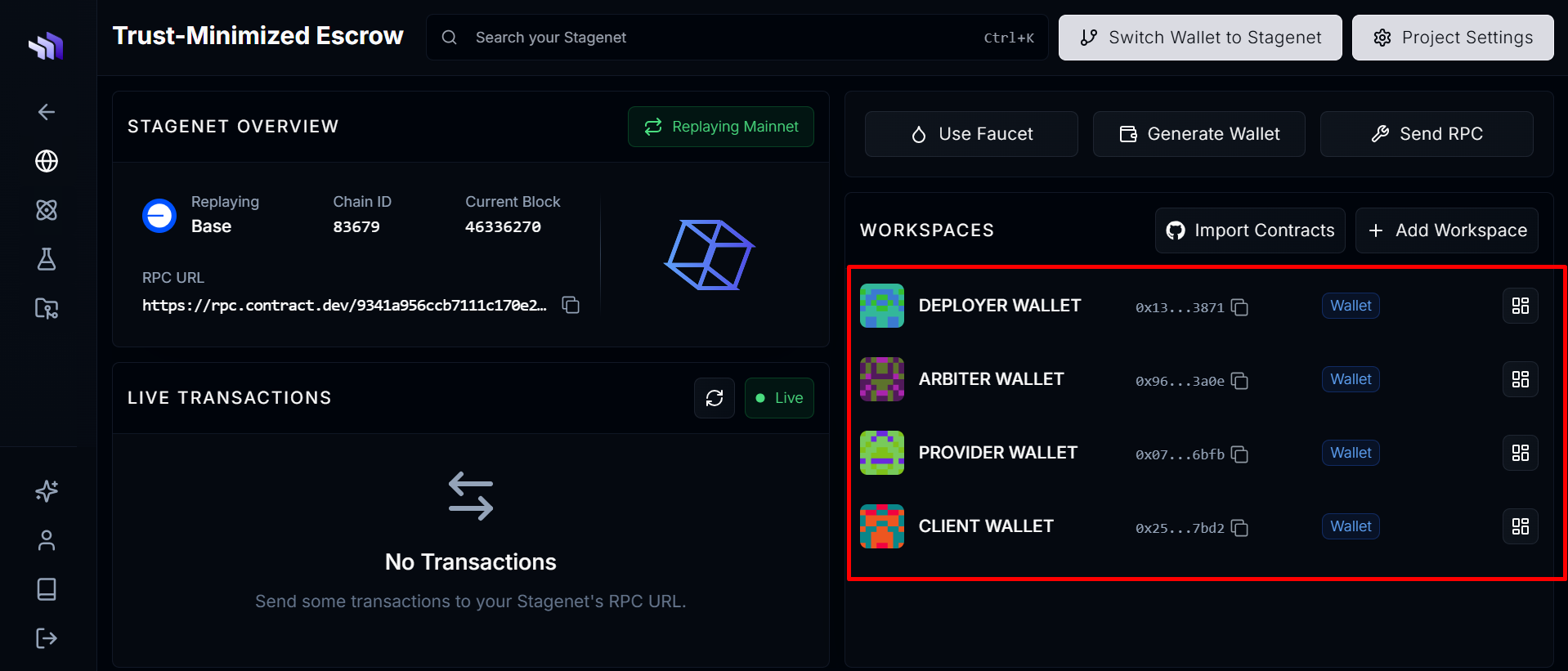
The immediate relief of this workflow is the infrastructure. By creating a project on contract.dev, I was instantly handed a live Stagenet RPC URL. No third-party node providers required.
To test this escrow, I needed three distinct, funded wallets. Instead of configuring these locally or begging a public faucet, I used the platform's Wallet Generator to spin up accounts for the Client, the Provider, and the Arbiter.
Using the built-in Stagenet Faucet, I funded the Client's wallet with 100 ETH instantly. This is a live RPC that anyone in the world can interact with. You get the freedom of a public testnet without the artificial scarcity of testnet tokens.
Step 2: CI/CD Sync and Deployment
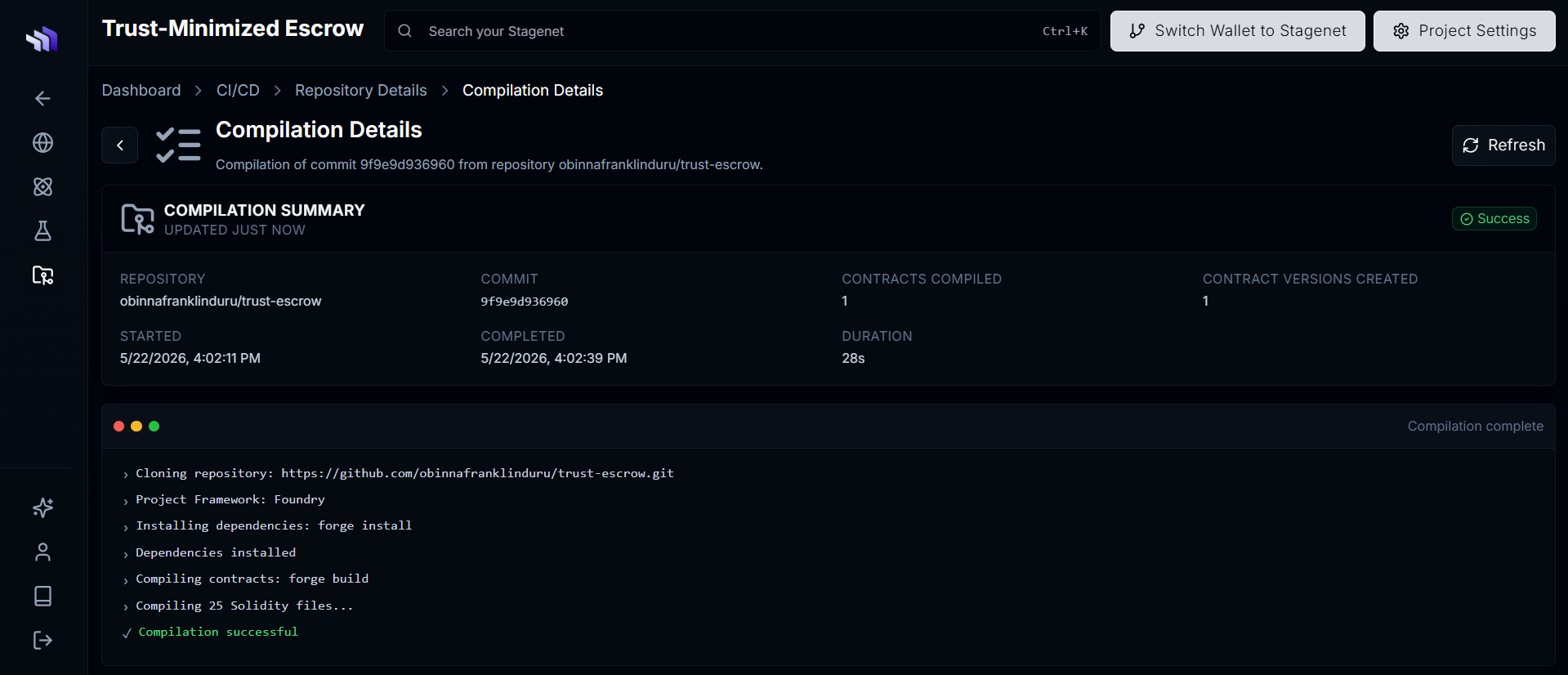
Unlike local nodes, the platform doesn't just guess your contract's ABI. By linking my GitHub repository, the platform's CI/CD pipeline automatically synced and compiled my Foundry project.
To deploy, I didn't have to learn a new framework. I simply opened my terminal and ran my standard Foundry deployment script (forge script), pointing it to the new Stagenet RPC and my newly funded wallet private key.
The moment the transaction confirmed on the network, the platform detected the deployed contract and automatically generated a Workspace: a dedicated visual dashboard perfectly mapped to my Solidity code.
(Crucial note for advanced developers: Unlike a local simulation, this Stagenet utilizes Mainnet Replay. It actively mirrors live mainnet state. If your contract interacts with live Uniswap liquidity or Chainlink oracles, you can test against those live states immediately without writing complex fork scripts).
Step 3: Verifying State Transitions
When testing architecture, immediate feedback is invaluable. Using the Account Impersonation feature directly from the dashboard UI, I impersonated the Client and executed the fundEscrow() transaction with 1 ETH.
The Workspace updated in real-time to reflect the new reality. Instead of relying on terminal queries or cast call commands, the dashboard visually confirmed that the contract balance was strictly locked at 1 ETH, and the stage variable had transitioned correctly from AwaitingFunding to Funded.
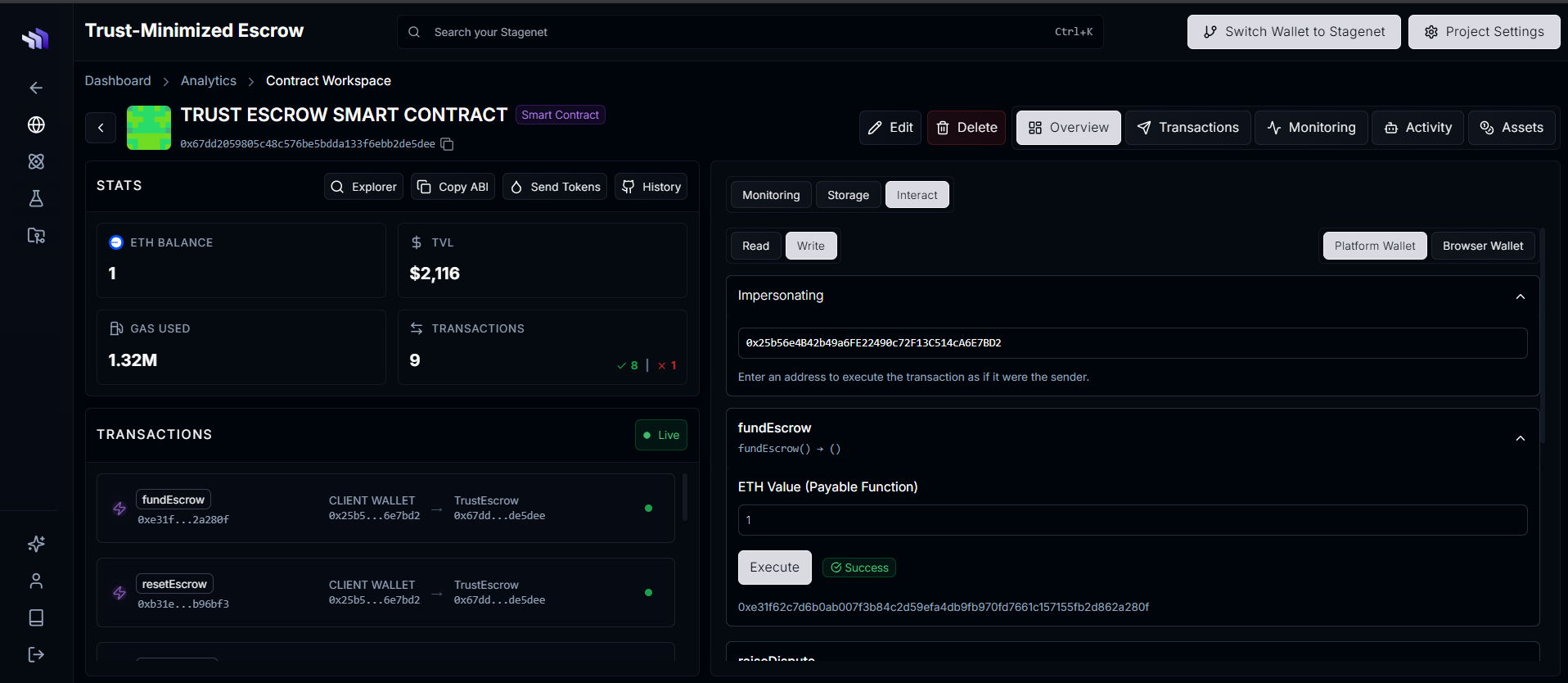
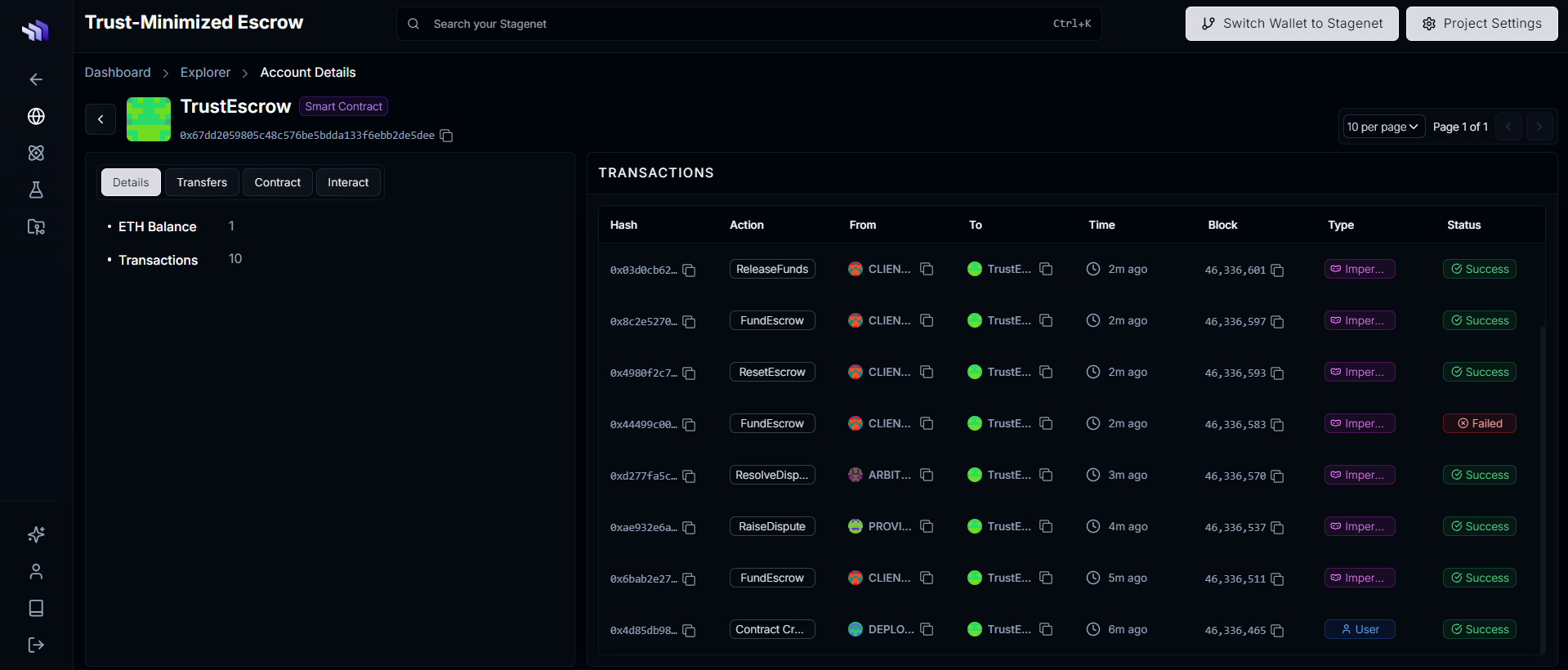
Continuing the simulation, I impersonated the Provider to raise a dispute, and finally the Arbiter to resolve it. The entire lifecycle of a complex 3-actor protocol was verified in seconds.
Step 4: Automating the Ecosystem (AI User Activity)
Manually clicking through a happy path is great for an initial sanity check. But what if you want to simulate a living, breathing protocol under continuous load? Normally, this requires writing complex Hardhat scripts or custom bots to continuously fire transactions and redeploy contracts.
This is where my workflow completely changed.
The platform includes an Activity Scheduler powered by AI. Instead of writing mock scripts, the AI reads your contract's source code, ABI, and storage layout, and designs realistic user personas for your specific protocol.
Because I built TrustEscrow to be reusable via the resetEscrow function, the AI was able to create infinite, continuous testing loops. With one click, it generated new dummy wallets, funded them, and scheduled recurring transaction workflows. In my Workspace, it automatically created two distinct, recurring timelines:
The Happy Path: It scheduled the Client to fundEscrow, releaseFunds, and resetEscrow every 20 blocks.
The Dispute Path: It scheduled a complex continuous workflow of fundEscrow -> raiseDispute -> resolveDispute -> resetEscrow every 30 blocks.
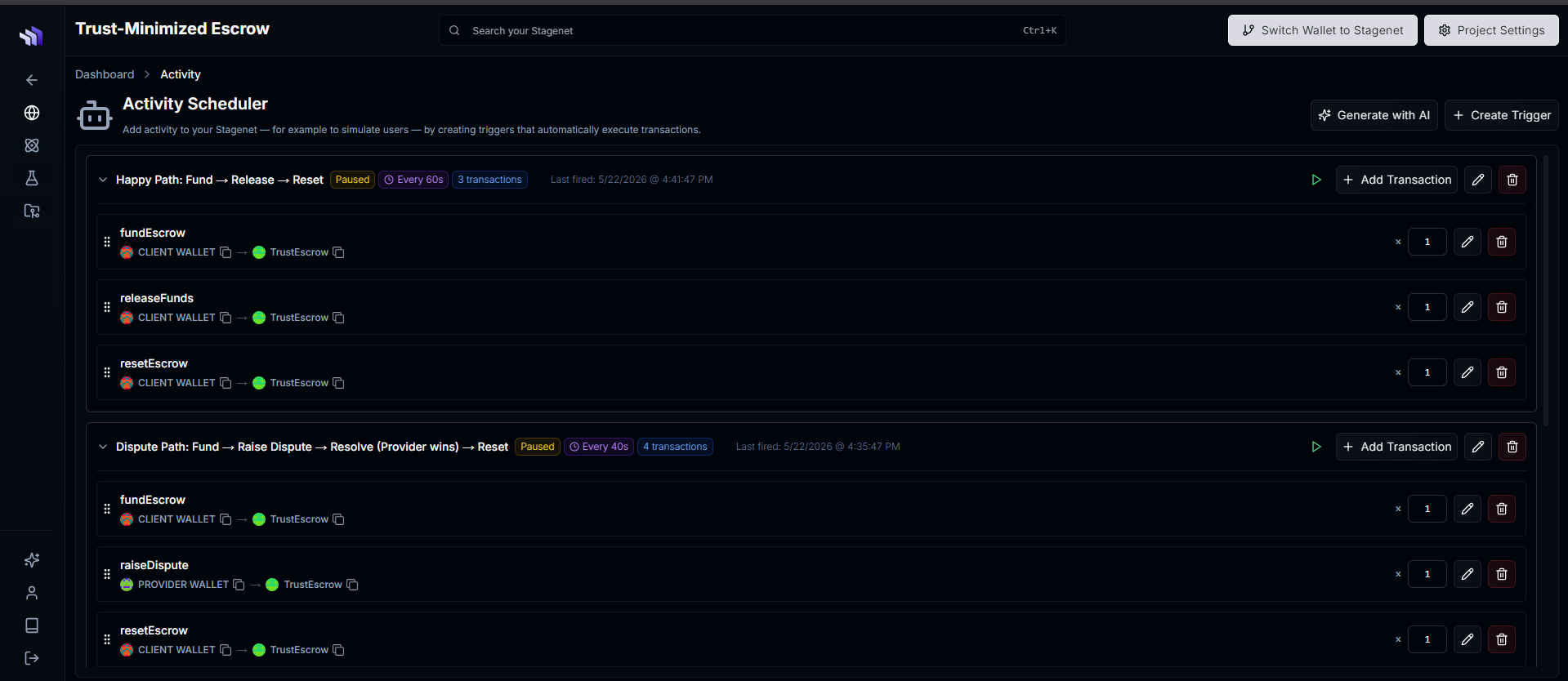
I didn't have to write a single line of testing script. I was able to sit back and watch the Stagenet process concurrent, multi-actor state transitions continuously.
Bridging the Frontend Gap
Beyond testing smart contract logic, this approach solves a very real integration problem.
When you build in Remix or on a local Anvil node, handing the protocol off to a frontend developer usually requires them to recreate your local environment just to build the UI.
Because a Stagenet is a persistent, globally accessible network, you can simply share the RPC URL with your frontend team. You hand them a live, fully-funded sandbox where the AI Activity Simulator is already generating realistic background traffic. They can begin building the interface immediately against predictable, living data.
Final Thoughts
Smart contracts handle real value, so engineering them requires a deep focus on security, invariants, and mathematical correctness. Testing infrastructure should support that focus, not distract from it.
While robust local environments are great for early iterations, serious architecture requires a production-like setting. Visual testing on a Stagenet makes it easier to observe protocol behavior, simulate concurrent user activity, and collaborate with your team without getting bogged down in RPC setups and faucet fatigue.
If you are tired of fighting local nodes to test multi-wallet architecture, I highly recommend integrating a visual Stagenet into your workflow.
You can view the full TrustEscrow architecture on my GitHub here: github.com/obinnafranklinduru/trust-escrow
Glossary of Terms (For the Curious)
- EVM (Ethereum Virtual Machine): The underlying engine that processes and executes smart contracts on Ethereum and other compatible blockchains. Web2 Analogy: Think of it like the global operating system or server environment (like Node.js or AWS) that runs your code.
- RPC URL: The digital bridge that allows your interface to communicate with the blockchain. Web2 Analogy: Just like an API endpoint connects a frontend web app to a backend database.
- Faucet: A developer service that provides free test tokens. Web2 Analogy: Like getting free "sandbox credits" in Stripe to test payments without using real credit cards.
- Mainnet vs Testnet: Mainnet is the live network with real financial value. A testnet is a public sandbox with zero-value tokens. Web2 Analogy: Mainnet is your live "Production" environment. A testnet is your "Staging" environment.
- Stagenet: A private testing environment that actively mirrors the live mainnet state. Web2 Analogy: A high-fidelity staging server that has been perfectly synced with a live copy of your production database.
- Private Key: The secret cryptographic password that grants total control over a wallet and its funds. Web2 Analogy: The root password to your bank account.
.env File: A hidden local file used to store sensitive information securely. Web2 Analogy: It serves the exact same purpose in Web2—keeping API keys and passwords out of public GitHub repositories.- ABI (Application Binary Interface): A file that acts as a translation manual telling a frontend exactly how to interact with a compiled smart contract. Web2 Analogy: Like an OpenAPI/Swagger document that defines the endpoints and expected payloads for a REST API.
- State Machine: An architectural pattern where a contract can only exist in one specific stage at a time (e.g., AwaitingFunding or Completed). Web2 Analogy: Like an e-commerce order that must strictly move from 'Pending' -> 'Shipped' -> 'Delivered' without skipping steps.
- Foundry: A fast, specialized command-line toolkit used for compiling, testing, and deploying smart contracts. Web2 Analogy: A mix between a build tool (like Webpack) and a testing framework (like Jest).
vm.prank(): A specific testing command used to impersonate a different user to verify access controls. Web2 Analogy: Like a "Login as User" feature in an admin dashboard to test what a specific customer sees.

