
Most systems don’t fail because of syntax — they fail because of how they handle flow.
At scale, software is no longer just about executing logic. It’s about orchestrating movement: requests, data, and work units flowing through a system under pressure. Different runtimes don’t just process tasks — they shape how work moves. And those choices define whether your system degrades gracefully… or collapses under load.
A Pragmatic Guide for Scalable Systems
Most systems don’t fail because of syntax. They fail because of poor decisions around concurrency and scaling.
If you’re building systems that need to handle real-world load, your runtime choice is not just an implementation detail — — it’s an architectural decision.
The Core Distinction
• Concurrency = handling many tasks
• Parallelism = executing tasks simultaneously
The real question is: How does your runtime use CPU cores?
Comparative Overview
Node.js
• Event loop (non-blocking I/O)
• Scales via processes (cluster)
• 1 process = 1 core
Go
• Goroutines (lightweight tasks)
• Thousands mapped to few threads
• Efficient multi-core usage
Python
• Threads, asyncio, multiprocessing
• True parallelism only via processes
• GIL limits threading
Node.js — — Process-Level Scaling
`const cluster = require(‘cluster’);
if (cluster.isPrimary) {
for (let i = 0; i < require(‘os’).cpus().length; i++) {
cluster.fork();
}
}`
• Scale = replicate processes
• No shared memory
• Strong for I/O, weak for CPU
Go — — Concurrency as a Primitive
go handleRequest()
• Massive concurrency with low overhead
• Scheduler handles complexity
• Designed for high-throughput systems
Python — — Power with Constraints
Threading
threading.Thread(target=task)
Multiprocessing
Process(target=task)
Async
async def task(): …
Flexible but fragmented model
Requires deliberate architecture
Quick Comparison
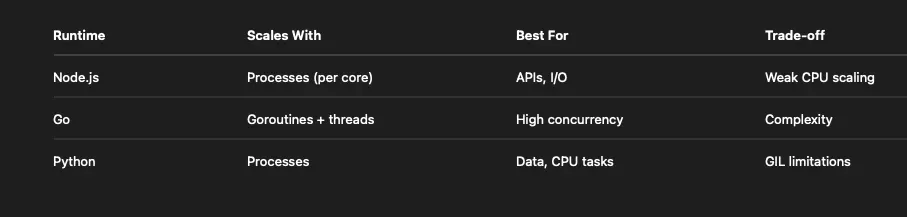
Use Case Mapping
• APIs → Node.js or Go
• Streaming systems → Go
• CPU-heavy workloads → Python (multiprocessing)
• Data / ML → Python
Key Takeaways
• Node.js: simple, effective, but process-bound
• Go: best-in-class concurrency model
• Python: powerful ecosystem, weaker runtime model
Final Perspective
There is no best language — — only trade-offs.
Senior engineering is about understanding those trade-offs early:
• Workload type (I/O vs CPU)
• Scaling strategy (cores vs machines)
• Operational complexity
Modern AI tooling makes it trivial to generate working code.
But scalable systems are not the result of code generation.
They are the result of:
• Correct architectural decisions
• Appropriate concurrency models
• Deep understanding of runtime behavior
Code gets you started.
Architecture determines whether your system survives production.