If you've ever searched something on Google, you've already used pagination.
Google has billions of results, and instead of loading everything at once, it breaks them into pages so users can browse step by step.
The same idea applies to modern web apps.
When your website or app has a lot of data, products, users, posts, or records, showing everything at once becomes messy and slow.
That’s where Shadcn Pagination helps.
If you're building with React, Next.js, or shadcn/ui, these Shadcn Pagination Components can help you organize large datasets cleanly and improve user experience.
Pagination is a UI pattern used to split large content or datasets into multiple pages.
Instead of rendering 500 items in one long list, pagination breaks them into smaller manageable chunks.
Example use cases:
- Product listings
- Blog archives
- Admin dashboard tables
- Search results
- Documentation pages
Shadcn UI Pagination gives you a flexible and customizable way to build this pattern in modern React apps.
As your app grows, your data grows too.
Without proper pagination, performance drops and users struggle to navigate large datasets.
- Improves page load speed
- Makes large data easier to handle
- Gives users better navigation control
- Works well with APIs and server-side data
- Keeps UI structured and clean
- Easy to integrate into tables and lists
Stop struggling with messy lists. Today I’m sharing my favorite Shadcn pagination examples to help you build a cleaner, more professional web interface in minutes.
A modern pill-style pagination component with rounded active states.
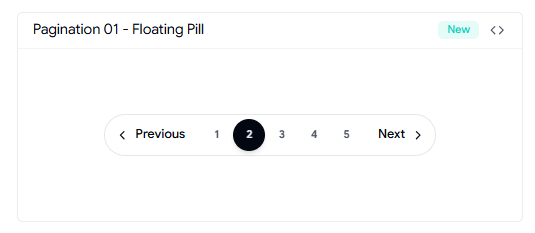
Features
- Modern floating design
- Great for SaaS and dashboard UIs
- Easy to integrate into any React project
A more polished pagination design with premium visual styling.
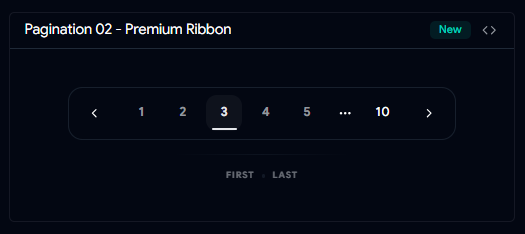
Features
- Premium ribbon-inspired appearance
- Best for high-end landing pages
- Clean active/hover states
Built for interfaces with many pages.
Instead of forcing users to click repeatedly, this variant makes jumping across page ranges easier.
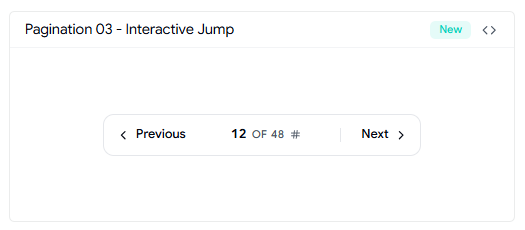
Features
- Ideal for large datasets
- Better navigation for deep pagination
- Improves usability in data-heavy apps
⬇️ Get these Shadcn Paginations
Classic pagination with previous and next controls.

Features
- Includes directional navigation
- Familiar UI pattern
- Great for blogs and search pages
Minimal pagination without page numbers.
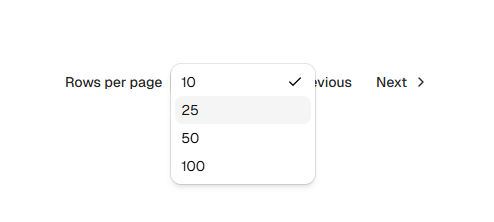
Useful when page numbers are not necessary.
Features
- Previous / Next only
- Great for tables with row selectors
- Cleaner compact layout
Simple & straightforward page-number-based pagination component.
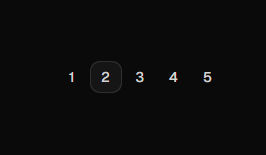
Features
- Simple and lightweight
- Easy to customize
- Works in most use cases
⬇️ Get these Shadcn Paginations
Most modern Shadcn Pagination Variants support:
- Previous, next, and page controls
- Active page highlighting
- Client-side and server-side data handling
- Flexible component structure
- Keyboard accessibility
- Fully responsive layouts
- Minimal design that fits most UIs
Pagination is not just about splitting content.
It improves both performance and usability.
Rendering too much data at once can:
- Slow down the page
- Increase API load
- Confuse users
- Hurt mobile experience
A good pagination system keeps your UI fast, structured, and scalable.
FAQ
Yes. Pagination improves internal linking structure and helps search engines understand relationships between content pages.
No. Pagination should only be used where content is split across multiple views or datasets.
Absolutely. Pagination is commonly used in:
- Admin panels
- Analytics dashboards
- User management tables
- Large data reports
Final Thoughts
Pagination is one of those small components that has a big impact on usability.
Whether you're building a dashboard, blog, product listing, or admin panel, having the right Shadcn Pagination Component makes your interface easier to use and easier to scale.
Instead of building from scratch, use these Shadcn UI Pagination Examples as a starting point and customize them to fit your project.
Check out this curated collection of Shadcn Pagination Components to explore more modern pagination patterns for your React and Next.js projects.

Feel free to send it to me on:
I’d love to review it and feature it here.