Benchmarking four open-source OCR engines on 5,578 handwritten medical prescriptions
Key Takeaways
- PP-OCRv5 (5M parameters) and GLM-OCR (0.9B parameters) both achieve 20%+ exact match on handwritten prescriptions, a 10x jump over Tesseract and EasyOCR
- GLM-OCR leads on character accuracy (CER 0.328), while PP-OCRv5 leads on word accuracy (WER 0.789)
- A 5M-parameter model trained on curated data rivals a 900M-parameter vision-language model
- Neither engine is clinically deployable yet: even the best gets only 1 in 3 words exactly right
Last month I spent some time squinting at prescription scans, trying to figure out if a doctor wrote Amoxicillin or Amitriptyline. I got it wrong twice. That got me wondering: how would today's OCR engines handle this?
The stakes are real. Medication errors injure approximately 1.3 million people annually in the United States alone and cost an estimated $42 billion globally (WHO, 2017). Illegible handwriting is a well-documented contributor: 35.7% of handwritten prescriptions contain errors, compared to just 2.5% of electronic ones (Albarrak et al., 2014).
A study of 4,183 prescriptions found that 10.21% of them are illegible, and 19.39% are barely legible (Albalushi et al., 2023). The global OCR market is projected to reach $32.9 billion by 2030, growing at a 14.8% CAGR (Grand View Research, 2025). Healthcare is one of the fastest-growing verticals driving that growth. But I couldn't find a public benchmark comparing today's open-source OCR engines on handwritten medical text.
So I ran one myself. I tested four engines on 5,578 handwritten prescription word images, and the results surprised me.
Who Are the Four Contenders?
These four engines span three generations of OCR thinking, from traditional pattern matching to specialized deep learning to generative vision-language models.
Tesseract: The Veteran
Google-backed and over 18 years old, Tesseract is the default OCR engine for a generation of developers. It uses an LSTM-based architecture designed primarily for printed text. Stable, well-documented, and runs everywhere, but handwritten cursive is not its strength.
EasyOCR: The Accessible One
Built on a CRNN (Convolutional Recurrent Neural Network) architecture with roughly 10 million parameters, EasyOCR's selling point is simplicity: pip install easyocr and you're recognizing text in 80+ languages. It uses deep learning but remains a traditional detection-recognition pipeline.
PP-OCRv5: The Data-Centric Specialist
Baidu's latest, with just 5 million parameters. PP-OCRv5 uses an SVTR_LCNet architecture with a Guided Training of CTC (GTC) strategy. The real innovation isn't the architecture, though. It's the training data.
The PP-OCRv5 paper (Cui et al., 2026) shows that data quality trumps model scale. They curated 22.6 million training samples by filtering along three dimensions. First, difficulty: they use model confidence as a proxy and found that samples in the [0.95, 0.97] range hit a sweet spot, hard enough to teach the model something new, but not so hard that the labels are unreliable. Second, accuracy: they cross-check predictions against labels to weed out mislabeled samples. Third, diversity: they cluster training images into 1,000 visual groups using CLIP embeddings and ensure each cluster is represented. Together, these filters yielded 2-3x improvements in handwritten recognition from v3 to v5 without changing the model architecture.
GLM-OCR: The Compact Vision-Language Model
From Zhipu AI and Tsinghua University, GLM-OCR takes a fundamentally different approach. It's a 0.9-billion-parameter multimodal model combining a 0.4B CogViT vision encoder with a 0.5B GLM language decoder (Duan et al., 2026). Rather than traditional CTC or attention-based sequence recognition, it generates text autoregressively, like a language model that reads images.
An important note: 0.9B is compact for a vision-language model. For comparison, Qwen3-VL has 235 billion parameters and GPT-4o is even larger. GLM-OCR was designed for efficiency, using Multi-Token Prediction (MTP) to generate approximately 5.2 tokens per decoding step, yielding a roughly 50% throughput improvement over standard autoregressive generation. It's trained through a 4-stage pipeline that includes supervised fine-tuning and GRPO reinforcement learning.
These four engines represent a clear spectrum: traditional (Tesseract), specialized deep learning (EasyOCR, PP-OCRv5), and generative VLM (GLM-OCR).
What Makes the RxHandBD Dataset So Hard?
We use RxHandBD (Shovon et al., Mendeley Data), a dataset of 5,578 cropped word images extracted from handwritten medical prescriptions written by doctors in Bangladesh. Each image contains a single word with a corresponding ground-truth label.
This dataset is hard for four reasons:
- Doctor's handwriting. Enough said.
- Medical terminology. Drug names like "Amoxicillin" and "Metformin" alongside dosage notations like "5% dns" and "1+0+1."
- Mixed language. English medical terms interspersed with Bangla script.
- Inconsistent quality. Varying paper backgrounds, pen types, and image capture conditions.
Here are a few samples to give you a sense of the difficulty range:
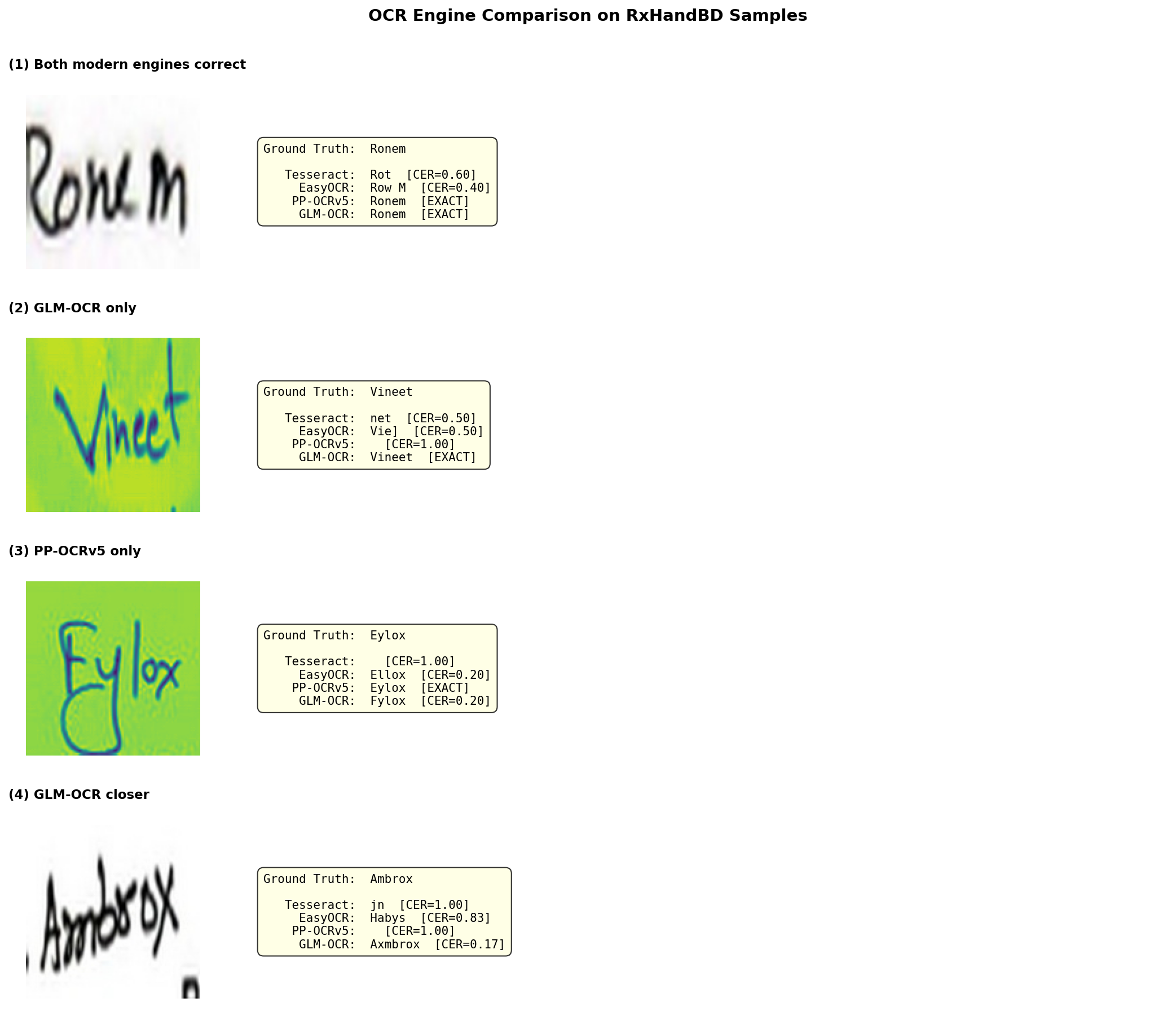
From top to bottom: a drug name both modern engines nail ("Ronem"), cases where only one engine succeeds ("Vineet" and "Eylox"), and a close call where GLM-OCR gets closest but still misses ("Ambrox").
One important methodological note: these are pre-cropped word-level images. We're isolating the recognition half of the OCR pipeline, not testing detection (locating text regions on a full page). This means our results reflect recognition accuracy only. Real-world performance also depends on how well each engine detects text regions before recognizing them.
How Did We Run the Benchmark?
Metrics
We evaluate using four complementary metrics:
- CER (Character Error Rate): Edit distance between predicted and reference strings, normalized by reference length. If the label says "Amoxicillin" (11 characters) and the OCR outputs "Amoxicilin" (1 deletion), the CER is 1/11 = 0.09. Lower is better.
- WER (Word Error Rate): Same concept at the word level. Any mistake in a word counts the entire word as wrong. Lower is better.
- Exact Match Rate: The strictest metric. Did the OCR output match the ground truth character-for-character after normalization? Higher is better.
- Latency: Wall-clock milliseconds per image, measuring practical throughput.
Setup
All engines run on an Apple Silicon Mac (CPU only). Single run. Default configurations for each engine with no fine-tuning or domain-specific adjustments. PP-OCRv5 runs its full detection + recognition pipeline even on pre-cropped images. GLM-OCR processes each image with the prompt "Text Recognition:".
What Do the Numbers Say?
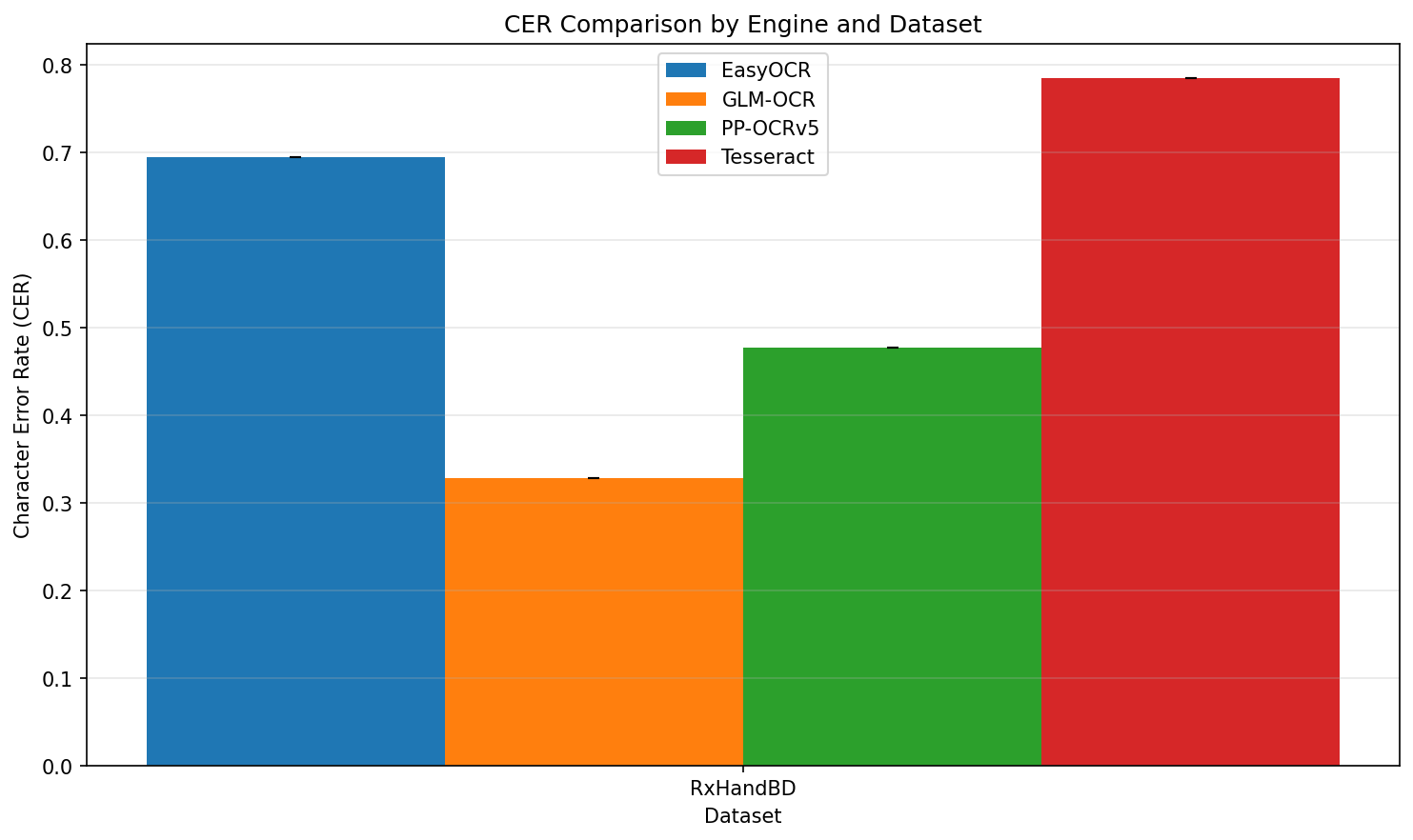
GLM-OCR achieves the lowest character error rate at 0.328, while PP-OCRv5 leads on word-level accuracy with a WER of 0.789. Both modern engines dramatically outperform the older generation, with exact match rates 8-13x higher than Tesseract or EasyOCR.
| Engine | Type | Parameters | CER (lower=better) | WER (lower=better) | Exact Match (higher=better) | Latency (ms/img) |
|---|
| Tesseract | LSTM | n/a | 0.785 | 1.043 | 2.5% | 49 |
| EasyOCR | CRNN | ~10M | 0.695 | 1.074 | 2.6% | 14 |
| PP-OCRv5 | SVTR+CTC | 5M | 0.477 | 0.789 | 21.4% | 103 |
| GLM-OCR | VLM | 0.9B | 0.328 | 0.801 | 32.6% | 141 |
Let me walk through what these numbers actually mean.
Finding 1: Tesseract and EasyOCR Barely Function on Handwriting
Both Tesseract and EasyOCR achieve under 3% exact match, meaning they get fewer than 1 in 40 words perfectly right. Their WER exceeds 1.0, which means on average they produce more errors than there are words. For practical purposes, these engines are unusable on handwritten medical text.
This isn't a knock on either project. Tesseract's LSTM architecture was optimized for printed text, and EasyOCR's CRNN similarly excels on clean, well-formatted inputs. Handwritten medical cursive is simply a different problem.
Finding 2: The Modern Engines Are a Generational Leap
PP-OCRv5 and GLM-OCR both break the 20% exact match barrier, a qualitative jump from the sub-3% performance of the older engines. The gap between "old" and "new" (a roughly 10x improvement in exact match) is far larger than the gap between PP-OCRv5 and GLM-OCR themselves.
Finding 3: Why Does GLM-OCR Win on Characters but Lose on Words?
This is the most interesting finding. GLM-OCR achieves a CER of 0.328, which is 31% lower than PP-OCRv5's 0.477. At the character level, the vision-language approach genuinely helps. GLM-OCR can use its language decoder's knowledge of likely character sequences to infer partially visible characters.
But PP-OCRv5 edges ahead on WER: 0.789 vs 0.801. It makes fewer word-level mistakes.
Why the divergence? My hypothesis: GLM-OCR's autoregressive generation occasionally produces subtle extra tokens or formatting variations. The GLM-OCR paper itself acknowledges "minor stochastic variation in formatting behaviors, particularly in line breaks and whitespace handling" (Duan et al., 2026). These small artifacts barely affect CER but can flip a word from "correct" to "incorrect" in WER/exact-match scoring.
The practical takeaway: which engine is "better" depends on your error metric. If you care about getting as close as possible character-by-character (for downstream spell-correction, for example), GLM-OCR wins. If you need clean word-level outputs with minimal postprocessing, PP-OCRv5 has the edge.
Finding 4: What Are the Real Deployment Trade-offs?
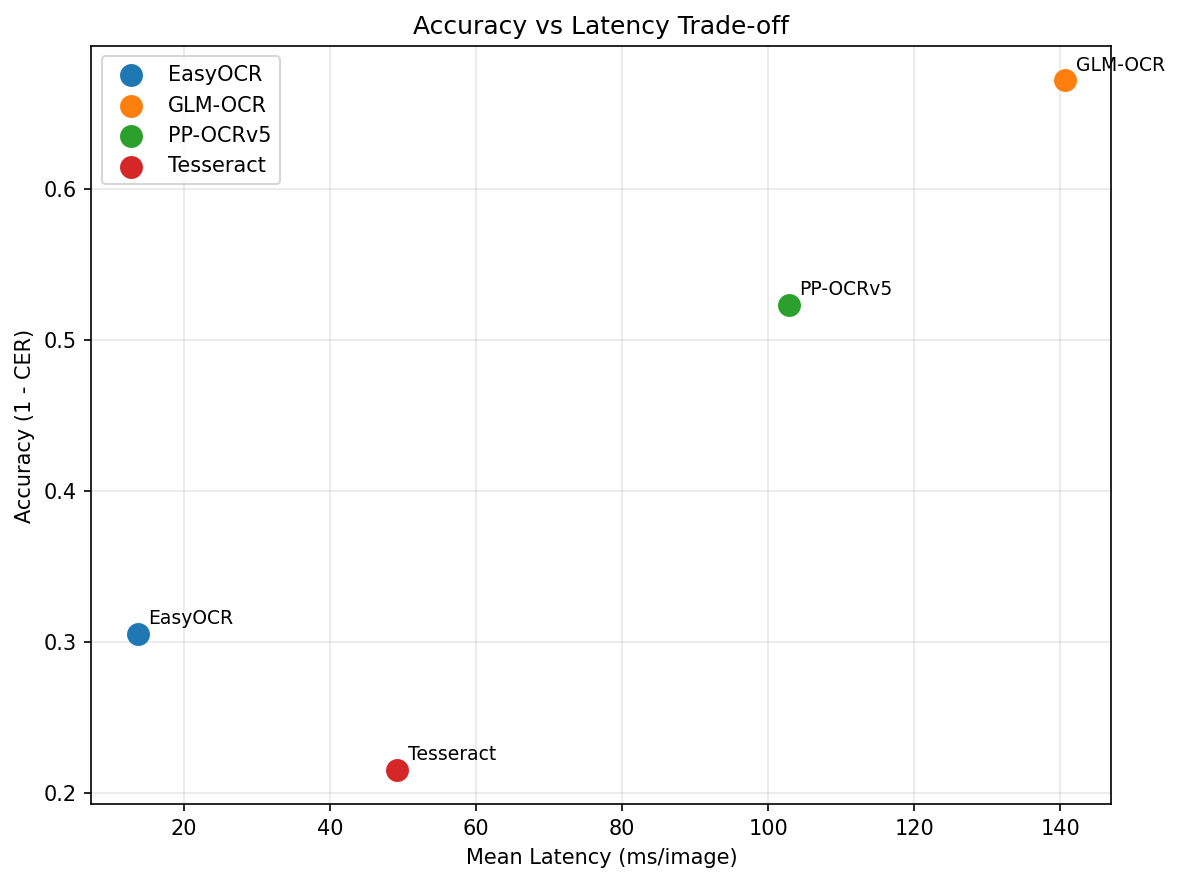
Both engines are fast enough for practical use. PP-OCRv5 processes images at 103ms each and GLM-OCR at 141ms. GLM-OCR's Multi-Token Prediction (generating roughly 5.2 tokens per step instead of one) keeps its inference speed competitive despite the larger model.
The bigger difference is model size and memory footprint. PP-OCRv5's 5M parameters take up roughly 20MB on disk, small enough for a Raspberry Pi or embedded device. GLM-OCR's 0.9B parameters need around 1.8GB at FP16 (less with quantization). Both run on CPU without a GPU, as our Apple Silicon benchmark shows, but GLM-OCR consumes significantly more RAM. The GLM-OCR paper notes that the model "enables deployment in both large-scale and resource-constrained edge scenarios" and supports frameworks like Ollama for local inference (Duan et al., 2026). For deploying across thousands of low-spec workstations, PP-OCRv5's small footprint is a clear advantage. For a centralized server or any machine with a few GB of RAM to spare, GLM-OCR is equally practical.
What Do the Predictions Actually Look Like?
Numbers tell one story. Seeing the actual predictions tells another. Here are four representative samples from the benchmark, hand-picked to illustrate each finding above.
GLM-OCR Nails a Complex Drug Name
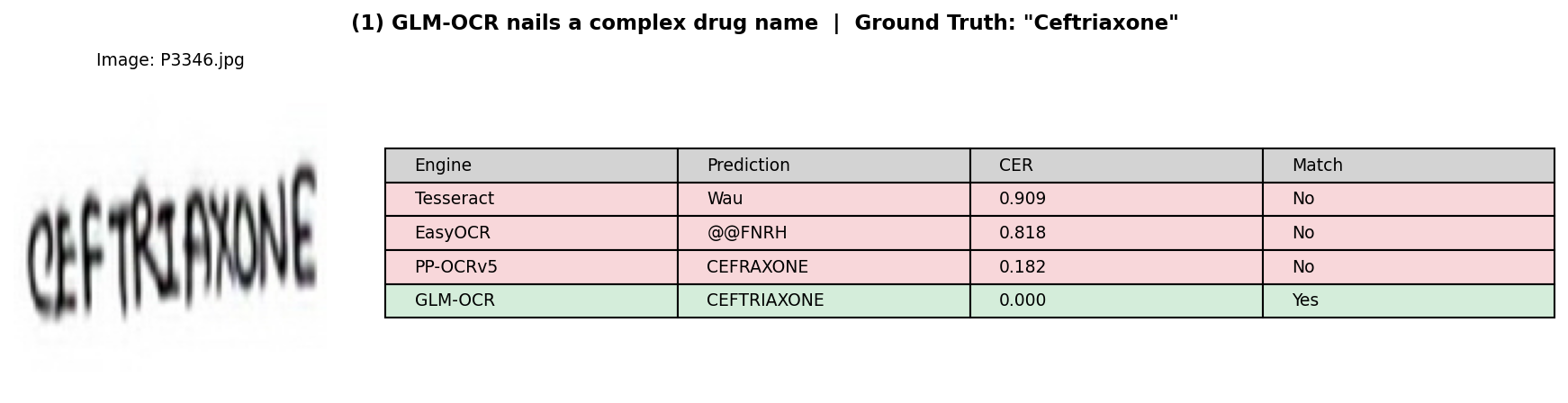
"Ceftriaxone" (a common antibiotic), 11 characters long. Tesseract reads "Wau" and EasyOCR produces "@@FNRH," both useless. PP-OCRv5 gets close with "CEFRAXONE" (CER=0.18, missing the 'ti'). Only GLM-OCR reads it perfectly. On long drug names, the language decoder's knowledge of likely character sequences gives it a real edge.
When PP-OCRv5 Is Closer and GLM-OCR Hallucinates
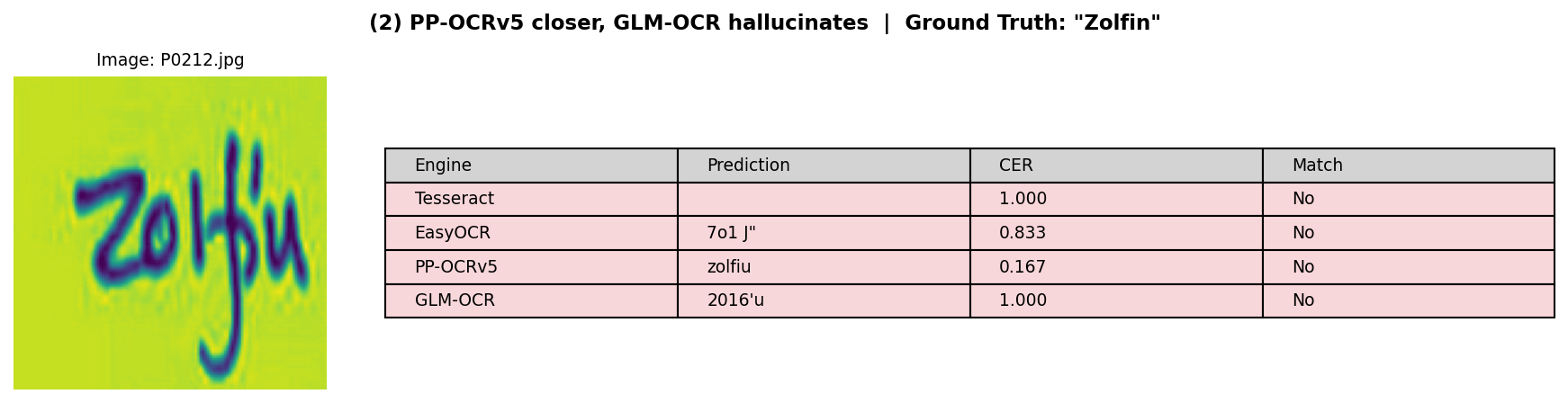
"Zolfin" (a proton pump inhibitor). PP-OCRv5 reads "zolfiu" (CER=0.17, just the last character wrong). GLM-OCR outputs "2016'u" (CER=1.0), completely misreading the word as a number. This is the flip side of the VLM approach: when the handwriting doesn't match patterns in the training data, the language model can steer the output in the wrong direction entirely.
GLM-OCR Nearly Perfect
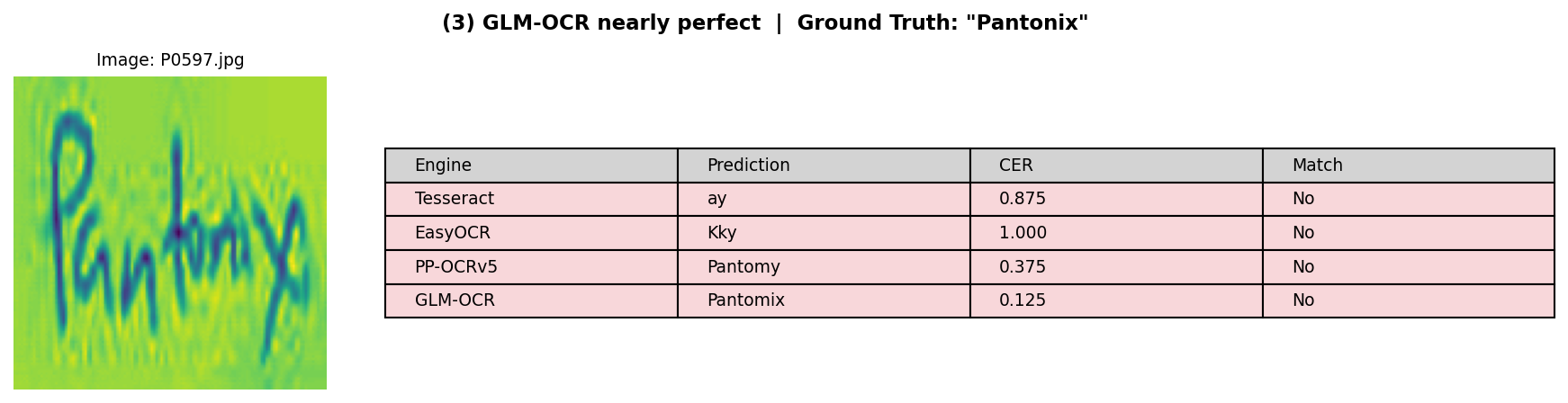
"Pantonix" (a pantoprazole brand). GLM-OCR outputs "Pantomix" (CER=0.125, one character off). PP-OCRv5 gets "Pantomy" (CER=0.375). Both are close, but GLM-OCR is three times more accurate by CER. Neither gets an exact match, which is the pattern behind Finding 3: GLM-OCR consistently gets closer character-by-character, even when neither engine gets the word exactly right.
When the VLM Goes Off the Rails
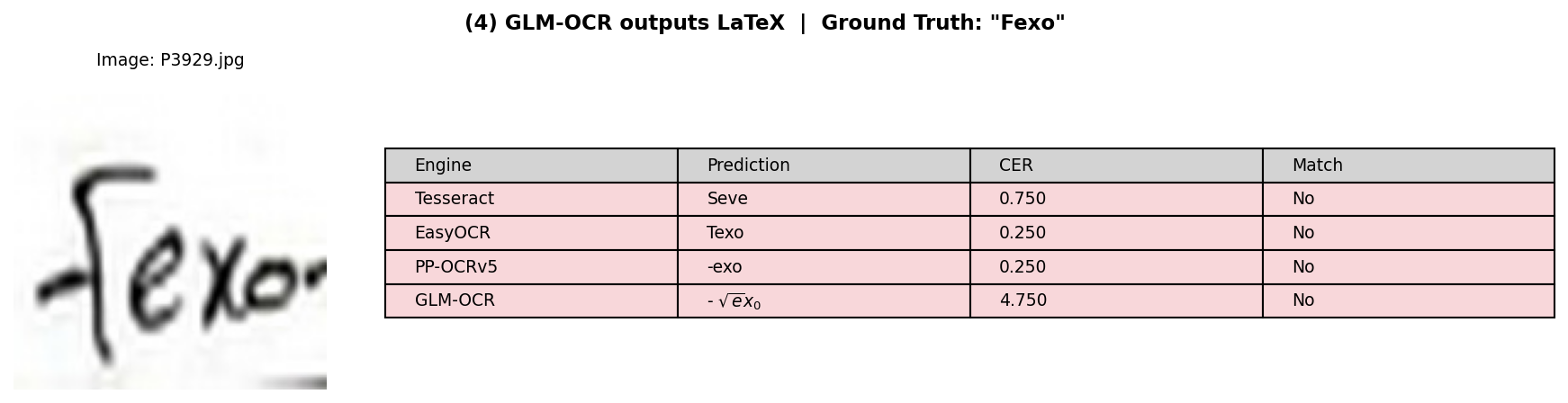
"Fexo" (fexofenadine, an antihistamine). EasyOCR reads "Texo" (CER=0.25) and PP-OCRv5 reads "-exo" (CER=0.25), both reasonable attempts. GLM-OCR outputs LaTeX math notation: $ \sqrt{e} x_{0} $ (CER=4.75). This is a rare but real failure mode of generative VLMs: the model interprets the handwriting as a math expression instead of text. It produced more characters than the ground truth has, which is why CER exceeds 1.0.
What Are the Limitations?
- Single dataset, single run. RxHandBD is one dataset of Bangladeshi prescriptions. US, European, or East Asian handwriting styles may produce different rankings. We don't have confidence intervals from multiple runs.
- Word-level only. We tested recognition on pre-cropped word images, not full-page detection + recognition. Real-world performance depends on the complete pipeline.
- CPU-only. All engines ran on CPU. GPU acceleration could significantly change the latency picture, particularly for GLM-OCR.
- Default configs. No engine was fine-tuned on medical data. Domain-specific adaptation could improve all of them.
- No clinical validation. OCR accuracy and clinical safety are different things. A 32.6% exact match rate is impressive for research, but not nearly sufficient for automated prescription processing without human review.
Conclusion
Modern OCR has made a genuine leap on handwritten medical text. PP-OCRv5 (5M parameters, best word-level accuracy) and GLM-OCR (0.9B parameters, best character-level accuracy) both dramatically outperform Tesseract and EasyOCR.
The two champions represent fundamentally different design philosophies: a data-centric specialized pipeline vs. a compact vision-language model. Yet they arrive at remarkably similar performance levels. Both are open-source and practically deployable.
For practitioners building healthcare OCR systems: these two engines deserve serious evaluation. Start with your specific error tolerance, hardware constraints, and whether you need word-level recognition or full-page document understanding.
For researchers: this is a domain with high clinical impact and, as these results show, plenty of room for improvement. Even the best engine here gets only 1 in 3 words exactly right on doctor handwriting. There's real work left to do.
What datasets or engines should I test next? Let me know in the comments.
References
World Health Organization. "WHO launches global effort to halve medication-related errors in 5 years." March 29, 2017. https://www.who.int/news/item/29-03-2017-who-launches-global-effort-to-halve-medication-related-errors-in-5-years
Albarrak AI, Al Rashidi EA, Fatani RK, Al Ageel SI, Mohammed R. "Assessment of legibility and completeness of handwritten and electronic prescriptions." Saudi Pharmaceutical Journal, 2014. https://pmc.ncbi.nlm.nih.gov/articles/PMC4281619/
Albalushi AK, et al. "Assessment of Legibility of Handwritten Prescriptions and Adherence to W.H.O. Prescription Writing Guidelines." J. of Pharmaceutical Research International, 2023. https://pmc.ncbi.nlm.nih.gov/articles/PMC10686667/
Cui C, Zhang Y, Sun T, et al. "PP-OCRv5: A Specialized 5M-Parameter Model Rivaling Billion-Parameter Vision-Language Models on OCR Tasks." arXiv:2603.24373, March 2026. https://arxiv.org/abs/2603.24373
Duan S, Xue Y, Wang W, et al. "GLM-OCR Technical Report." arXiv:2603.10910, March 2026. https://arxiv.org/abs/2603.10910
Shovon MSH, et al. "RxHandBD: A Handwritten Prescription Recognition Dataset from Bangladesh." Mendeley Data. https://data.mendeley.com/datasets
Grand View Research. "Optical Character Recognition Market Analysis." 2025. https://www.grandviewresearch.com/industry-analysis/optical-character-recognition-market
Benchmark conducted independently. No affiliation with any OCR project. All engines evaluated using default configurations.
About the author: Botao Deng is an ML/AI engineer and researcher who builds and evaluates production models.GitHub